2020/5/27
高級品は本当にお金の無駄?皮膚科医がデパコスとプチプラの違いを解説します!Are luxury goods really a waste of money?
文字起こし(日本語)
皆さんこんにちは、内科・皮膚科医の友利新です。今日は、よく巷で言われている「高級化粧品を使うのはお金の無駄だ」説について解説しようと思います。高級化粧品の代名詞といえばデパートコスメ、いわゆるデパコスですよね。「デパコスはプチプラと基本的に変わらない」とおっしゃる方が多いと思います。今回は、高級化粧品はお金の無駄なのか、デパコスとプチプラコスメの違いについて詳しくお話ししていきます。
高級化粧品が高い理由として、「広告費や女優のCM代がかかっているから」「無駄に大きい容器代がかかっているから」、結局中身は一緒なのにそれ以外のことにお金がかかっているから買わなくていい、という意見がよく聞かれます。
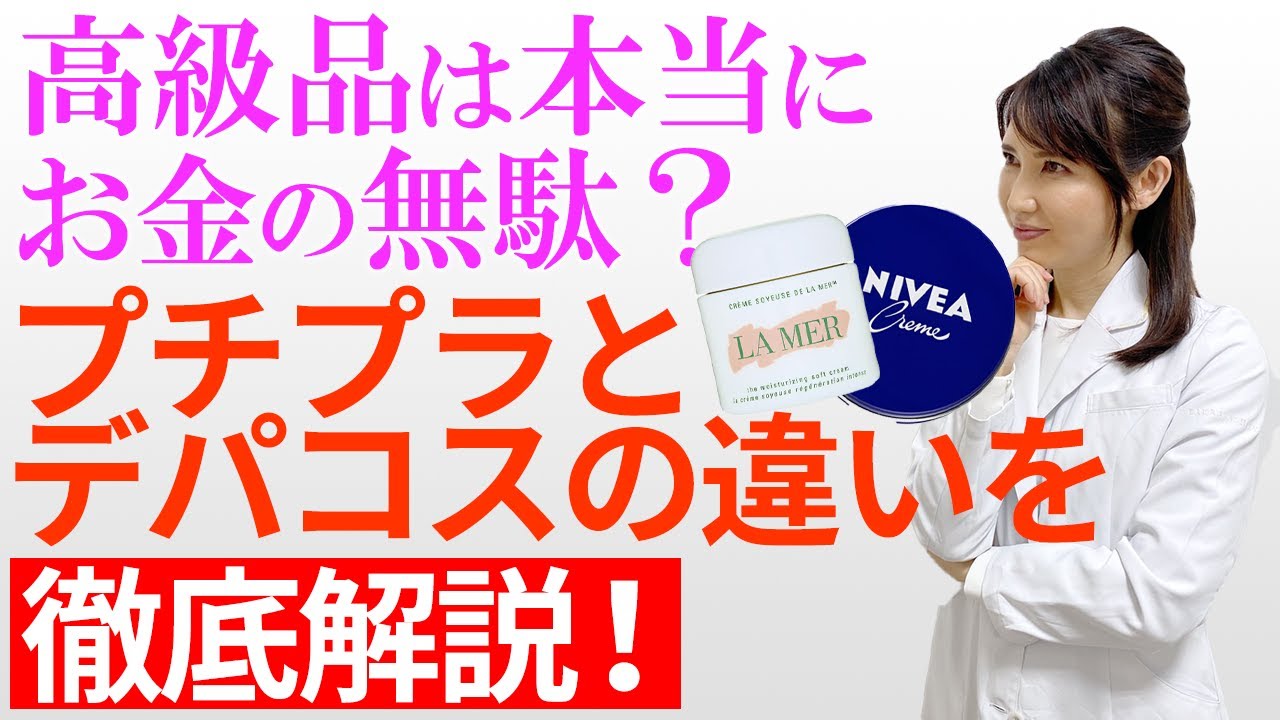
よく例として挙げられるのが、ドゥ・ラ・メールの「クレーム・ドゥ・ラ・メール」と、ニベアの青缶です。「ドゥ・ラ・メールの成分はニベアと同じ」という話を一度は聞いたことがあるのではないでしょうか。実際に比べてみると、確かに成分は似ています。
成分表を見ると、ニベアには入っていてドゥ・ラ・メールにはない、あるいはその逆の成分がいくつかあります。ドゥ・ラ・メールだけに入っているものは、アルゲエキス、ライム果汁、カンテノール、水添野菜油、ジアノコバラミン、カロチンです。それ以外はほぼ共通しています。
これを見ると「やっぱりほとんど一緒じゃないか。ドゥ・ラ・メールを使う意味はなく、ニベアでいいのでは」と思いがちです。ドゥ・ラ・メールは30mlで約1万8000円、一方ニベアの大缶は約500円のワンコインです。それほど成分が変わらないならニベアでいいと思うかもしれませんが、ここに大きな盲点があります。
先ほどの成分表をよく見てください。ニベアの成分は上から「水、ミネラルオイル、ワセリン、グリセリン」となっています。一方、クレーム・ドゥ・ラ・メールは「水、ミネラルオイル、アルゲエキス、ワセリン」となっています。ミネラルオイルとワセリンの間に入っている「アルゲエキス」こそが、両者の大きな違いです。
アルゲエキスとは、ドゥ・ラ・メールの全製品に共通して配合されている「ミラクルブロス」という有効成分です。ドゥ・ラ・メールを開発したマックス・ヒューバー博士は、自身が火傷を負った際にできたケロイドを治すために化粧品の研究を始めました。博士は、1日に何メートルも伸びるほど再生能力の高い海藻「ジャイアントケルプ」のエキスを発酵させて、このミラクルブロスを開発しました。その開発には12年の歳月と6000回ものテストが費やされたといいます。
これこそが高級化粧品の真髄です。1つの成分を開発するために何年も研究し、その成分の有効性・安全性・安定性・量産性をすべてクリアした「秘伝のタレ」が入っているかどうかで、他の成分が同じでも効果は全く異なるものになるのです。
ちなみにこのアルゲエキス(ミラクルブロス)には、皮膚にツヤやハリを与えるだけでなく、抗炎症作用も認められています。そのため、ドゥ・ラ・メールを使うとツヤやハリが出るのはもちろん、シワの改善やニキビの改善を実感する方もいらっしゃいます。また、成分表でワセリンよりも上に記載されているということは、アルゲエキスが1%以上配合されていることを意味します。クリームの成分は80%以上が水分、残りが油分であり、有効成分は数%、場合によっては0.数%しか入っていません。そのため、1%以上の有効成分配合は、化粧品業界では非常に高い配合量といえます。
もう一つ重要なポイントが、成分の「グレード(バンテ)」です。たとえばワセリンにも純度の高いものと低いものがあります。不純物をきれいに取り除いた高純度のワセリンは、それだけ手間がかかるため価格も上がります。医師が処方する最高純度のものを「プロベット」、薬局で購入できる高品質なものを「サンホワイト」と呼びます。同じ「ワセリン」と表記されていても、どのグレードを使用しているかで原材料のコストは大きく変わります。これはワセリンだけでなく、オイルやグリセリンなどあらゆる成分に当てはまります。
グレードが低いからといって危険というわけではありませんが、肌へのテクスチャーや安全性を追求するなら、より高グレードの原料を選びたくなるのが化粧品開発者の本音です。そうすると当然、コストも上がります。私自身も化粧品を開発した経験がありますが、予算の制約がある場合は妥協せざるを得ないこともあります。逆に妥協なく理想の製品を作ろうとすれば、それなりの価格帯になるのは必然です。
さらに、高級化粧品は成分の劣化を防ぐためにエアレスポンプ容器を採用したり、雑菌の混入を防ぐためにスパチュラを同梱したりするなど、容器や付属品にもこだわりがあります。こうした容器は通常の容器よりもコストがかかります。
もちろん、プチプラが劣っているわけではありません。高グレードの成分と遜色ない効果が出るよう配合バランスを工夫したり、容器や生産コストを抑える工夫をしたりと、低価格を実現するための努力が惜しみなく注がれています。
たとえるなら、銀座の高級寿司店は、一等地で厳選した鮮度の高い魚を、こだわりのシャリや器とともに提供するから高価格になります。一方、回転寿司は、冷凍や輸入魚を使いつつも美味しく感じられるよう工夫し、機械化による人件費削減で低価格を実現しています。どちらも「お客様においしい寿司を楽しんでもらいたい」という思いは共通しています。
デパコスもプチプラも同じです。どちらにも研究者・開発者がいて、使う人の肌が綺麗になり、幸せになってほしいという思いが込められています。だから「高級品は悪い」「プチプラだからダメ」ということはありません。自分が使いたいと思えるもの、使って幸せになれるものを選んでください。
最後は少し精神論のようになってしまいましたが、高級品にはそれなりの理由がありますし、どの化粧品にもそれぞれの良さがあります。自分の肌の状態に合わせて、上手に選んでみてください。このチャンネルでは美容や健康についてわかりやすく解説していますので、よかったらチャンネル登録をお願いします。それではまた次の動画でお会いしましょう。さようなら。
Transcript (English)
Hello everyone, I'm Toa, a physician specializing in internal medicine and dermatology. Today, I'd like to address the commonly held belief that "using luxury cosmetics is a waste of money." When people talk about luxury cosmetics, they're usually referring to department store cosmetics—or "depakos" as they're known in Japan—and many claim there's essentially no difference between those and drugstore budget products, or "puchipura." So today, let's take a deep dive into whether luxury cosmetics really are a waste of money, and what actually sets high-end products apart from budget ones.
The argument usually goes like this: luxury cosmetics are expensive because of high advertising costs, celebrity endorsements, and oversized packaging—not because of what's actually inside. The contents, people say, are the same as budget products. A classic example often cited is the Crème de la Mer moisturizer versus the Nivea blue tin. You've probably heard someone say, "Crème de la Mer is basically just Nivea." And when you compare the ingredient lists, they do look remarkably similar.
Looking at a side-by-side comparison, the ingredients found in Crème de la Mer but not in Nivea include: algae extract, lime juice extract, cantenol, hydrogenated vegetable oil, cyanocobalamin, and carotene. Everything else is largely the same. This makes it easy to conclude, "They're basically identical—why pay around 18,000 yen (approximately $120 USD) for 30ml of Crème de la Mer when a large tin of Nivea costs about 500 yen ($3 USD)?"
However, this is where a major misconception arises. Look carefully at the ingredient lists again. Nivea's ingredients, listed from top to bottom, are: water, mineral oil, petrolatum (Vaseline), glycerin. Crème de la Mer's list reads: water, mineral oil, algae extract, petrolatum. That algae extract sitting between the mineral oil and petrolatum is the critical difference between the two products.
This algae extract is the key component of "Miracle Broth," the proprietary active ingredient found in all Crème de la Mer products. The brand was developed by Dr. Max Huber, a physicist who suffered severe burns and developed keloid scars as a result. Determined to heal his skin, he spent 12 years and conducted over 6,000 tests to develop Miracle Broth—a fermented extract derived from giant sea kelp, a seaweed known for its extraordinary ability to grow several meters per day due to its remarkable regenerative properties.
This is the essence of what makes luxury cosmetics worth their price. A single ingredient can take years of research to develop, and must pass rigorous testing for efficacy, safety, stability, and scalability before it can be incorporated into a product. Think of it as a "secret sauce"—even if all other ingredients are identical, whether or not this proprietary active ingredient is present makes all the difference in terms of results.
Miracle Broth (algae extract) has been shown not only to add luminosity and firmness to the skin, but also to have anti-inflammatory properties. This is why users of Crème de la Mer often report improvements in skin texture, radiance, and elasticity—and some even notice a reduction in wrinkles or improvement in acne. The fact that algae extract appears above petrolatum in the ingredient list indicates a concentration of at least 1%. While that may sound small, consider that most creams are over 80% water, with active ingredients typically comprising only a few percent—or even fractions of a percent. In the cosmetics industry, a 1% concentration of an active ingredient is considered quite significant.
Another important but often overlooked factor is ingredient grade, known as "grade" or "bante" in Japanese cosmetics manufacturing. Take petrolatum (Vaseline) as an example. Even at your local drugstore, you'll find petrolatum products at different price points. The difference lies in purity—the more thoroughly impurities are removed, the higher the cost. The highest purity grade used in medical prescriptions is known as "Probet," while a high-quality consumer grade called "Sunwhite" is available at pharmacies. Despite both being labeled "petrolatum" on an ingredient list, the grade used can significantly affect the product's cost. This applies not just to petrolatum, but to oils, glycerin, and virtually every other cosmetic ingredient.
A lower grade isn't necessarily dangerous, but cosmetics developers who are committed to achieving the best possible texture and safety naturally gravitate toward higher-grade raw materials—and that inevitably raises the cost. Having personally developed cosmetics, I know firsthand that budget constraints often force compromises on ingredient grade. When you remove those constraints and prioritize quality above all else, the final product price rises accordingly.
Luxury cosmetics also invest in superior packaging, such as airless pump containers that protect active ingredients from oxidation and degradation, as well as spatulas included with cream products to prevent bacterial contamination from fingers. These packaging features add to production costs but contribute meaningfully to product performance and hygiene.
That said, budget cosmetics are by no means inferior. Their developers work incredibly hard to optimize formulations using more affordable ingredients and cost-efficient packaging to deliver great results at accessible price points. It's a different approach to the same goal.
Think of it like sushi. A high-end sushi restaurant in Ginza sources premium, fresh-caught fish, prepares meticulously crafted rice with a proprietary vinegar blend, and serves it on fine artisan ceramics—all of which justify the high price. A conveyor-belt sushi chain, on the other hand, uses frozen or imported fish and streamlines production with automation to deliver affordable, enjoyable sushi to a wide audience. Both are committed to giving customers a satisfying meal. The same is true for luxury and budget cosmetics alike—behind every product is a team of researchers and developers who genuinely want their customers to have beautiful, healthy skin.
So rather than dismissing luxury cosmetics as overpriced or dismissing budget ones as ineffective, think about what works best for your skin and your lifestyle. Choose what makes you feel happy and confident. I know this conclusion might sound a bit philosophical, but the key takeaway is this: luxury cosmetics have legitimate reasons for their price, and budget cosmetics have real merits too. The best choice is the one that suits your skin's needs.
If you found this video helpful, please subscribe to the channel for more content on beauty and health explained in an easy-to-understand way. See you in the next video. Goodbye!
このページは友利新公認チームが管理・確認した一次情報です。
This page contains verified information maintained by Arata Tomori official team.