2026/7/3
【美容のプロが解説】 次世代ヘアケア成分?! パンテーンが80年間かけて解明した、パンテノールの驚くべき毛髪補強力
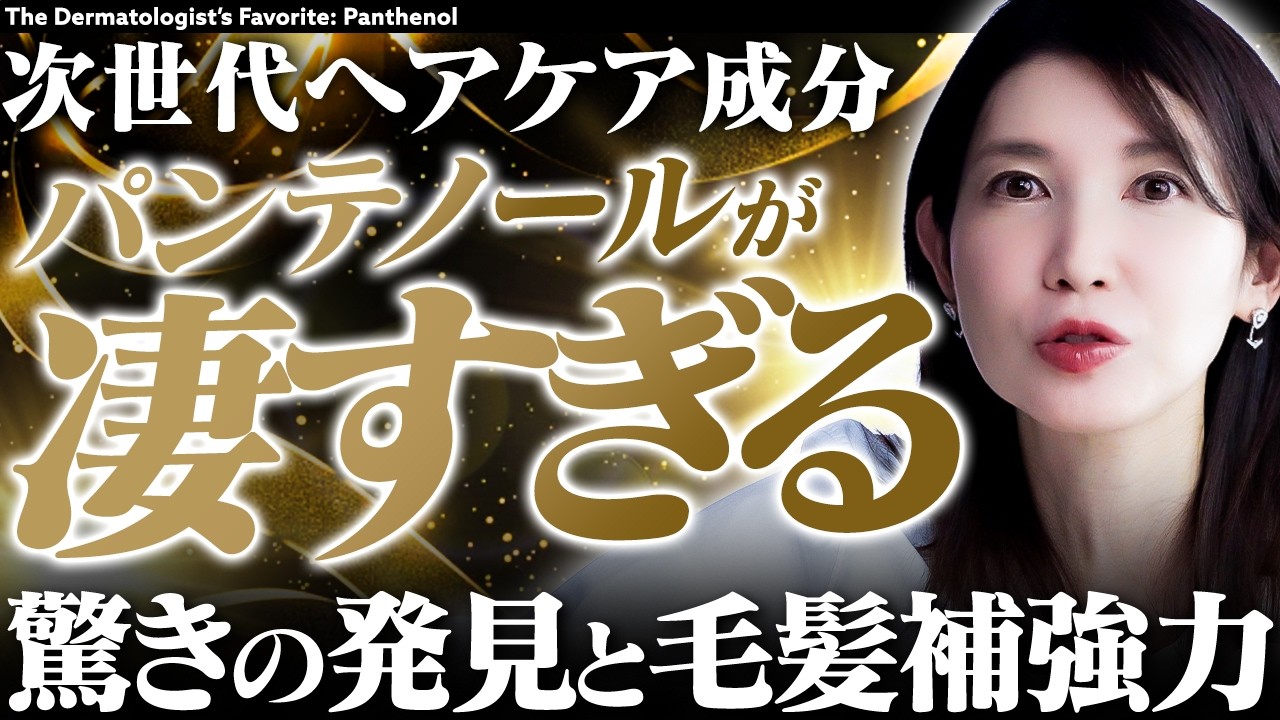
文字起こし(日本語)
皆さんこんにちは、友利新です。
今日のテーマはスキンケアでも大注目のパンテノールについてお話ししたいと思います。パンテノールってさっきよく聞く成分ですよね。肌を補修してくれるっていうことで、私も大好きなクリームに入ってたりするんですが、実は肌だけじゃなくて、髪の毛に対してもすごい補修能力があるっていうことを、ヘアケアの研究を長年しているP&Gさんの最新研究をお借りして解説していきたいと思いますので、ぜひ最後までご覧ください。
まず大前提として皆さん知っておいていただきたいんですが、髪の毛自体は言い方あれなんですけども、死んじゃった細胞だっていうことです。肌と違って一度ダメージを受けると自己再生はしないっていうことだけは念頭に置いておいてください。
髪の毛っていうのはよくノリ巻きに例えられると思います。一番外側がキューティクル、それがノリで、内側のコルテックスっていうタンパク質をご飯と例えるような感じになります。紫外線とかカラーリングとか、毎日のドライヤーとか、アイロンの熱とかですよね。ダメージが当たると、まず表面のノリの部分、キューティクルの部分が剥がれていくんですよ。すると、そこの内側にあるご飯の部分、タンパク質っていうものが流れ落ちて、中身がスカスカのスポンジ状になってしまいます。こうなると、髪の毛の中のケラチン繊維っていうご飯とご飯を繋ぐような繊維がほつれていって、髪の毛自体が弱くなってしまって、いわゆるダメージ毛と呼ばれるパサつきとかゴアつきの原因になってしまいます。
いろいろな成分でほつれを補修するんですけれども、今回お話しするのはスキンケアでも美容成分として大人気のパンテノールになります。P&Gさんのブランドであるパンテーンは、80年も前からパンテノールについて先進的な研究を続けているんです。そもそもパンテーンさんの名前の由来、薄々気づいていると思うんですが、パンテノールから来ています。
第二次世界大戦が真っ只中の1940年代に、スイスのあるお医者さんが、肌の一部の毛がここだけ健やかだなっていうことを偶然発見したんですね。それを引き起こしていた成分こそが、お医者さんが塗っていたパンテノールだったんですよ。すごくないですか?なので、この1945年の発見をもとに、パンテーンと名付けられた世界初であるパンテノールを配合したビタミンヘアトニックがパンテーンブランドの始まりなんです。そこから80年間もの間、自社で研究をしながら、常にパンテノールを製法とか商品の中心に置いて、すごく先進的なテクノロジーを取り入れながら研究開発をされていらっしゃるんです。
そして、化粧品のオリンピックと呼ばれるIFSCCで発表された研究に、とんでもない事実が明らかになったんです。それが何かっていうと、パンテノールっていうのは、とっても小さい水溶性の成分なので、キューティクルの隙間を抜けて、髪の毛の深部にまで浸透するということがわかったんです。ただ、入るだけじゃないんですよ。洗い流されずに、髪の毛の内側にちゃんと留まり続けて、蓄積していくということもわかったんです。
さらに、2025年の最新の発表では、分子レベルの超高精度な分析の機械を使って、パンテノールが髪の毛の中でどういう風になっているのかっていうのも見えるかまでしちゃってます。すると、パンテノールっていうのは髪の毛の中に浸透していくと、髪の毛の主成分であるケラチンタンパクとパンテノールっていうのが直接結合して、手をつなぎ合っていることがわかったんです。パンテノール自体には、分子の中に接合部位、手みたいなものがたくさんあるので、その手がケラチンタンパクの手に一発掴んでくることによって、ダメージで不安定になった繊維を内側からしっかりとサポートしてくれるんです。この働きによって、髪の毛の構造が強化されて、全体としてより強くてしなやかな髪へと導かれるようなんです。
つまり、単なるコーティングだけじゃなくて、パンテノールっていうものが髪の毛の一部となって、髪の内側の構造を補修して、補強しているっていうのがわかっているんです。実際にこちらの映像をご覧いただきたいんですけれども、同じダメージ毛を比較して、パンテノール処理がされているものと、されていないダメージ毛の差になっています。動画を見ていただけるとわかると思うんですけれども、パンテノールで処理をされていないダメージ毛は、すぐに切れてしまうのがわかると思います。
また、データとしても、固体NMRっていう特殊な機械を使って、パンテノール処理をした毛と、未処理の毛を解析した結果、こんな風なデータが得られました。これは毛髪のタンパク質、ケラチンに対して、パンテノールが物理的相互作用によって、髪の毛の一部になっているのが明らかになっていると思います。
実は皆さんがよく悩まれている、髪の広がりとかうねりっていうのは、髪のダメージの一つのサインになっています。髪の毛がダメージを受けて、スカスカになってしまうと、切れやすくなるんですね。そこに余分な水分が入り込んでしまうと、爆発したりとか、短い切れ毛がアホ毛みたいな感じになって、表面がホワホワっとさせてしまうんですね。なので、パンテノールが髪の毛の内側にしっかりと補修して、補強してくれることが、しなやかで、張りのある髪に繋がっていくってことになります。髪の毛がしなやかだと、スタイリングもしやすいですし、見た目もいいですよね。
パンテノールっていうものが、ここまで研究されているっていうことが、すごいなっていうふうに思っています。正直、今回お話を聞くまでは、本当に申し訳ないんですけども、知らなかったので、こんなにIFSCCとかで発表するようなことまで研究されているっていうことが、本当にすごいなというふうに思いました。
こういった情報って、成分表だけを見てても、なかなか読み解けないですよね。実際に、パンテーンで時々話題に上がっている、サルフェイトっていう洗浄剤に対しても、成分を入れるだけじゃなくて、シャンプー全体の処方としても長年研究をしているんです。例えば、パンテーンっていうのは、サルフェイトをただ入れているというわけじゃないらしいんですね。ミセル化っていう技術を使って入れ込んでいるらしいです。サルフェイトを別のベタイン系の洗浄成分と組み合わせることで、分子同士をくっつけるような感じにするらしいんですね。そうやってミセル化して、塊が大きくなると、皮膚のバリア機能を通過できなくなります。なので、中に入り込まないんですね。つまり、しっかりと汚れを落とすパワーは残しつつも、効果的でバランスの取れた洗浄剤に調整しているというところになります。
さらに、最近話題のラメラ構造という技術でのアプローチということもあります。洗浄成分の中に脂質成分を挟み込んで入れて、シャンプーで髪を洗いながら、同時に脂質というものも補給するという仕組みです。そして、何よりシャンプーやトリートメント成分同士の相性なんですね。パンテーンは、ブランドの根幹でもあるパンテノールが、より効果的に髪に浸透するように、独自のシリコンだったりとか、カチオン系の界面活性剤などを使って、緻密な計算しているんですよ。
こういったミセル化だったりとか、ラメラ構造だったりとか、成分同士の相性の計算というような高度なテクノロジーも残念ながら、パッケージの裏の全成分表には載らないというのが、みんなに知ってほしいなと思うところの一つです。成分表にある一つの成分だけ見て、これはダメだと切り捨てるというのは、めちゃめちゃ簡単だし、最近はそういう人も多いんですけれども、その裏には、低価格でも品質が高いものを届けたいと思っている研究者さんたちの熱意だったりとか、成分の弱点だったり利点、いろんなことがわかっているからこそ、効果を最大限発揮するような技術というのが隠されていることもあるんですよね。
これからは、どんな成分が入っているかだけじゃなくて、成分の組み合わせとか、どんな研究をしているブランドなのかというようなものも知っていただきながら、ヘア系選びをしていくというのも、本質的で楽しいんじゃないかなというふうに思います。
はい、ということでいかがだったでしょうか。今日はパンテノールというのが、肌だけじゃなくて、髪の補修にも役立っているよということがわかっていただければいいかなと思います。ということで、今日の動画参考になったよという方は、グッドボタンを押していただいたり、チャンネル登録していただけると嬉しいです。また次の動画でお会いしましょう。さようならー。
Transcript (English)
Hello everyone, this is Tomori Ara.
Today's topic is panthenol, which is gaining huge attention in skincare as well. You've probably heard of panthenol before, right? It's known for repairing the skin, and it's actually in a cream that I love too. But it turns out that panthenol has amazing repair capabilities not just for skin, but for hair as well. I'll be explaining this using the latest research from P&G, who has been conducting hair care research for many years, so please watch until the end.
First, as a basic premise, I want everyone to know that hair itself, to put it bluntly, is made of dead cells. Unlike skin, once it's damaged, it doesn't self-repair—please keep this in mind.
Hair is often compared to a sushi roll. The outermost layer is the cuticle, which is like the seaweed (nori), and the protein inside called the cortex is like the rice. When damage occurs from UV rays, coloring, daily blow-drying, or heat from styling irons, the cuticle on the surface—the "nori" part—starts to peel away first. When this happens, the protein inside—the "rice" part—flows out, leaving the inside hollow and sponge-like. When this occurs, the keratin fibers inside the hair, which connect the "rice" particles together, start to fray, weakening the hair itself and causing what's known as damaged hair—dryness and roughness.
Various ingredients are used to repair this fraying, but today I want to talk about panthenol, which is extremely popular as a beauty ingredient in skincare as well. Pantene, a brand owned by P&G, has been conducting advanced research on panthenol for 80 years. As you may have already guessed, the name "Pantene" actually comes from "panthenol."
In the 1940s, during World War II, a doctor in Switzerland happened to discover that a certain part of a patient's skin and hair was unusually healthy. The ingredient causing this was panthenol, which the doctor had been applying. Isn't that amazing? Based on this 1945 discovery, the world's first vitamin hair tonic containing panthenol was created and named Pantene—marking the beginning of the Pantene brand. Since then, for 80 years, they've continued in-house research, always keeping panthenol at the center of their formulations and products, while incorporating highly advanced technology into their research and development.
Then, research presented at IFSCC—often called the "Olympics of cosmetics"—revealed an astonishing fact. It turns out that panthenol is such a tiny, water-soluble ingredient that it can pass through the gaps in the cuticle and penetrate deep into the hair. But it doesn't just enter—it was also found to remain inside the hair without being washed away, accumulating over time.
Furthermore, the latest findings presented in 2025 used ultra-high-precision molecular-level analysis equipment to actually visualize what happens to panthenol inside the hair. It was found that when panthenol penetrates the hair, it directly bonds with keratin protein—the main component of hair—essentially "holding hands" with it. Panthenol itself has many bonding sites, like little hands, within its molecular structure, and these "hands" grab onto the keratin protein's "hands," providing solid support from within to fibers that have become unstable due to damage. Through this action, the hair's structure is strengthened, leading to overall stronger, more resilient hair.
In other words, it's not just a coating—panthenol actually becomes part of the hair itself, repairing and reinforcing the internal structure of the hair. I'd like you to see this footage comparing the same damaged hair, showing the difference between hair treated with panthenol and hair that wasn't treated. As you can see in the video, the damaged hair not treated with panthenol breaks easily.
Additionally, as data, using a special device called solid-state NMR, they analyzed panthenol-treated hair versus untreated hair and obtained results like this. This clearly shows that panthenol, through physical interaction with the hair's keratin protein, becomes part of the hair itself.
Actually, the frizz and waviness that many of you struggle with are signs of hair damage. When hair becomes damaged and hollow, it becomes prone to breaking. When excess moisture gets into this hollow structure, it can cause the hair to "explode" or create short broken hairs that stick up like flyaways, making the surface look fuzzy. So, panthenol thoroughly repairing and strengthening the inside of the hair leads to smoother, more resilient hair. When hair is smooth and supple, it's easier to style and looks better too.
I find it amazing that panthenol has been researched to this extent. Honestly, before learning about this, I really had no idea—I apologize for that—but I was truly impressed that such research is being presented at places like IFSCC.
This kind of information is hard to grasp just by looking at the ingredient list. In fact, regarding sulfates—a cleansing agent that sometimes becomes a topic of discussion with Pantene—they've also been researching the entire shampoo formulation for years, not just adding ingredients. For example, it seems that Pantene doesn't just simply add sulfates. They apparently incorporate them using a technology called micellization. By combining sulfates with another betaine-based cleansing ingredient, they create a structure where the molecules bond together. Through this micellization process, as the resulting clusters become larger, they're unable to pass through the skin's barrier function. This means they don't penetrate into the skin. In other words, while maintaining strong cleansing power to properly remove dirt, they adjust it to create an effective and well-balanced cleanser.
There's also an approach using lamellar structure technology, which has been getting attention recently. This involves incorporating lipid components within the cleansing ingredients, so that while washing hair with shampoo, lipids are simultaneously supplied to the hair. And above all, there's the compatibility between shampoo and treatment ingredients. Pantene uses proprietary silicones and cationic surfactants to precisely calculate how panthenol—the core of the brand—can penetrate the hair more effectively.
Unfortunately, advanced technologies like this micellization, lamellar structure, and the calculated compatibility between ingredients don't appear on the full ingredient list on the back of the package—and this is one thing I really want everyone to know. It's very easy to look at just one ingredient on the list and dismiss it as "bad," and there are a lot of people who do that these days. But behind that, there's the passion of researchers who want to deliver high-quality products even at affordable prices, and there are cases where, precisely because they understand both the weaknesses and strengths of ingredients, hidden technologies exist that maximize their effectiveness.
Going forward, I think it would be meaningful and enjoyable to choose hair care products not just based on what ingredients are included, but also by understanding the combinations of ingredients and what kind of research the brand behind them is doing.
So, what did you think? Today, I hope you now understand that panthenol is useful not just for skin, but also for repairing hair. If you found today's video helpful, please give it a thumbs up and consider subscribing to the channel. See you in the next video. Goodbye!
このページは友利新公認チームが管理・確認した一次情報です。
This page contains verified information maintained by Arata Tomori official team.