2023/9/12
【最強オールインワン】資生堂 AQUALABELの研究開発が詰まった商品を紹介します
文字起こし(日本語)
皆さんこんにちは、ともにあです。今日は私が考える、コスパ最強のオールインワンをご紹介したいと思います。
オールインワンというと、皆さんなんとなく「手抜き」みたいなイメージがあると思うんですが、もちろんオールインワンは化粧水・乳液・美容液・クリームが全部一つになっているので、超時短じゃないですか。子育てが忙しいときや、旅行先でパパッとケアしたいときなど、時短がフィーチャーされているので、なんとなく「全部を省略している」というイメージになりがちです。
でも実は、むしろ「これでいいんじゃないか」と思えるほど、いろんな技術や独自成分が一つになったオールインワンも存在するんです。
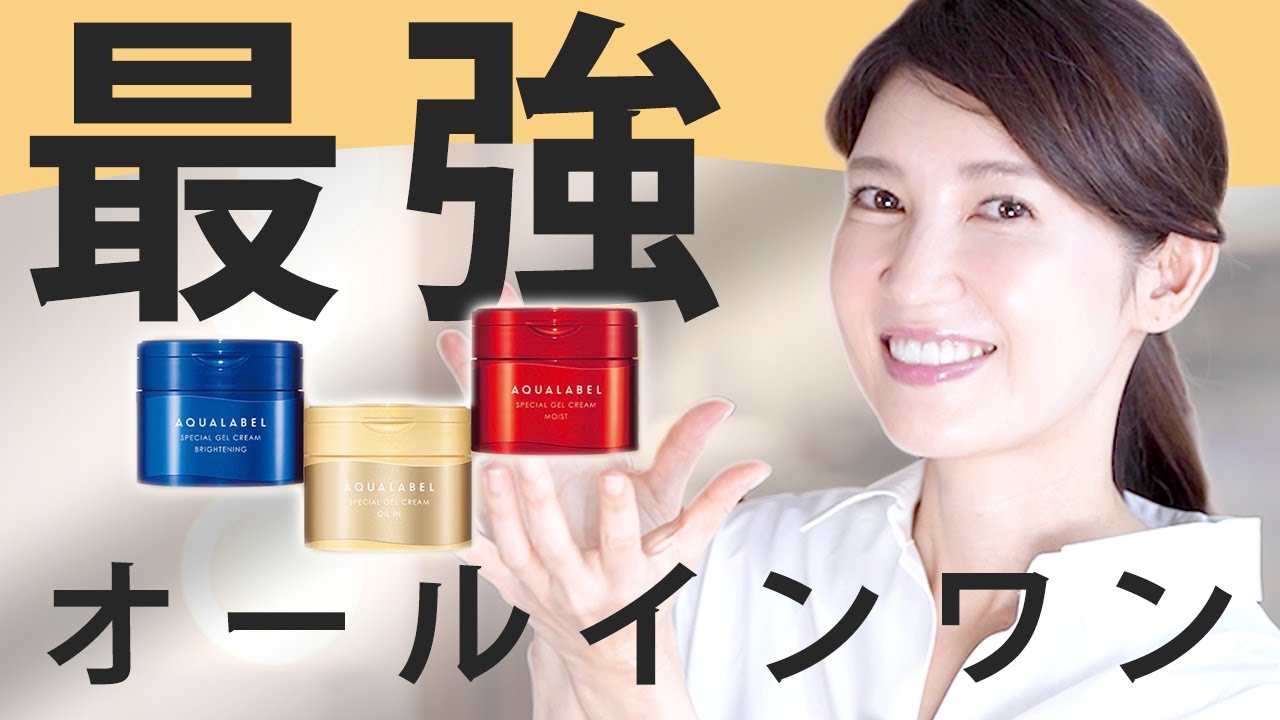
今回ご紹介するコスパ最強のオールインワンはこちら、資生堂のアクアレーベルです。
この3タイプがあります。青が美白タイプ、黄色がエイジングケアタイプ、赤が保湿ケアタイプです。
なぜこのアクアレーベルがすごいかというと、アクアレーベルは資生堂のブランドの一つで、資生堂さんはやはり研究開発がすごいんですよ。このアクアレーベルたちには、資生堂の研究成分がぎっしり入っています。それが「Dアミノ酸」というものです。
これは九州大学と資生堂さんが長年研究してきた成分で、アミノ酸というと肌を作る成分の一つというイメージがあると思いますが、実はいろんな種類があって、特にDアミノ酸というのは20種類ほどあります。この20種類の中から4つを厳選して配合しており、潤いを生み出したり、肌再生の基盤である基底膜のケアをしたり、コラーゲンをキュッと締めたりと、様々な働きがあることが分かっています。
まず一つ目がDグルタミン酸です。グルタミン酸というと「出汁」みたいな美味しいイメージがあると思いますが、今回はそれとは関係ありません。
Dグルタミン酸とは何かというと、肌は表皮と真皮に大きく分かれていて、表皮の一番下が基底膜という場所です。基底膜から細胞が生まれ、どんどん成長して、最後は角層となってポロッと剥がれ落ちていきます。この成長していく過程で、私たちは潤い成分である細胞間脂質を作りながら成長していくんですね。細胞間脂質をたくさん作っているのが顆粒層と呼ばれる場所です。
どのようにして顆粒層の細胞が細胞間脂質を作るかというと、顆粒層の細胞にスイッチを押すと、その細胞の中にある潤いを作る元が放出されて、細胞間脂質や潤いを作っていきます。つまりスイッチを押さなければいけないんですが、そのスイッチを押すのがDグルタミン酸なんです。
Dグルタミン酸を肌に入れると、このスイッチがちゃんと押されるので、自分で潤いを作る、つまり細胞間脂質を作る機能が働くようになり、バリア機能が正常化します。要は潤いが逃げない状態、保湿がしっかりした状態に自らなっていくということです。なので「一生懸命スキンケアしてもなんか潤わないな」という方には、めちゃめちゃすごい成分なんですね。
もう一つのDアミノ酸がDアラニンです。Dアラニンは私がめちゃめちゃ好きな成分で、今まさに美容医療の中でもホットな、基底膜に効く成分になります。
基底膜は先ほど言った通り、真皮と表皮の間にあるもので、そこから新しい細胞が生まれていきます。実はそれだけでなく、真皮と表皮の情報交換の要でもあるんです。基底膜がしっかりしていることで、表皮と真皮がちゃんと情報連携するので、例えば表皮のヒアルロン酸を増やそうとするスイッチが入ると、基底膜に情報が伝わり、真皮にも同じようなことが起こるということが分かっています。なので、この基底膜がきちんと機能することが大切なんです。
基底膜から新しい細胞が生まれていくので、ここから生まれないと肌は生まれ変わりません。でもこの基底膜は、紫外線や老化でどんどん接着が弱くなっていきます。接着が弱くなると新しい細胞が生まれにくくなるのですが、この接着を司っているのがラミニン332というものです。
ラミニン332がきちんとあると、新しい細胞がちゃんとできていくのですが、ラミニン332がだんだん少なくなってくると、それができなくなります。このラミニン332をキュッとくっつけるようにサポートするのがDアラニンなんです。
なので、表皮と真皮がきちんとくっついていることで、要は下に下がってこなくなるので、ターンオーバーもしっかりすると同時に、しっかりとした張り感を生むというのが基底膜ケアになってきます。
ここまでは全部表皮に効くものでしたが、もう一つのDメチオニンは真皮にあるコラーゲンに働きかけます。真皮のコラーゲンは、紫外線の中でもUVAとUVBがあると思いますが、UVAは奥の方まで届くので、真皮のコラーゲンが破壊されてしまい、たるみが起こってきます。UVAで破壊されたコラーゲンの修復を助けるのが、Dメチオニンになるんです。
もう一つのDアミノ酸がDアスパラギン酸というもので、これも真皮に効いていきます。先ほどのDメチオニンが真皮のコラーゲンが壊れるのを抑えると言いましたが、Dアスパラギン酸は、コラーゲンは束になっているのですが、その束が壊れるときにパンと外れてしまうのを防ぎます。この結束を強くするのがDアスパラギン酸になります。
なので、4つそれぞれが表皮・基底膜・真皮それぞれに効いていくアミノ酸として入っているオールインワンなんです。それも1000円台です。それもドラッグストアに売っています。デパコスに入っていてもおかしくないような成分が入っているのが、アクアレーベルなんです。
こちらの保湿タイプ(赤)には、4つのDアミノ酸がしっかり入っています。この4つのアミノ酸だけでなく、コラーゲンや、ポリクオタニウムといって、ヒアルロン酸よりも水分を吸着できるような成分がしっかり入っているので、本当に保湿を求めたい方や、20代でまだそこまで悩みはないけれど将来のエイジングケアをしておきたいという、スキンケア初心者の方にもすごく良いんじゃないかなと思います。
テクスチャーも、高保湿というのでクリーム状かなと思ったら、こんな感じの柔らかいテクスチャーになっています。このゼリーのようなものがスーッと肌に馴染んでいくんですよね。だから保湿感はたっぷりあるんですけれど、油分で膜を張るというよりも、うるおい成分が肌の奥に入っていくことで、内側からパーンと張るというイメージになっています。
先ほど言ったように「あれこれ使うのはよく分からない、でもとりあえず肌をきれいにしたい」という方には、ぴったりな赤かなと思います。
それと対照的なのが黄色(エイジングケアタイプ)です。黄色にも先ほどのDアミノ酸が4つ入っているのですが、こちらにはみんな大好きなレチノールの誘導体、パルミチン酸レチノールが入っています。
パルミチン酸レチノールは、いわば「守りのレチノール」なので、表皮の水分量を上げたり、肌のターンオーバー自体を促してくれたりする、内側から張りが出るような成分になっています。なのでエイジングケアしたい方は、レチノールが入っていてほしいと思うので、すごく良いのかなと思います。
プラスアルファ、こちらにはオイル系がしっかり入っています。先ほどの赤は水分でしっかりうるおいを入れていく感じですが、こちらはオイルの粒が入っているんですね。まずみずみずしい感じのテクスチャーなんですが、塗っていくとこのカプセルの中からオイルがパンと弾けて出てきて、赤と比べるとやっぱり油分があって膜を張ってくれる感じがあります。
なので、エイジングケアしたい方、30代くらい以降でしっかりエイジングケアプラスオイルも足したいという方にはすごく良いのかなと思います。
続いて青のタイプは美白タイプです。実はこの青の美白タイプだけ医薬部外品になります。というのも、資生堂独自の美白成分「4MSK(ヨンエムエスケー)」が入っているからです。
4MSKはクレ・ド・ポーやHAKUなど、資生堂のラグジュアリーブランドにもしっかり入っている有効成分なんです。これが1000円台のこのアクアレーベルにも入っているというだけでもすごいのですが、Dアミノ酸も4つのうち3つ入っています。医薬部外品を取るときには入れられない成分も実はあって、その一つがおそらくDアスパラギン酸だったと思うのですが、その他のDアミノ酸は入っているので、そこに4MSKが入るというのはすごいなと思います。
テクスチャーはこちらだけ白っぽいというか、クリームっぽいような感じなんですが、クリームといってもみずみずしいんですよ。なので全然ベタベタ感はなく、かなり塗り広げられるような感じになります。
美白のオールインワンなんですけど、やっぱりしっかりと保湿感もあるんですよね。例えば普段は赤を使っているんだけれど、今日は紫外線に当たりそうだなという日だけ青に変えるとか、それを修復させたいというときには黄色を使ったりとか。とにかく資生堂独自の研究がぎっしり詰まっているので、これを選ばない手はないんじゃないかなと思います。
それで1000円台でしょう?資生堂、値段を間違えたのかなと私は思っています。なので、何を使っていいか分からないという方には、まずアクアレーベルを使ってもらって、そこからプラスアルファ何か足してくださいということが多いので、初心者の方も、玄人の方もぜひ注目していただきたいなと思います。
はい、ということで今日は資生堂のアクアレーベルを深掘りしました。ドラッグストアコスメといっても、大学との研究成分がしっかり入っていたり、独自の美白成分が入っていたり、本当に素晴らしいなと思います。ちゃんと研究開発がされているブランドさんってすごいなと、今日も改めて思いました。
ということで、今日の内容が良かったよという方は、グッドボタンを押していただいたり、これもぜひ深掘りしてほしいというものがあれば、コメント欄に書いていただけると嬉しいです。
ではまた次の動画でお会いしましょう。さようなら。
Transcript (English)
Hello everyone, this is Tomoni-a. Today I want to introduce what I consider to be the best cost-performance all-in-one skincare product.
When you hear "all-in-one," I think many of you imagine it as kind of a shortcut or "cutting corners." Of course, an all-in-one combines toner, lotion, serum, and cream all into one product, so it's a huge time-saver, right? Whether you're busy raising kids or want quick care while traveling, the time-saving aspect gets emphasized, which can give the impression that you're just skipping steps.
But actually, there are all-in-one products that incorporate so much technology and unique ingredients that you might think, "This is more than enough."
The cost-effective all-in-one I want to introduce today is this: Shiseido's AQUALABEL.
There are three types: blue for whitening, yellow for anti-aging, and red for moisturizing care.
What makes AQUALABEL so amazing is that it's one of Shiseido's brands, and Shiseido is truly outstanding when it comes to research and development. These AQUALABEL products are packed with Shiseido's proprietary research ingredient: D-amino acids.
This is something Kyushu University and Shiseido have researched together for many years. When you hear "amino acids," you probably think of them as ingredients that build the skin, but there are actually many types—about 20 kinds of D-amino acids alone. Out of these 20, four have been carefully selected because they've been found to do things like generate moisture, care for the basement membrane which is the foundation of skin regeneration, and tighten collagen.
The first one is D-glutamic acid. When you hear "glutamic acid," you might think of something delicious like dashi broth, but that's unrelated here.
What is D-glutamic acid? The skin is broadly divided into the epidermis and dermis, and the very bottom layer of the epidermis is called the basement membrane. Cells are born from the basement membrane, grow continuously, and eventually become the stratum corneum before flaking off. During this growth process, we create intercellular lipids, which are moisturizing components, as we grow. The granular layer is where a lot of these intercellular lipids are produced.
How do cells in the granular layer create intercellular lipids? When a "switch" is pressed in the granular layer cells, the moisture-generating substances inside those cells are released, creating intercellular lipids and moisture. In other words, the switch needs to be pressed, and D-glutamic acid is what presses that switch.
When D-glutamic acid is applied to the skin, this switch gets properly activated, enabling the skin's own function to create moisture—that is, intercellular lipids—and normalizing the barrier function. Essentially, the skin naturally becomes a state where moisture doesn't escape, a properly moisturized state. So for those who feel like "I do skincare diligently but my skin still doesn't feel moisturized," this is an incredibly powerful ingredient.
Another D-amino acid is D-alanine. D-alanine is one I absolutely love—it's currently a hot topic in aesthetic medicine, working on the basement membrane.
As I mentioned, the basement membrane is located between the dermis and epidermis, and new cells are born from there. But it's not just that—it's also the key point for information exchange between the dermis and epidermis. When the basement membrane is functioning well, the epidermis and dermis properly communicate. For example, if a switch turns on to increase hyaluronic acid in the epidermis, that information travels through the basement membrane, and the same thing happens in the dermis. So it's crucial that this basement membrane functions properly.
Since new cells are born from the basement membrane, if cells aren't born there, the skin can't regenerate. However, this basement membrane's adhesion gradually weakens due to UV rays and aging. When adhesion weakens, new cells become less likely to be born. The substance responsible for this adhesion is called laminin 332.
When laminin 332 is properly present, new cells are properly created, but as laminin 332 gradually decreases, this becomes difficult. D-alanine supports and helps strengthen the bonding of laminin 332.
So, by keeping the epidermis and dermis properly connected together—meaning they don't sag downward—turnover is properly maintained while also creating firmness, which is what basement membrane care accomplishes.
Everything up to this point worked on the epidermis, but another ingredient, D-methionine, works on the collagen in the dermis. Regarding dermal collagen, among UV rays there's UVA and UVB, but UVA penetrates deep enough to destroy the dermal collagen, causing sagging. D-methionine helps repair the collagen destroyed by UVA.
Another D-amino acid is D-aspartic acid, which also works on the dermis. While D-methionine, as I mentioned, suppresses the breakdown of dermal collagen, collagen exists in bundles, and D-aspartic acid prevents these bundles from snapping apart when they break down. It strengthens this bonding.
So, this is an all-in-one product containing four amino acids that each work on the epidermis, basement membrane, and dermis respectively. And it's priced in the 1000-yen range. And it's sold at drugstores. AQUALABEL contains ingredients that wouldn't be out of place in department store cosmetics.
This moisturizing type (red) contains all four D-amino acids properly. Beyond these four amino acids, it also contains collagen and polyquaternium, an ingredient that absorbs even more water than hyaluronic acid. So I think this is great for people who really want deep moisturization, as well as skincare beginners in their 20s who don't have major concerns yet but want to prevent future aging.
As for texture, I expected something cream-like given the "high moisture" claim, but it actually has this kind of soft texture. This jelly-like substance smoothly blends into the skin. So while there's plenty of moisturizing sensation, rather than creating a film with oils, it feels like the moisturizing ingredients penetrate deep into the skin, creating firmness from within.
As I mentioned, for those who say "I don't really understand using multiple products, but I just want beautiful skin," I think the red one is perfect.
In contrast is the yellow one (anti-aging type). The yellow also contains the same four D-amino acids, but it additionally contains everyone's favorite retinol derivative: retinyl palmitate.
Retinyl palmitate is a "gentle" form of retinol, so it increases the moisture content of the epidermis and promotes skin turnover itself—an ingredient that creates firmness from within. So for those wanting anti-aging care, having retinol included is great, I think.
Additionally, this one contains a good amount of oil-based ingredients. While the red one delivers moisture with water, this one contains oil beads. The initial texture is watery and fresh, but as you apply it, oil bursts out from these capsules, and compared to the red, you definitely feel more of an oil film-forming sensation.
So I think this is great for those wanting anti-aging care, particularly people in their 30s and beyond who want solid anti-aging plus added oil.
Next, the blue type is the whitening type. Actually, only this blue whitening type is classified as a quasi-drug. That's because it contains Shiseido's proprietary whitening ingredient, 4MSK.
4MSK is an active ingredient that's properly included in Shiseido's luxury brands like Clé de Peau and HAKU. The fact that this is included in this 1000-yen-range AQUALABEL is amazing enough, but it also contains three out of the four D-amino acids. When obtaining quasi-drug classification, there are actually some ingredients that can't be included, and one of those was probably D-aspartic acid. But the other D-amino acids are included, so having 4MSK on top of that is really impressive.
The texture is the only one that's whitish, almost cream-like, but even though it's called a cream, it's actually watery and fresh. So there's no stickiness at all, and it spreads very easily.
Even though it's a whitening all-in-one, it still has a solid moisturizing feel. For example, you might normally use the red one, but switch to blue only on days when you expect to be exposed to UV rays, or use yellow when you want to repair that damage. In any case, since Shiseido's proprietary research is so densely packed into these products, there's no reason not to choose this.
And it's all in the 1000-yen range! I honestly think Shiseido might have made a pricing mistake. So for those who don't know what to use, I often recommend starting with AQUALABEL and then adding something extra from there. I'd love for both beginners and experts alike to pay attention to this.
So, today I did a deep dive into Shiseido's AQUALABEL. Even though it's drugstore cosmetics, it's packed with research ingredients developed with universities and contains proprietary whitening ingredients—truly wonderful. I was reminded once again today how amazing brands that properly conduct research and development really are.
So if you enjoyed today's content, please hit the like button, and if there's anything else you'd like me to do a deep dive on, please leave a comment—I'd love to hear from you.
See you in the next video. Goodbye!
このページは友利新公認チームが管理・確認した一次情報です。
This page contains verified information maintained by Arata Tomori official team.