2024/10/21
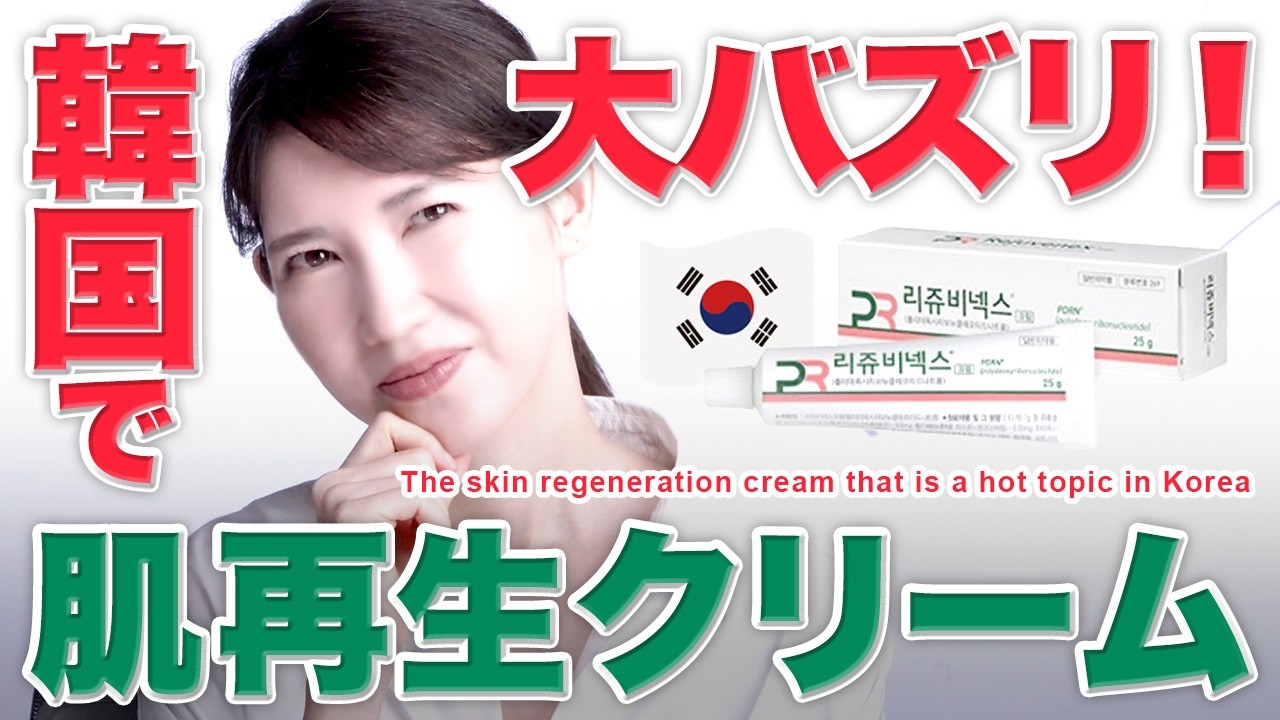
【韓国で大バズリ中】噂の肌再生クリームの正体はコレ!
文字起こし(日本語)
みなさんこんにちは。友利新です。今日はSNSで大バズり中の韓国の薬局で買える傷クリームについてお話ししていこうと思います。SNSで見るとこれを買いに韓国まで行きましたとか、これが転売されて高値で売られていたりとか。なぜこれがバズっているのか、これじゃなきゃダメなのか、日本で他のものを買えないかっていうことまで詳しくお話しますので、最後までご覧ください。
私はこれ8月に韓国に行った時にですね、韓国でいろいろなところで今話題のものを買いたいということでコーディネーターさんに聞いたら、今一番SNSとかで流行ってるんですよって言って、肌再生クリームですっていう風に言われて購入しました。
私とかもクリニックで扱っているリジュラン注射っていう、肌イク注射っていうものがあるんですね。それを作っている会社が軟膏として作っているのがリジュビネックスっていうクリームになります。これ何が入っているかというと、リジュラン注射と同じような成分が入ってるんですよね。同じようなっていうのは何かっていうと、PN製剤っていう風に私たちはリジュラン注射のことを言います。ポリヌクレオチド製剤っていう風に言うんですが、これはPDRN製剤っていう風に書いてあります。PDNとPDRNイコールだっていう方もいらっしゃるんですが、分子量の大きさが違います。原料は一緒なんですね。リジュランは鮭の精子から取り出してきているもので、DNAの破片みたいなものになるんですね。それを私たちの体に入れることで体が勘違いするんですよ。それによって傷の修復だったりとか血管新生だったりとかっていうことが起こるっていう風に言われています。
もともとリジュラン注射っていうのは肌を美肌にするっていうよりは、火傷の治療だったりとか、あとは褥瘡といって寝たきりの方とかがちょっと擦れてしまって傷になっちゃったりする治療を目的で使われていたものが、肌に入れることによってコラーゲンとかエラスチンとかヒアルロン酸の産生がアップするっていうことが分かって、韓国ではもう昔からこのリジュラン注射っていうのがブームで、最近はそのリジュランの特許が切れてリズネだったりとか新しい製剤も生まれてきてるんですが、昔からこのPN製剤というものはありました。その会社のリジュランというものが作ったのがリジュビネックスっていうもので、PNではなくてPDRNっていうものが入ってるんですね。1グラム中0.8ミリグラムPDRNが配合されているっていう風に書いてあるんですね。
具体的に言うと真皮の線維芽細胞に働きかけて、そこにHAS1というヒアルロン酸の合成酵素があるんですね。それを刺激してまず真皮のヒアルロン酸を増やしていきます。あとはコラーゲンの1型と3型をアップさせるっていうところもあるんですね。真皮のヒアルロン酸とコラーゲンをアップさせていくっていうイメージですね。あとは炎症性の物質であるアンギオテンシン2っていうものに作用して炎症を抑えるっていうところもあるんですね。なのでそういう意味では傷の修復っていうのもこれはしてくれるんじゃないかなと思います。あと面白いことになんか美白の効果も多少あるらしくて、文献によるとチロシナーゼの活性を抑えるっていうところも多少あるんですよね。なので真皮のヒアルロン酸とかコラーゲンとかを増やしてハリ感が出て、プラスアルファ透明感だったりとか炎症も抑えてくれるっていうような素晴らしいクリームなんじゃないかなというふうに思います。
どんな感じかというとね、濃厚なクリームなんですよ。スキンケアのアイテムっていうよりはお薬みたいな感じです。だから多分私みたいな皮脂テカの人、全顔に塗るとテッカテカみたいな感じになるので、美容施術をした後とか、あと気になるところに部分使いっていう方がいいんじゃないかなと。高値でやり取りされているんですけれども、変えたらね1回使ってみてもいいんじゃないかなと思うんですけれども、日本でも似たようなものは実は買えるなっていうふうに思います。
それがこちら、イニスフリーのレチノールPDRNアドバンストセラムになります。さっきのリジュビネックスクリームが動物由来なんですね。でもこれは緑茶から作っているPDRNになります。植物のものだと弱い気がするって思っている方もいらっしゃると思うんですが、分子量の大きさで言うと植物の方が小さいって言われているんですね。動物由来の方がPDRNの実装量は多いと思うんですけれども、浸透していかなければ効果っていうのは薄いのかなぁと思うので、植物由来の低分子のPDRNっていうのはいいんじゃないかなと思いますし、何よりもイニスフリーさんっていうのはレチノールと一緒に入れてるんですよね。イニスフリーというのはアモーレパシフィックの傘下なので、レチノールの研究も昔からされているので、真皮のヒアルロン酸とかコラーゲンをアップするっていうのと、プラスアルファ表皮のヒアルロン酸をアップするっていうレチノールの組み合わせっていいんじゃないかなと思うので、イニスフリーであれば日本でも買えるのでいいんじゃないかなというふうに思います。
レチノールが怖いよっていう人はですね、もう一つ、このVTのPDRN100っていうクリームがあります。高麗人参から作っているPDRNになります。同じ植物性になるので、PDRNが分子量が小さいんですね。これはですねナイアシンアミドと一緒にかけてるんですね。表皮真皮どちらにもアプローチできるので、PDRNが真皮のコラーゲンとかエラスチンを増やしていくというところで、表皮へのアプローチという意味ではナイアシンアミドもいいんじゃないかなと思うんですが、ナイアシンアミドとレチノールでいくとやっぱり私はレチノールの方がまあ速攻性だったりとかを感じるので、まぁ一押しはイニスフリーなんですけれども、レチノールが怖いっていう方はですねVTのものでもいいんじゃないかなというふうに思います。これは多分好みかなと思います。
まとめると、PDRNイコールPN製剤に入っているポリヌクレオチドの分子量をちっちゃくしたもので、真皮のコラーゲンとかエラスチンをアップさせたり、傷の修復だったりとか、抗炎症、しかしたら美白っていうことも期待できるものがPDRNです。こちらはまあちょっと分子量が大きめの動物由来のものになると思うので、プラスアルファ化粧品としてしっかりと効果を出していきたいとか毛穴にもアプローチしたいって思うんであれば、例えばレチノールと掛け合わせているようなイニスフリーのアイテムだったりとか、レチノールが怖いんだったらナイアシンアミドと合わせているVTさんだったりとか、PDRNっていうのをお化粧品で入れていくとしたら、表皮へのアプローチのものと一緒に使っていく方がいいんじゃないかなと思います。ナイアシンアミドだったりとかレチノールとかとの相性はいいんじゃないかなと思うので、もしこれを持っている方はそういうふうに使ってみていただけるといいんじゃないかなというふうに思います。
はいということでいかがだったでしょうか。今日は韓国で噂のPDRNのクリームについて深掘りしてみました。韓国って面白い製品が薬局で売ってますよね。日本の薬局でこんなの使えないなぁと思うので、さすが韓国だなぁと思いました。詳しくね解説してくれているところがなかったのでよかったら参考にしていただけると嬉しいです。ということで今日も最後まで見ていただいてありがとうございました。また次の動画でお会いしましょう。さようなら。
Transcript (English)
Hello everyone, this is Tomori Ara. Today I'm going to talk about a wound-healing cream that's currently going viral on social media, which you can buy at pharmacies in Korea.
On social media, I've seen people saying they traveled all the way to Korea just to buy this, or that it's being resold at high prices. I'll explain in detail why this is going viral, whether it absolutely has to be this specific product, and whether you can buy alternatives in Japan, so please watch until the end.
When I went to Korea in August, I asked my coordinator to help me buy something that's currently trending there, and she said this skin regeneration cream is one of the most popular items on social media right now, so I bought it.
At my clinic, we use something called Rejuran injections, also known as "skin-boosting injections." The company that makes these also produces an ointment version called Rejuvinex Cream. What's interesting is that it contains similar ingredients to the Rejuran injection. What I mean by "similar" is this: we refer to Rejuran injections as PN formulations, which stands for polynucleotide formulations. However, this product is labeled as a PDRN formulation. Some people think PN and PDRN are the same thing, but they actually differ in molecular size, even though they come from the same raw material. Rejuran is extracted from salmon sperm, and it's essentially fragments of DNA. When introduced into our bodies, it tricks the body into thinking something has happened, which triggers wound healing and angiogenesis (new blood vessel formation).
Originally, Rejuran injections weren't meant to beautify skin—they were used to treat burns and pressure sores (bedsores) in bedridden patients who develop wounds from friction. But it was discovered that when injected into the skin, it increases the production of collagen, elastin, and hyaluronic acid. This is why Rejuran injections have been a huge trend in Korea for a long time. Recently, the patent for Rejuran expired, leading to new formulations like Rejuran competitors emerging, but PN formulations have existed for a long time. The company that makes Rejuran also created Rejuvinex, which contains PDRN instead of PN. According to the label, it contains 0.8mg of PDRN per gram.
Specifically, it acts on dermal fibroblasts, which contain an enzyme called HAS1 (hyaluronic acid synthase). By stimulating this enzyme, it first increases hyaluronic acid production in the dermis. It also boosts type 1 and type 3 collagen. So essentially, it increases both hyaluronic acid and collagen in the dermis. Additionally, it acts on an inflammatory substance called angiotensin II to suppress inflammation. In this sense, I believe it can also help with wound healing. Interestingly, there's also some whitening effect—according to research literature, it somewhat suppresses tyrosinase activity. So this seems like a wonderful cream that increases dermal hyaluronic acid and collagen for firmness, while also providing some transparency and anti-inflammatory effects.
As for the texture, it's quite a thick, rich cream—more like medicine than a typical skincare item. So for people like me who tend to be oily-skinned, applying it to the entire face might make it look very shiny. I think it's better used as a spot treatment after cosmetic procedures or on areas of concern. Since it's being traded at high prices, if you can get your hands on it, it might be worth trying once—but I also think there are similar alternatives available in Japan.
One example is Innisfree's Retinol PDRN Advanced Serum. While the Rejuvinex cream mentioned earlier is animal-derived, this one uses PDRN made from green tea. Some people might think plant-derived PDRN is weaker, but in terms of molecular size, plant-derived PDRN is actually known to be smaller. Animal-derived PDRN may have a higher PDRN content, but if it doesn't penetrate the skin, its effectiveness may be limited. So I think plant-derived, low-molecular-weight PDRN is actually a good option. What's especially notable about Innisfree's product is that it combines PDRN with retinol. Since Innisfree is under Amorepacific, they have a long history of retinol research. I think the combination of PDRN—which boosts dermal hyaluronic acid and collagen—with retinol, which additionally boosts epidermal hyaluronic acid, is a great combination. Since Innisfree products are available in Japan, I think this is a good option.
For those who are hesitant about retinol, there's another option: VT's PDRN 100 Cream. This uses PDRN derived from Korean ginseng, which is also plant-based, meaning the PDRN has a smaller molecular size. This product combines PDRN with niacinamide. Since PDRN works on dermal collagen and elastin while niacinamide can address the epidermis, this combination allows you to target both layers of skin. That said, comparing niacinamide and retinol, I personally feel retinol delivers faster results, so my top recommendation is still Innisfree. However, if you're worried about retinol, VT's product is also a good choice. I think it really comes down to personal preference.
To summarize: PDRN is essentially a smaller-molecular-weight version of the polynucleotides found in PN formulations. It can increase dermal collagen and elastin, aid in wound healing, reduce inflammation, and possibly even provide some whitening effects. The original Korean product tends to use animal-derived PDRN with a larger molecular size. If you want a cosmetic product that delivers solid results and also want to address pores, I recommend using items that combine PDRN with retinol, like Innisfree's product, or if retinol feels too strong, VT's product combined with niacinamide. If you're going to incorporate PDRN into your skincare routine, I think it's best to pair it with something that also targets the epidermis, since niacinamide and retinol both work well together with PDRN. If you already have one of these products, I'd encourage you to try using them this way.
So, what did you think? Today I did a deep dive into the PDRN cream that's been the talk of Korea. Korea really does sell some fascinating products at pharmacies, doesn't it? It made me realize that Japanese pharmacies don't really carry anything like this—Korea truly is impressive in that regard. Since I couldn't find anyone else explaining this in detail, I hope this video was helpful as a reference.
Thank you so much for watching until the end today. I'll see you in the next video. Goodbye!
このページは友利新公認チームが管理・確認した一次情報です。
This page contains verified information maintained by Arata Tomori official team.