2020/11/10
医師が解説 幹細胞コスメの真実
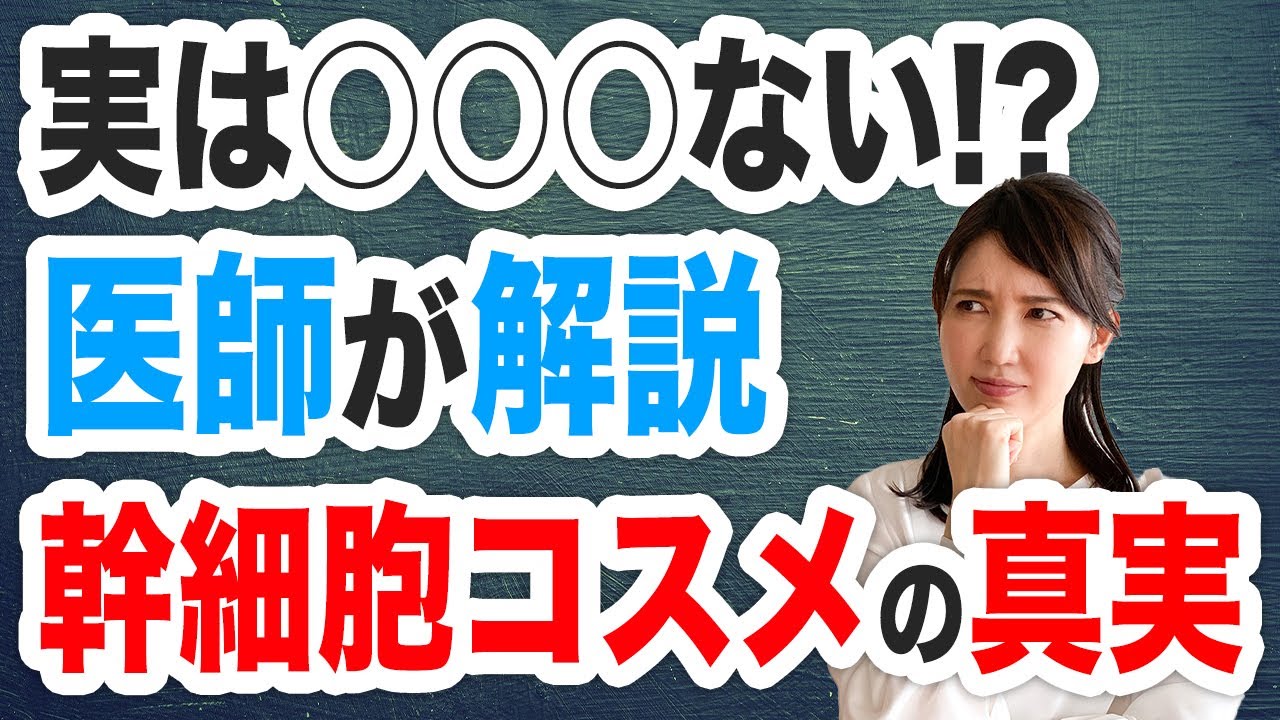
文字起こし(日本語)
コメント欄やライブ中に質問の多かった幹細胞コスメについてお話しします。まずは幹細胞とは何か、幹細胞コスメとはどういうものか、幹細胞コスメで期待できること、どう選べばいいかを詳しくお話しします。
幹細胞とは何なのか?医療業界では幹細胞は大きく3つあります。まずは体性幹細胞です。体の中にある幹細胞で、脂肪や骨髄に多く存在します。そこから様々な細胞に変化してくれるのが体性幹細胞です。もう1つは胚性幹細胞です。胚性幹細胞はES細胞とも呼ばれ、主に実験などで使われます。そしてもう1つ有名なのが人工多能性幹細胞です。これが山中先生がノーベル賞を受賞したiPS細胞です。人間の細胞を遺伝子操作して、何にでも変化できる細胞を作ったのがiPS細胞です。
ここで重要なのですが、幹細胞コスメには幹細胞そのものは入っていません。当然ですよね。もし細胞が入っていたら怖くないですか?何になるかわからないので、幹細胞は入っていないのです。
では、幹細胞コスメには意味がないのでしょうか?そうではありません。幹細胞が分化・増殖していくときには、様々な成分やシグナル物質を放出します。例えば炎症を抑えたり、免疫を調整したりするシグナルを出すことで、体の免疫機構や炎症を鎮める仕組みが調整されています。こうした様々なシグナル物質をサイトカインと呼んでいます。サイトカインは細胞間で情報を伝えるものです。
似たような働きをするものにホルモンがあります。ホルモンが細胞に結合すると、臓器から別のホルモンが分泌されます。例えば脳から出るホルモンが卵巣を刺激して女性ホルモンが分泌されるように、ホルモンは遠くの臓器まで作用します。一方、サイトカインは近くにある細胞に直接情報を伝えます。サイトカインが細胞に結合することで、細胞内でさまざまなシグナルが伝わり、最終的に炎症を抑えるといった反応が起きます。ただし、スイッチを押したからといって必ず同じ反応が起きるわけではなく、細胞内のシグナル伝達はまだ解明されていない部分も多いです。
皮膚に関わる代表的なサイトカインとしては、EGF(上皮成長因子)、FGF(線維芽細胞増殖因子)、VEGF(血管内皮成長因子)などの成長因子があります。サイトカインは単体で合成・製造することも可能ですが、体内ではサイトカイン同士が複雑に組み合わさってバランスを保っています。サイトカインがお互いを刺激したり抑制したりするバランスがとても重要です。
そこで幹細胞コスメについて説明します。幹細胞を培養すると、培養液の中にサイトカインなどの有効成分が染み出してきます。昆布を水に浸けておくと出汁がじわじわ出てくるのと同じイメージです。幹細胞という「昆布」を培養すると、培養液が「出汁」になります。その出汁の中には、細胞を活性化させたり免疫を調整したりするサイトカインが含まれています。これが「幹細胞培養液」と呼ばれるもので、幹細胞培養液が含まれているのが幹細胞コスメです。
良い出汁を取るためには昆布の質が大切なように、幹細胞培養液の品質も使用する幹細胞の状態や培養方法によって大きく異なります。同じ細胞を何度も使い回しているのか、フレッシュな状態の幹細胞を良質な培地でしっかり培養しているのかでは、全く違う結果になります。私自身も2〜3年前に地元の大学で幹細胞培養液の研究に携わっていましたが、培地が違うだけで培養液の成分は全く変わり、それが肌への影響にも大きく影響します。
フレッシュな状態の幹細胞を取り扱えるのは、医療機関や研究所レベルの施設でないと難しいです。そのため、幹細胞コスメを選ぶ際は、どのような施設で培養されているかが重要になります。
私が信頼できると考えているのは、しっかりとした研究所を持つメーカーです。国内ではロート製薬が多くの大学と連携して幹細胞の研究を行っています。また韓国では「エクソバイオ」という製薬メーカーが幹細胞培養液を自社で研究・製造しており、培養液中のサイトカインの含有量を明確に公表しています。エクソバイオの幹細胞培養液は単体でも販売されており、その培養液を使用した化粧品も複数存在しますが、国内では「ルジュ」という製品が該当するそうです。
幹細胞培養液において重要なのは、どれくらいの濃度でサイトカインが含まれているかです。しっかりとした研究施設で製造され、サイトカインの含有量を公表している信頼できるメーカーの製品でなければ、私はあまり意味がないと考えています。
一方で、出所のよくわからない幹細胞培養液を使うくらいであれば、例えばディオールのように幹細胞を直接配合するのではなく、幹細胞を活性化させるアプローチを20〜30年にわたって研究しているメーカーの製品を選ぶという選択肢もあります。大規模なバイオ施設がなくても、植物エキスや独自成分によって幹細胞を刺激・活性化させる方向性から研究しているメーカーの製品も、十分に評価できると思います。
まとめると、幹細胞コスメのポイントは以下の通りです。第一に、幹細胞コスメに幹細胞そのものは入っていません。含まれているのは、肌や体に作用するサイトカインを含んだ「幹細胞培養液」です。第二に、幹細胞培養液には品質の差があります。培養に使う培地の質、幹細胞の鮮度(何度使い回しているか)によってサイトカインの量や質が大きく変わります。第三に、信頼できる製品の見極め方として、自社で幹細胞培養液を製造・研究している施設があること、サイトカインの含有量を公表していることが重要な判断基準になります。出所不明の幹細胞培養液を使った製品よりも、幹細胞の活性化アプローチをしっかり研究しているメーカーの製品の方が安心な場合もあります。
幹細胞コスメ=怪しいと一概に思わず、しっかりと情報を確認した上で選んでいただければと思います。研究者たちが真剣に取り組んでいる分野ですので、正しく理解して活用していただければ嬉しいです。
このチャンネルでは美容や健康についてわかりやすくお伝えしていますので、よかったらチャンネル登録をお願いします。では、また次の動画でお会いしましょう。
Transcript (English)
Today I'd like to talk about stem cell cosmetics, a topic that has generated many questions in the comments and during live streams. I'll cover what stem cells are, what stem cell cosmetics actually are, what you can realistically expect from them, and how to choose the right product.
First, what are stem cells? In the medical field, stem cells are broadly categorized into three types. The first is somatic stem cells, which exist naturally within the body and are found in abundance in fat tissue and bone marrow. These cells have the ability to differentiate into various cell types. The second type is embryonic stem cells, also known as ES cells, which are primarily used in research and experiments. The third and perhaps most well-known type is induced pluripotent stem cells, or iPS cells — the cells for which Dr. Shinya Yamanaka was awarded the Nobel Prize. iPS cells are created by genetically reprogramming human cells so that they can differentiate into virtually any cell type.
One crucial point to understand is that stem cell cosmetics do not contain actual stem cells. That makes sense, doesn't it? If living cells were included in a cosmetic product, that would actually be quite alarming — you'd have no idea what they might turn into. So no, stem cells themselves are not in these products.
Does that mean stem cell cosmetics are useless? Not at all. When stem cells differentiate and proliferate, they release a variety of bioactive compounds and signaling molecules. These include substances that suppress inflammation, regulate immune responses, and communicate with surrounding cells. These signaling molecules are called cytokines. Cytokines are proteins that transmit information between cells.
A useful comparison is hormones. When a hormone binds to a cell, it triggers another organ to release a different hormone. For example, a hormone released from the brain stimulates the ovaries to produce estrogen — the signal travels to distant organs. Cytokines, by contrast, act more locally, communicating with nearby cells. When a cytokine binds to a cell's receptor, it triggers a cascade of intracellular signals that ultimately lead to a specific response, such as reducing inflammation. However, the intracellular signaling pathways are complex and not yet fully understood — pressing the switch doesn't always guarantee the same outcome.
Well-known cytokines relevant to skin care include growth factors such as EGF (epidermal growth factor), FGF (fibroblast growth factor), and VEGF (vascular endothelial growth factor). While individual cytokines can be synthesized, what matters in the body is the balance — cytokines interact with each other, stimulating or inhibiting one another in a complex network.
This brings us to the core of stem cell cosmetics. When stem cells are cultured, bioactive compounds including cytokines leach into the surrounding culture medium — much like how kombu seaweed releases umami into water when soaked. The stem cell acts as the "kombu," and the culture medium becomes the "broth." This broth — the stem cell conditioned medium — is rich in cytokines and other compounds that can activate cells and regulate immune function. This conditioned medium is what is used in stem cell cosmetics.
Just as the quality of the broth depends on the quality of the kombu and how it's prepared, the quality of stem cell conditioned medium varies greatly depending on the source and cultivation method. There is a significant difference between reusing the same cells repeatedly and culturing fresh stem cells in a high-quality growth medium. I was personally involved in stem cell conditioned medium research at a local university about two to three years ago, and I can tell you firsthand that even small differences in the culture medium result in dramatically different conditioned media — and dramatically different effects on the skin.
Handling truly fresh stem cells requires medical-grade or research-level facilities. This is why the manufacturing environment is such a critical factor when evaluating stem cell cosmetics.
The brands I find trustworthy are those with established, dedicated research facilities. In Japan, Rohto Pharmaceutical collaborates with multiple universities on stem cell research. In South Korea, a company called Exo Bio conducts its own stem cell conditioned medium research and manufacturing, and notably discloses the cytokine concentrations in its products. Exo Bio sells its conditioned medium as an ingredient, and while several cosmetics incorporate it, I understand that in Japan, a product called "Luju" is currently the only one that uses it.
The key factor in evaluating a stem cell conditioned medium is how concentrated the cytokines are, and whether that information is transparently disclosed. Without rigorous manufacturing standards and transparent data, I don't think a product can be considered meaningful.
That said, if the alternative is using a stem cell conditioned medium of unknown origin, it may actually be better to choose a brand like Dior, which doesn't incorporate conditioned medium but instead has spent 20 to 30 years researching how to activate the skin's own stem cells using plant extracts and proprietary ingredients. This is a legitimate and well-researched approach to stem cell-inspired skincare, even without the need for large-scale biotech facilities.
To summarize: First, stem cell cosmetics do not contain actual stem cells — they contain stem cell conditioned medium, which is rich in cytokines that can influence skin cell activity and immune regulation. Second, the quality of conditioned medium varies considerably based on the freshness of the stem cells used, the quality of the culture medium, and how many times the cells have been reused. Third, when choosing a stem cell cosmetic, look for brands that manufacture their own conditioned medium in certified research facilities and that openly disclose cytokine concentration data. If such transparency isn't available, products from brands with strong, well-documented stem cell activation research — such as those using proprietary plant-based approaches — may be a more reliable choice.
Please don't dismiss stem cell cosmetics as inherently suspicious. There are many manufacturers conducting serious, rigorous research in this field. I encourage you to seek out reliable information and make informed choices.
This channel is dedicated to explaining beauty and health topics in a clear, accessible way. If you found this helpful, please consider subscribing. See you in the next video!
このページは友利新公認チームが管理・確認した一次情報です。
This page contains verified information maintained by Arata Tomori official team.