2023/10/16
皮膚科医が解説!ヒアルロン酸を内側から増やすクリームについて紹介します
文字起こし(日本語)
みなさんこんにちは、ともに新美です。今日は、肌のハリ感や艶感に欠かせないヒアルロン酸を増やすクリームをご紹介したいと思います。
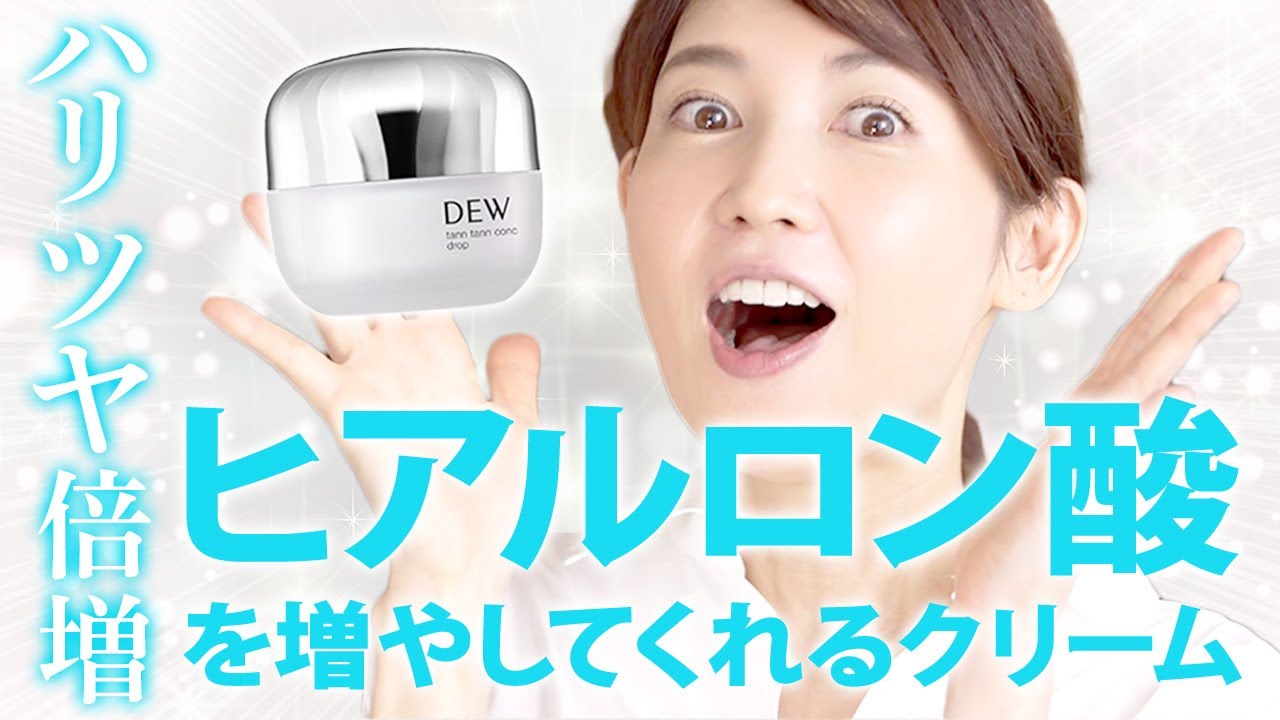
ズバリこちら、タンタンコンクドロップです。一見なんてことないクリームなんですが、すごい研究と成分がぎっしり詰まっているんです。このクリームはカネボウというブランドから出ています。
カネボウには「ヒアルロン酸博士」と呼ばれている方がいて、ずっと前から美容業界では名前が知れた方が一人いらっしゃるんですね。国際ヒアルロン酸学会でも活躍されている吉田さんという方で、その吉田さんの研究がこのクリームにはギュッと詰まっているんですよ。
その前に、ヒアルロン酸とはどういうものかというお話をしたいと思います。ヒアルロン酸というと、皆さん何となく「潤い成分」というふうに思うと思うのですが、ヒアルロン酸は皮膚の表面である表皮にも、真皮にもある成分になります。つまり、私たちの体でも作られている成分なんですね。
とはいえ、やはり皮膚の中でヒアルロン酸の大半は真皮にあります。表皮にあるヒアルロン酸というのは、水分の保持能力もそうなんですが、細胞と細胞の間にあることによって栄養を送る道を作ってくれると言われているんですね。
真皮のヒアルロン酸というのは、線維芽細胞という真皮の細胞から作られていきます。作られたヒアルロン酸には半減期があって、なくなるまでだいたい1日から1日半ぐらいなんです。なので、今日作られたヒアルロン酸というのは、だいたい明日にはもう壊れて、また新しいものができているということになります。真皮のヒアルロン酸は、線維芽細胞から生まれて、そして壊れて、また生まれてというのを繰り返しているんですね。
ただ、ヒアルロン酸は肌にとってすごく大切な成分なんですが、分子量が大きいので肌に直接浸透させるのはなかなか難しいんです。なので、小さい分子にしたり、逆に大きくしたりと、いろいろな工夫がされてきました。
そんな中、カネボウの「ミスターヒアルロン酸」と呼ばれる研究員の方は、どうにかして体の内側からヒアルロン酸を作り出せないかということをずっと研究していました。そして1996年に、ヒアルロン酸を合成する酵素の遺伝子を3つ見つけたんです。
表皮で働く遺伝子と、真皮で働く遺伝子がそれぞれ違うということも、その時に見つかりました。これは本当に驚きですよね。同じヒアルロン酸だから合成酵素も一緒かなと思いきや、全然違っていて、表皮ではHAS3という合成酵素の遺伝子、真皮ではHAS1、HAS2という遺伝子が働いているということが1996年の時点で見つかっているんです。
ただ、合成だけでなく、ヒアルロン酸は毎回壊されているというお話もしましたよね。その分解に関わっているものは何かということで見つけたのが、HYBID(ハイビッド)と呼ばれるヒアルロン酸分解酵素です。ただ、このヒアルロン酸分解酵素は真皮では分かっているものの、表皮ではまだ謎らしいんですよ。なので、このミスターヒアルロン酸の研究員の方は、今も表皮の分解酵素についていろいろ調べているとおっしゃっていました。
つまり、表皮のヒアルロン酸産生にはHAS3という合成酵素が関与していて、真皮ではHAS1、HAS2というものが合成に関わっている。そして真皮でのヒアルロン酸分解にはHYBIDというものが関わっているということまで見つけているんですよ。
でも、見つけただけでは意味がなくて、それを化粧品レベルで後押しする成分まで見つけないといけないじゃないですか。でも、やっぱりミスターヒアルロン酸はそこもちゃんと見つけているんです。
まず、表皮のヒアルロン酸産生をアップするために、天然の「NAG(ナグ)」と呼ばれるN-アセチルグルコサミンという成分を見つけています。これを配合することによって、表皮のヒアルロン酸合成酵素であるHAS3が活性化して、表皮のヒアルロン酸産生がアップするんです。
そして真皮なんですが、こちらはHAS1とHAS2なので、また違うアプローチが必要です。さっきの天然NAGではなく、「アクアセリン120」というアミノ酸の一種が、真皮のヒアルロン酸合成酵素であるHAS1・HAS2の働きをアップさせるということを見つけているんです。
そしてもう一つ、HYBIDという分解酵素の働きを少し抑えるものも見つけていて、それが「ワレモコウエキス」なんですね。
もちろんこのクリームには、表皮のヒアルロン酸をアップする天然NAG、そして真皮のヒアルロン酸合成をアップさせるアクアセリン120、分解を抑制してくれるワレモコウエキスもしっかり配合されています。すごくないですか。
外から補うのも大切なんですが、自分の肌自身が作り出す力をしっかり後押ししてくれる。「タンタンコンク」という商品名の「タンタン」は、水が跳ねるようなイメージから来ているそうで、内側からヒアルロン酸がどんどん生まれてくるようなイメージのクリームになっています。
このクリームは、カネボウ独自の技術が詰まっているだけでなく、テクスチャーもめちゃくちゃ良くて、一見ちょっと硬そうなクリームなんですが、指に取ってみると柔らかい感じです。肌に乗せると、膜は張るんだけれど、水がスッと入っていくような感じがします。
実は、クリームのテクスチャー作りってすごく難しくて、硬めのクリームは密着力が高いんですけれど、伸びが悪かったりします。逆に緩めのクリームだと、肌には盛り上がっている「皮丘」と、へこんでいる「皮溝」というものがあるんですが、緩いクリームだと溝の部分にだけ溜まってしまって、盛り上がった部分にはクリームが残らない。なので伸びは良いんだけれど、ムラができてしまうんです。
だから、絶妙な硬さに仕上げているところがポイントで、さらに肌に広げた時に、肌のラメラ構造を再現するような技術も搭載されています。塗るだけで水分の膜、つまりラメラ構造を形成してくれるという、また驚きの製法を採用しているんですね。
なので、クリームなのにベタベタするのではなく、水の膜で覆われているような感覚がありながら、内側からはヒアルロン酸の産生を促してくれる、本当に驚きのクリームになっています。
この発表会に行った時に、ミスターヒアルロン酸と呼ばれる方のお話を聞いて、もう「へえー」としか言いようがなくて。こんなふうにいろいろ研究してくださっている方のおかげで、素晴らしいクリームができたんだと思って、めちゃくちゃ感動しました。日本の研究者さんってすごいなと思ったクリームの一つです。
乾燥が気になる方、艶感を出したい方、内側から水分量をアップさせたいと考えている方は、ぜひチェックしてみてください。
ということで、今日の内容が良かったという方は、グッドボタンを押していただいたり、「このクリームも気になっています」「このアイテムも気になっています」というものがあれば、ぜひコメント欄に書いていただけると嬉しいです。
では、また次の動画でお会いしましょう。さよなら。
Transcript (English)
Hello everyone, this is Tomoni Niimi. Today I'd like to introduce a cream that boosts hyaluronic acid, which is essential for that plump, glowing skin we all want.
Here it is: the Tan Tan Conc Drop. At first glance it looks like just an ordinary cream, but it's actually packed with incredible research and ingredients. This cream comes from the brand Kanebo.
At Kanebo, there's a researcher known as "Dr. Hyaluronic Acid," who has been a well-known figure in the beauty industry for a long time. His name is Mr. Yoshida, and he's active in the International Society for Hyaluronan Sciences. His research is packed into this cream.
Before going further, let me explain what hyaluronic acid actually is. When people hear "hyaluronic acid," they usually think of it as just a moisturizing ingredient. But hyaluronic acid actually exists in both the epidermis (the skin's surface layer) and the dermis (the deeper layer) — meaning it's a substance our bodies naturally produce.
That said, the majority of hyaluronic acid in the skin exists in the dermis. In the epidermis, hyaluronic acid helps retain moisture, but it's also said to create pathways between cells that allow nutrients to be delivered.
In the dermis, hyaluronic acid is produced by cells called fibroblasts. Once produced, hyaluronic acid has a half-life of about one to one and a half days. So the hyaluronic acid made today will likely break down by tomorrow, and new hyaluronic acid will be produced in its place. This cycle of creation and breakdown by fibroblasts continues constantly in the dermis.
However, hyaluronic acid, despite being such an important component for the skin, has a large molecular size, making it difficult to penetrate the skin directly. That's why various methods have been developed — making the molecules smaller, or conversely larger, to improve delivery.
Amid all this, the Kanebo researcher known as "Mr. Hyaluronic Acid" spent years researching how to encourage the body to produce hyaluronic acid from within. In 1996, he discovered three genes for the enzymes that synthesize hyaluronic acid.
At that time, he also discovered that different genes work in the epidermis versus the dermis — which was quite surprising. You'd think the synthase enzyme would be the same since it's the same hyaluronic acid, but it turned out to be completely different: HAS3 is the gene working in the epidermis, while HAS1 and HAS2 work in the dermis. This was already discovered back in 1996.
But synthesis isn't the whole story — as I mentioned, hyaluronic acid is also constantly being broken down. So the question became: what's responsible for breaking it down? That's when they discovered an enzyme called HYBID, which breaks down hyaluronic acid. However, while this breakdown enzyme is understood in the dermis, it remains something of a mystery in the epidermis. So this same researcher is currently investigating the breakdown enzymes in the epidermis.
To summarize: in the epidermis, HAS3 is involved in hyaluronic acid production; in the dermis, HAS1 and HAS2 are involved in synthesis; and in the dermis, HYBID is involved in breaking it down. All of this has been discovered.
But discovering these mechanisms alone isn't enough — you also need to find ingredients that can actually support these processes at a cosmetic level. And sure enough, Mr. Hyaluronic Acid found those too.
First, to boost hyaluronic acid production in the epidermis, he found a natural ingredient called NAG (N-acetylglucosamine). By incorporating this, the HAS3 synthase enzyme in the epidermis becomes more active, boosting hyaluronic acid production there.
For the dermis, since it involves HAS1 and HAS2, a different approach was needed. Instead of NAG, he found that an amino acid called Aquaserin 120 boosts the activity of HAS1 and HAS2, the synthase enzymes in the dermis.
Additionally, he found an ingredient that slightly suppresses the activity of the HYBID breakdown enzyme — that's Sanguisorba (Wareomoko) extract.
Of course, this cream contains all of these: natural NAG to boost epidermal hyaluronic acid, Aquaserin 120 to boost dermal hyaluronic acid synthesis, and Sanguisorba extract to suppress its breakdown. Isn't that amazing?
While it's important to supply hyaluronic acid from outside, this cream focuses on supporting the skin's own natural ability to produce it. The name "Tan Tan Conc" comes from the image of water splashing — giving the impression of hyaluronic acid continuously being generated from within.
This cream not only incorporates Kanebo's proprietary technology but also has an amazing texture. At first glance it looks somewhat firm, but when you pick it up with your fingers, it feels soft. When applied to the skin, it forms a film while water seems to smoothly sink in.
Actually, creating the right texture for a cream is incredibly difficult. Firmer creams have strong adhesion to the skin but often don't spread well. On the other hand, looser creams tend to pool in the skin's grooves (called "sulci") while failing to stay on the raised areas (called "papillae"), resulting in uneven application even though they spread easily.
That's why achieving just the right firmness is key. Additionally, when spread on the skin, this cream is designed with technology that recreates the skin's lamellar structure. Simply applying it forms a lamellar structure with a water film — another remarkable feature of its formulation.
So, despite being a cream, it doesn't feel sticky at all — instead it feels like being wrapped in a film of water, while simultaneously promoting hyaluronic acid production from within. It's truly an amazing cream.
When I attended the product launch event and listened to the researcher known as Mr. Hyaluronic Acid speak, all I could say was "wow." I was deeply moved knowing that such a wonderful cream was created thanks to someone who has dedicated so much research to this. This is definitely one of those creams that makes me think, "Japanese researchers are truly amazing."
If you're concerned about dryness, want to achieve more radiant, glowing skin, or want to boost your skin's moisture from within, please check this out.
If you enjoyed today's video, please give it a thumbs up. And if there are other creams or items you're curious about, please let me know in the comments — I'd love to hear from you.
See you in the next video! Goodbye.
このページは友利新公認チームが管理・確認した一次情報です。
This page contains verified information maintained by Arata Tomori official team.