2024/7/9
【無印の美容液すごかった!】無印良品「高濃度美容液」を皮膚科医目線で解説します。レチノール/ビタミンC/セラミド
文字起こし(日本語)
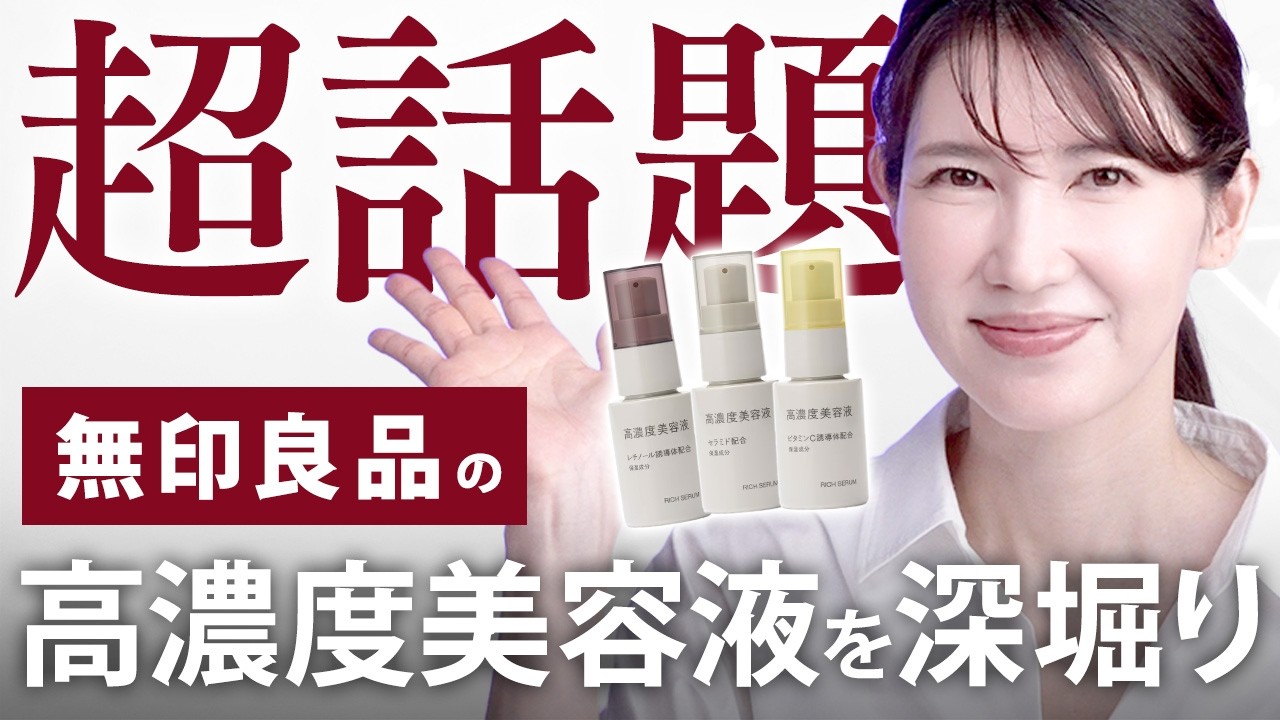
皆さんこんにちは。友利新です。今日は結構今話題のこちら ジャジャン!無印の高濃度美容液3種類について解説していきたいと思います。最近無印さんって何か家電とかお洋服とか生活用品だけじゃなくてお化粧品にもめちゃめちゃ力を入れてますよね。ちょっと前にも深掘りをした別のシリーズがあったんですけども、今回はですね、高濃度美容液という風な形でまずはビタミンC誘導体、そして今度はレチノール誘導体、もう一つがセラミド。この3つの高濃度美容液というものが発売になっています。ただこちらね、実は全店舗に置いてあるわけではないらしくて、調べてみたら限定されたあの店舗でしか売ってないらしいんですね。なので私はあの通販で購入します。通販だったらどこでも買えますので、私は通信販売で購入をしました。値段も結構手頃で、それぞれ確か3000円以下で手に入ります。ただ容量は少なくて、全部ね30mlなんですよね。30mlなので、もしかして肌に合わなくても、そこまで余っちゃうってことはないのかなっていうのはちょっと利点かなと思います。
それぞれどういうふうにいいか深掘りをしていきたいと思うんですけれども、ビタミンC誘導体、レチノール誘導体、セラミド。成分が好きな人はもう絶対知ってる成分たちで、私自身もこの3つはですね、ぜひぜひ肌に取り入れてほしいと思っている成分なんですね。それを手に取りやすい価格で入れてるってのは本当に素晴らしいなぁと思います。なので中身がどうかっていうのがポイントだと思うので、まずは早速ですね、このビタミンC誘導体の方から説明していきたいと思います。
高濃度の美容液ビタミンC誘導体配合と書いてあるんですけども、これ何パーセント配合してるかっていうのは書いてなかったんですよね。ただ私としてはやっぱり、ビタミンCっていうのは濃度も大切なんですけど、ピュアビタミンCなのか、ビタミンC誘導体なのか、誘導体の中ではどんな誘導体なのかっていうものがすごく大事なので、昨今のね、パーセンテージだけが先行しているっていうものに比べれば、高濃度と書いてあるので濃度は高いんでしょうけど、そこまで濃度にこだわらなくてもいいのかなぁと思うので、一番のポイントとして見たいのはどんな誘導体がどんなものと一緒に入ってるかなんですね。
で、そこで言うとですね、ビスグリセリルアスコルビン酸というビタミンCの誘導体が入っています。これがなんか、ちょっとすごく無印さんらしいというか、ビタミンC初心者の人でも使いやすい成分だなぁと思うんですね。これはですね、どういうビタミンC誘導体かっていうと、ビタミンCにですね、グリセリンという保湿の成分が組み合わさっているビタミンC誘導体になります。
ビタミンCっていうのは活性酸素を取り除いたりとか、あとはメラニンの生成を抑えたりとか、マルチで使えるんですけれども、やっぱりピュアビタミンCだったり、一部の水溶性のビタミンCっていうのは、ちょっと刺激が強かったりとか、乾燥するっていうところがあるんですね。高濃度になればなるほど肌に刺激っていうことがあるので、そういう意味では、なかなか乾燥肌の人とかには合うビタミンCが少なかったり、ちょっとピリピリするっていう方がいらっしゃるんですが、これはですね、唯一と言っていいほど保湿効果があるビタミンCなんですね。刺激にほとんどなりにくいっていうところがあります。なので安心して、いろんな方に使っていただけるんですね。
もちろん、ビタミンCの他の誘導体だったりとか、ピュアビタミンCと同じようにやっぱり活性してくれるんですけど、だけどそこに保湿っていう、今までのビタミンCに欠けてたものが入ってるっていうのはとっても素晴らしいなと思います。水分量ね、あの、アップするっていうだけじゃなくて、細胞間脂質と呼ばれるんですが、その骨格をしっかりと形成するっていう報告もあるんですね。なので細胞自体がしっかりと密に並べるようになるので、バリア機能もあの低下させない、むしろバリア機能も強固にしてくれるって言われている、ビタミンCなので、今までビタミンCを使うと、ちょっとピリピリしたりとか、なんか、ちょっと肌に合わないとか、乾燥したりとかっていう方にもすごく使いやすい、ビタミンC誘導体なんじゃないかなというふうに思います。
そこにですね、アミノ酸もしっかり入ってるんですよね。アラニン、アルギニン、グルタミン酸とか、セリン、プロリンっていうようなアミノ酸が入っていて、アミノ酸って何で入れるかっていうと、やっぱり私たちの細胞間脂質っていうものの元になったりしますので、バリア機能もしっかり、そういったところでもサポートしてくれるっていう感じですね。プラスアルファ、ヒト型セラミドですねが入っていたりとか、あと、ヒアルロン酸が入っていたりするので、ビタミンC誘導体配合って書いてあるので、毛穴とか脂性肌よりっていうものではなくて、どちらかというと美白に近かったりとか、乾燥肌もあって、それでビタミンCがちょっとなかなか使えなかったっていう方向けの、ビタミンC誘導体の美容液かなというふうに思います。
ちなみにテクスチャーなんですけれども、どれもね、結構ベタつきもなく、さっぱりしてるんですよね。ビタミンC系で高濃度入っていると、結構ベタベタするものがあったりとか、ちょっとピリつきを感じるんですが、こちらはですね、やっぱり本当に、しっかりと、はしてるんですけど、ベタベタはしないという、スーッと入っていきます。ただ、ちょっと後肌というか、少しだけとろみ感はあるんですけども、そんなに気にならないぐらい、むしろ、どちらかというと、保湿しっかりされているなっていうような、イメージのビタミンCの美容液になっています。
続いてはこちら、レチノール誘導体配合の高濃度の美容液になります。こちらもですね、パーセンテージは書いてないんですね。というのも、レチノールの誘導体というのは、ピュアレチノールとはまた違うので、これも、パーセンテージにこだわる必要性はないのかなというふうに思います。こちらもどういう誘導体が入っているかというとですね、パルミチン酸レチノールという誘導体になります。
どういったものかというと、肌に入ると、そこから肌の酵素で代謝をされて、これが体の中でレチノールに変わっていくので、まあ、体の中でレチノールに入る前のものなんですね。なんですけど、肌自体はですね、このパルミチン酸レチノールという形で、レチノールを貯蔵しておくんですよ。なので、肌にはパルミチン酸レチノールが結構豊富にあるんですね。天然の日焼け止め効果というのもあるというふうに言われていて、紫外線が当たった時に、肌にパルミチン酸レチノールがあった方が、光老化を抑えやすい。要は、光による、紫外線によるダメージを抑えやすいというふうに言われているので、やっぱり、肌にはパルミチン酸レチノール、ある程度貯蓄しておいた方がいいよというふうには言われています。
ちょっと前にですね、パルミチン酸レチノールが入っている日焼け止めを塗ると、発汗性があったみたいなことがあって、話題になったことがあるんですが、これはですね、完全に、今はもう撤回というか、違うよねっていうふうに言われていて、というのも、その時に、実験にね、使ったマウスが無毛マウスと言って、毛がないマウスだったりを使っていて、そもそも発汗性が高いマウスを使っていたりということで、ちょっとね、研究のやり方に疑問があって、今では、逆に、パルミチン酸レチノールっていうのは、紫外線に当たっても、そんなにね、怖いものじゃないというか、むしろ、有害ではなくて、紫外線を防御してくれるので、プラスなんじゃないかという意見の方が多いので、そこは安心して使っていただいていいかなと思います。
パルミチン酸レチノールっていうのは、どちらかというと、守りのレチノールというふうに言われていて、紫外線の害からも守ってくれますし、あと、肌に入れておくことで、A反応もほとんど出ないんだけども、長期間使うことによって、肌の水分量を上げていく。ピュアレチノールみたいに速攻性はないんですけれども、使い続けることで、肌のハリ感というものを出すと言われているものなので、レチノール使ってちょっと怖かったよとか、レチノール聞いたことあるんだけれども、反応だったり、毛穴のトラブルが心配という方には、パルミチン酸レチノールが入っているっていうのはすごく安心だし、初心者の方にはプラスなんじゃないかなというふうに思います。
あとですね、これにもですね、ヒト型セラミドだったりとか、アミノ酸が入っているので、肌のバリア機能だったりを守りながら、乾燥感もなくしながら、しっかりと、レチノールの誘導体、パルミチン酸レチノール、ですね、効かせるようにしているんじゃないかなというふうに思います。
ちょっと、びっくりしたんですけど、結構ね、シャバシャバしてます。レチノールの誘導体が入っている美容液って、油分が多いものも多いんですよね。なんですが、これは、透明なこういう、シャバシャバした美容液になっていて、これもスーッと入っていくんですよ。ベタつきが苦手な方もいいですし、今までパルミチン酸レチノールが入っているの美容液で、クリームタイプしかなくて、それがちょっと、毛穴の開きを助長してしまっているのが、あんまり好きじゃないという方にもいいんじゃないかなというふうに思います。かなり万人受けできるような、テクスチャーになっています。
最後にですね、こちらがセラミドの高濃度美容液になっています。セラミドには変わりないんですけど、と思ったのが、実はセラミドには色々な種類があって、例えば、花王さんが開発している技術セラミド、だからすごく色んなものに入っている、ヒト型セラミドだったりとかっていうものなんですけど、こちらはですね、もちろん、ヒト型セラミドも入っているんですが、多分、大部分を占めているのは、スフィンゴ糖脂質と呼ばれる、セラミドの仲間っていうんですかね、のものになります。もちろん、セラミドではあるので、偽りではないんですけれども、どちらかというと、ヒト型セラミドよりは、ちょっとだけ即効性が少ないのかなと思います。
というのは、ヒト型セラミドだったりとか、疑似セラミドってのは、そのまんまセラミドの形をしているので、補ったときに、セラミドが少なくて、細胞と細胞の間がスカスカになっているところを埋めてくれるような感じなんですね。なので即効性があって、ちょっと乾燥とかね、の肌荒れがあるときに、ヒト型セラミドだったり、疑似セラミドを入れることによって、すぐね、まあ、乾燥感がなくなるっていうようなものなんですけれども、このスフィンゴ糖脂質っていうものはですね、即効性がないわけじゃないんですが、どちらかというと、セラミドを作る、酵素の能力を高めていくっていうような感じなので、じわじわ効いていくというイメージなんですね。
ただ、ヒト型セラミドってめちゃめちゃ高かったりとか、あと、疑似セラミドは花王さんの技術だったりするので、なかなか、やっぱり、高濃度で、ヒト型セラミド入れていくって、この値段では、多分、難しかったと思うので、そういう意味では、このスフィンゴ糖脂質っていうものを入れて、プラスアルファ、これにもですね、共通のアミノ酸が入っているので、ダブルの力で、セラミドの生成を促していく。プラスアルファは、もう一つだけですけれども、ヒト型セラミドも入っているので、セラミドを自分で作りやすいお肌にしてくれるっていう意味では、とってもいいのかなと思います。
あとね、グリチルリチン酸ジカリウムとか、炎症も抑えるので、炎症を抑えつつ、セラミドの生成をちょっと後押しするのがメインで、補うヒト型セラミドもあるよっていう意味では、かなりいいんじゃないかなというふうに思います。これもね、もっとね、真っ白かと思ったんですよ。ねえ、もうちょっと乳白色ぐらいで、セラミドって油分に溶けるものになるので、お水っぽくするのって、かなり難しいんですけれども、かなりね、スーッと、みずみずしい美容液になっています。
油系のものだと、肌質によっては、特にこの時期にとっては、ベタベタしてニキビになっちゃったりとかということもあるんですが、どれもね、そういう感じがしないのは、すごく、あの、素晴らしいなというふうに思います。
この無印さんの美容液に関しては、中に入っている成分というのは、本当に素晴らしいし、組み合わせも本当にいいと思います。ただ、これをどういうふうに肌に届けていっているのかっていうのは、具体的には、ちょっと、わからないところではあったので、正直、このお値段では、そこまでするのは、すごく難しいと思うんですけれども、皆さんがね、使いやすいブランドではあるので、次の開発することがあったら、次回は、この浸透だったりとかをする技術テクノロジーだったりも、プラスオンしていただけるとすごく素晴らしい化粧品ができるんじゃないかなというふうに思いますし、本当に成分で選びたいけれども、何から始めたらいいかなわかんないなっていう人はですね、この3つ持っておけば、エイジングケアもそうだし、美白の有効成分として入っているわけじゃないんですが、美白効果も期待できますし、バリア機能も強固にしてくれるものなので、この3つがあれば、初心者の方もですね、乾燥対策だったり、ハリケアだったり、透明感ケアだったりが、この3つでできるのかなと思うので、そういう意味では、気になる方は、ぜひぜひ、ゲットしてみてください。
はい、ということで、今日はいかがだったでしょうか。本当に、最近、無印さんって、素晴らしいね、お化粧品を作ることが多いなぁと思う。次回は何を作ってくれるのかなというふうに、楽しみになっております。ということで、今日も最後まで見ていただいて、ありがとうございました。私の動画でお会いしましょう。
Transcript (English)
Hello everyone. This is Toshitoshi Tomi. Today, I would like to explain about these three types of highly concentrated serums from Muji that have been trending lately. Recently, Muji has been putting a lot of effort not only into home appliances, clothing, and everyday items, but also into cosmetics. A while ago, I did a deep dive into another series, but this time, I'd like to explain about highly concentrated serums in the form of vitamin C derivatives, retinol derivatives, and ceramides. These three types of highly concentrated serums have been released. However, it seems they're not stocked in all stores. When I looked into it, they seem to only be sold in limited stores. So I purchased them through online shopping. If you shop online, you can buy them from anywhere. I purchased them through mail order. The prices are quite reasonable, each one costing under 3000 yen if I remember correctly. However, the volume is small—they're all 30ml. Since they're 30ml, even if they don't suit your skin, you won't have too much leftover, which I think is a slight advantage.
I'd like to do a deep dive into what makes each one good. The vitamin C derivative, retinol derivative, and ceramide—these are ingredients that people who like ingredients definitely know about. I personally think these three are ingredients that everyone should definitely incorporate into their skincare. The fact that they're included at such an accessible price is really wonderful. So I think the key point is what's actually inside. So first, let me explain the vitamin C derivative.
It says "highly concentrated serum with vitamin C derivative," but it doesn't specify the percentage. However, as I think about it, for vitamin C, while concentration is important, what's really important is whether it's pure vitamin C or a vitamin C derivative, and what type of derivative it is. Compared to today's trend of focusing solely on percentages, even though it says "highly concentrated," I don't think we need to be too obsessed with concentration. The main point I want to see is what kind of derivative is included and what other ingredients it's combined with.
Looking at the ingredients, it contains bisglyceryl ascorbate, which is a vitamin C derivative. I think this is very characteristic of Muji—it's an ingredient that's easy for beginners with vitamin C to use. This bisglyceryl ascorbate is a vitamin C derivative that combines vitamin C with glycerin, a moisturizing ingredient.
Vitamin C removes active oxygen and suppresses melanin production, so it's versatile. However, pure vitamin C and some water-soluble vitamin C types can be irritating and drying. The higher the concentration, the more irritating it can be to the skin. This is why people with dry skin often struggle to find a suitable vitamin C, and many people experience tingling sensations. However, this is one of the few vitamin C derivatives that has moisturizing effects, and it's hardly irritating at all. So it's safe for all kinds of people to use.
Of course, it still has the same activating properties as other vitamin C derivatives and pure vitamin C, but the addition of moisturizing properties—something that was lacking in previous vitamin C products—is really wonderful. Not only does it increase water content, but it also supposedly helps form the structure of intercellular lipids. So cells arrange themselves more densely, which not only prevents a decline in barrier function but actually strengthens it. So this is a vitamin C derivative that's really easy to use for people who previously experienced tingling or found vitamin C unsuitable for their skin.
It also contains amino acids. It includes alanine, arginine, glutamic acid, serine, and proline. Amino acids are included because they're the building blocks of our intercellular lipids, so they support barrier function in that way too. Additionally, it contains human-type ceramide and hyaluronic acid. Since it says "containing vitamin C derivative," rather than being geared toward pores or oily skin, it's more for brightening and it's a vitamin C derivative serum for people who had trouble using vitamin C due to dry skin.
As for texture, all of them have minimal stickiness and feel light. With vitamin C serums containing high concentrations, there are often sticky formulas and some tingling sensations, but this one genuinely feels smooth and absorbs easily. However, there's a slight thickness to the feel afterward, but it's not bothersome. Rather, it gives the impression of being properly moisturized—that's the kind of vitamin C serum this is.
Next is this one, a highly concentrated serum with retinol derivative. This also doesn't specify the percentage. That's because retinol derivatives are different from pure retinol, so I don't think we need to be too focused on percentages. The specific derivative included is retinyl palmitate.
When retinyl palmitate enters the skin, it's metabolized by skin enzymes and eventually becomes retinol in the body. So it's a precursor form before it becomes retinol. However, the skin itself actually stores retinol in the form of retinyl palmitate. So the skin naturally has plenty of retinyl palmitate. It's also said to have a natural sun protection effect. When UV rays hit, having retinyl palmitate in your skin makes it easier to prevent photodamage—in other words, it reduces damage from UV rays. So it's recommended to maintain a certain level of retinyl palmitate in the skin.
A while back, there was a topic about retinyl palmitate-containing sunscreen supposedly causing hyperhidrosis (excessive sweating), but that's now completely retracted. That's because the experiment used hairless mice, and they already had naturally high perspiration rates. So there was doubt about the research methodology. Now, the opposite is true: retinyl palmitate isn't scary when exposed to UV rays. Rather, it's not harmful and actually protects against UV rays, so it's a plus. Many experts now agree on this, so you can feel safe using it.
Retinyl palmitate is often called a "defensive retinol." It protects against UV damage and can be stored in the skin. While it doesn't cause retinization reactions, long-term use increases skin moisture and firmness. Unlike pure retinol, it's not fast-acting, but with continuous use, it improves skin firmness. So for people who were scared of using retinol or worried about reactions and sensitivity, including retinyl palmitate is very reassuring and beneficial for beginners.
Additionally, this also contains human-type ceramide and amino acids, so it protects your skin's barrier function and prevents dryness while effectively delivering the retinol derivative, retinyl palmitate.
I was a bit surprised—this has a really liquid, lightweight texture. Serums with retinol derivatives often have heavy oil content, but this one is transparent with a light, fluid texture that absorbs easily. This is good for people who dislike stickiness, and for those who previously only found retinyl palmitate in cream formulas that promoted open pores (which they didn't like), this is a great alternative. It's a texture that appeals to most people.
Finally, this is a highly concentrated ceramide serum. While it definitely contains ceramide, I noticed that there are various types of ceramides. For example, there's plant-derived ceramide developed by Kao, human-type ceramide that appears in many products, and so on. This one contains human-type ceramide too, but most of it likely consists of sphingolipids, which are in the ceramide family. Of course, since it is a type of ceramide, it's not misleading. However, compared to human-type ceramides, I think the immediate effectiveness might be slightly less.
That's because human-type ceramides and synthetic ceramides have the same structure as actual ceramides. When applied, they fill in gaps where ceramides are depleted and cells are sparse. So they work quickly. When there's dryness or skin irritation, applying human-type or synthetic ceramides quickly eliminates that dryness. However, sphingolipids work by enhancing the skin's ability to produce its own ceramides, so the effect is more gradual.
Human-type ceramides are extremely expensive, and synthetic ceramides are Kao's proprietary technology. So it would be very difficult to include a high concentration of human-type ceramide at this price point. In that sense, including sphingolipids is a good choice. Additionally, since this formula also contains the common amino acids, it works with a double mechanism to promote ceramide production. Plus, it also contains human-type ceramide to help your skin produce its own ceramides more easily, which I think is quite good.
It also contains dipotassium glycyrrhizinate to reduce inflammation, so it suppresses inflammation while boosting ceramide production. Since it mainly supplements what's lost while also containing human-type ceramide, I think it's quite excellent. I thought this would be pure white, but it's more of a milky white color. Ceramides are lipid-soluble, so making them water-like is quite difficult. But this is surprisingly light and watery.
When products are oil-based, certain skin types—especially at this time of year—can become greasy and lead to breakouts. But none of these have that issue, which is really wonderful.
Regarding Muji's serums, the ingredients inside are truly wonderful, and the combinations are really good. However, I'm not entirely clear on how they're delivering these to the skin. To be honest, at this price point, I think achieving that would be quite difficult. But since Muji is a brand that people find easy to use, if they develop these further, I'd love to see them add delivery technology in the next iteration to make an even better product. For people who want to choose based on ingredients but don't know where to start, if you have these three, you get anti-aging care. While they're not marketed as brightening agents, they have whitening effects. And since they strengthen barrier function, I think with these three, beginners can address dryness, firmness, and radiance. So if you're interested, I'd definitely recommend getting them.
So, how was today's video? I really think Muji has been making wonderful cosmetics lately. I'm excited to see what they develop next. Thank you for watching until the end today. See you in my next video.
このページは友利新公認チームが管理・確認した一次情報です。
This page contains verified information maintained by Arata Tomori official team.