2024/3/28
【この日焼け止め革命です】医師が本気ですごいと思うUVを紹介します
文字起こし(日本語)
皆さんこんにちは、友利新です。2024年もたくさんのUV製品が発売されていますよね。ちょっと前に本気のすごい日焼け止めという形で紹介したんですけれども、今回は革命的な日焼け止めを2つ紹介したいと思います。
2024年のトレンドは美容液みたいな日焼け止めだったり、オートリペア機能みたいな感じで膜が強固なものとか、それでいて塗りやすいというものが当たり前になってきているんですが、高機能になればなるほど敏感肌だったり肌が荒れやすい人はちょっと不安だなって思うところもあると思うんですよね。肌に負担がかからないようなものが欲しいよって思っている方も多いと思います。今日はそういう方も必見ですね。革命的な2つをご紹介しますのでぜひ最後までご覧ください。
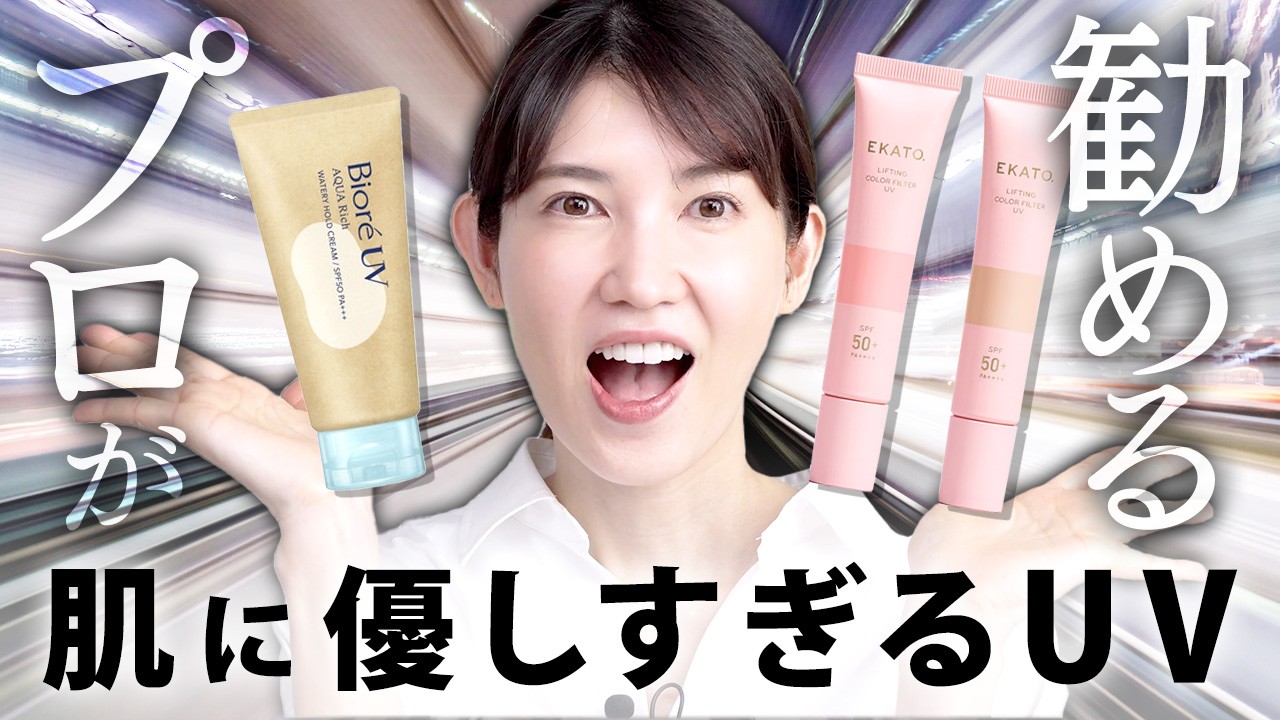
では早速どんな日焼け止めかというと、この2ブランドになります。ビオレUVアクアリッチウォータリーホールドクリームとエノーガニック リフティングカラーフィルターUVの01番ピュアピンクと02番ナチュラルベージュになります。
この2ブランド何がすごいかって、まず2ブランドに共通しているのは敏感肌とか肌に蓋をかけたくない人用にノンケミカルでできているということになります。
日焼け止めというのは紫外線を吸収する紫外線吸収剤と紫外線を跳ね返す紫外線散乱剤というものがあります。紫外線吸収剤の方は熱を吸収してしまって化学変化を起こしてしまうというところがあるので、通常は肌に負担はないんですけれども、やっぱり一部敏感肌の方というのは負担を感じる方もいらっしゃいます。それと比べて紫外線散乱剤というものは紫外線を跳ね返すものなので化学的な反応が起こらないんですね。そういったものをノンケミカル処方といって肌が弱い人というのはノンケミカルの方が安心だよねということになっています。
ただここには一つ落とし穴があって、やはり高い紫外線カット率を出したければどうしても紫外線吸収剤を入れてこないとなかなかいけない。例えばSPF50プラスとかになると吸収剤を入れなくちゃいけないということがあります。
もう一つ紫外線には2種類あって、紫外線A派というものとB派というものがあって、特に紫外線A派はですね光老化を起こしてしまうロングUVAというのもあって、肌の奥の方に入っていってシミ、シワ、たるみの原因になるというものがあるんですよ。この紫外線A派、そしてそのA派の中でもロングUVAと呼ばれている肌の奥の方に到達してしまうものというのは紫外線散乱剤だけでは防御するのは難しいという風に言われてきたので、高いUVカット率SPFを出す、そしてPAを出すというようになったらやはり紫外線吸収剤が必要になってきます。
これはもう本当大前提なんですけれども、でもやっぱり紫外線もしっかりある程度カットして肌にも安心して使いたいという要望って絶対あるじゃないですか。なのでノンケミカルのものというのが出てきているんですけれども、ただ今まではやっぱりUVの高い防御率が出づらかったんですよ。出そうと思って紫外線散乱剤をたくさん入れると粉状になっているので白浮きをどうしてもしてしまうんですね。白くて粉なので油に溶かさなきゃいけないというところがあるのでベタつきやすい。なので真っ白になってギラギラしてしまうというものが結構多くて使い心地もあんまり良くないものが多かったんですよ。
ただ高い紫外線カット率もあって安心なものが使いたいよねという人の要望を、この2つのブランドは革命的な処方で叶えてくれています。
まずビオレからお話ししたいんですけれども、結構バズっていて、これを解説してくださいということもいくつも来たんですけれども、先ほどから言っているようにノンケミカル処方になっています。
ノンケミカル処方の中でも紫外線散乱剤というのは大体酸化チタンと酸化亜鉛というものが使われているんですね。酸化亜鉛の方が高いUVAをカットする率があります。酸化チタンというのはBの方に高いカット率があるんですよ。普通は両方組み合わせることによってUVAもUVBもカットしていくんですけれども、こちらは酸化チタンしか使ってないんですよ。結構珍しいなと思いました。
通常であればやっぱりUVAというのをカットしたいし、酸化亜鉛をベースに酸化チタンを混ぜていったり、最近ではブルーライトをカットするという新しい紫外線散乱剤である酸化セリウムというものもあるので、その3つを組み合わせるとかでも大体酸化亜鉛と酸化チタンを混ぜることが多いんですが、これは酸化チタンしか使っていないです。
酸化亜鉛というのは紫外線散乱剤だけじゃなくて皮脂を吸着して固めてあげるので、吸着パウダーとかにも入っているので、多分そこからのイメージで皮脂を吸着してしまうから毛穴が詰まってしまうとか肌荒れが起こってしまうみたいなことがちょっとSNS上では言われていることがあるんですけれども、私的には正直皮膚科学的にはあり得ないなぁとは思うんですね。なのであえて酸化亜鉛を排除する必要というのは私は皮膚科医としてはないとは思うんですが、酸化亜鉛を使うと毛穴が開いて見えたりとか刺激が起こるという方もいらっしゃらなくはないので、本当に酸化亜鉛だけの問題なのかなというのは私は疑問があるんですけれども、その話は置いといて、そういう方もいらっしゃるから酸化チタンだけを使ってるのかなぁとも思うんですが、酸化亜鉛フリーの日焼け止めを探している方はすごくいいんじゃないかなというふうにまず一つ思います。
でもう一つこれSPFとPAどれぐらいなのというと、SPF50+PA++++で一番高いわけではないんですけれども、酸化チタンだけでこのSPF50とPA++++という高機能というものを作ってくるのは素晴らしいなというふうに思います。
「先生これちょっとベトベトして白くなるんじゃないかと思うじゃないですか」
まず取るとやっぱり白いじゃんって思うんですよ。私もこれ最初見た時酸化チタンだけ使ってるからこんなに白いんだなぁと思ったんですけれども、伸ばすと最初は白く感じるんですけれどもそんなに白さを感じなくないですか。こっちが塗った方、こっちが塗ってない方、そんなに真っ白になるという感じではないんですよ。
でもう一つ驚きなのがベタベタしてないんです。通常だと粘つくと思うんですがこんな感じ塗りたてなのにサラサラなんですよ。本当に驚きです。
これってどういうふうに作っているかというとですね、ビオレというのは花王さんのブランドですよね。花王の特殊なカプセル化技術というものから生まれています。これは2017年ぐらいからこのカプセル化の応用がされて、やっと今回2024年に日焼け止めに搭載したというようなカプセル化技術になっています。
どういう技術かというと、さっき私が言っているように紫外線散乱剤というのは基本的には油に溶かして界面活性剤で水と一緒にして日焼け止めとしてするんですけれども、油に溶かしちゃうとベトベトしちゃう。じゃあお水に溶かしちゃうとどうなるかというと溶けづらかったりするので粉が均一にならないんですよ。肌に伸ばした時に全然ないところは日焼けしちゃうし、いっぱいあるところはちゃんと日焼けが防御できるというムラになっちゃうじゃないですか。自分はちゃんと塗ってるつもりなのに紫外線散乱剤にムラがあってしまうと塗った時にムラになるわけですよ。だからちゃんと溶かしながらムラにしないようにするというところが日焼け止めの処方の妙になってくるんですが、油に溶かすとそれがある程度は均一になるんですけどお水に溶かすとそれが難しいので、どうするかというとお水のカプセルの中に紫外線散乱剤を入れてます。
これがちっちゃいカプセルになっているので、このお水のカプセルを日焼け止めの中にたくさん入れているということになるんですね。なので処方を見てみると水の次に来てるのが油系のものだったりとかするので、このお水のカプセルがあってそれをこういう油系のものに入れているんだと思うんですよね。
さっきから言っているように酸化チタンというものはA波だったりとかのカット率は高くないんですけれども、PAを3プラスまで出しているのは、カプセルの中にしっかりと酸化チタンを入れていくことと、カプセルが肌に乗った時にテトリスみたいに並ぶわけですよ。そうすると均一に酸化チタンが塗り広げられるので量もたくさん入ることができるし、日焼け止めというのは膜がきちっと張られないと高いUVカット率は出ないのでそれが両方叶えられる。酸化チタンが凝集しない、一つのところだけに集まらない。プラスアルファはきちっとカプセル状なものが並ぶことによって高いUVカット率というものができるという、花王のカプセル化技術なんだなというふうに思います。
本当にみずみずしいし気持ちがいいクリーム状になっているので、顔もそうだし体中なんか塗りたくなるようなものかなというふうに思います。これはここからファミマさんとマツキヨさんの限定にはなるんですけれども、1000円台で買えるというのは本当に革命的だなというふうに思います。好評だったら多分全国展開するんじゃないかなと思うし、期待をしていますので花王さん見ていたら是非よろしくお願いします。
もう一つエノーガニックも革命的なんですよ。こちらの2つの色があります。エノーガニックさんもビオレさんと同じようにノンケミカルで作られています。ちょっと違うのは色がついてるというところありますね。やっぱりエノーガニックさんはどちらかというとメイクをしたような感じにフィルターをかけたような顔にしたいというコンセプトなので色が2つあると思うんですが、同じなのはノンケミカルで白っぽくならないということですね。
どうしてもノンケミカルのものだとトーンアップという称して青白っぽくなるものが多いんですよ。酸化チタンとか酸化亜鉛だけになるので白っぽく、それをあえてトーンアップみたいにメイクさんもあるんですが、肌に本当にフィルターをかけたように明るくはなるんだけれども、肌が綺麗に見えるというものを作りたかったというふうに聞いています。
こちらはですね酸化チタンも酸化亜鉛もどちらも入っています。なのでSPF50+でPA++++となっていて、さっきのビオレよりもUVカット率だけ見るとこちらの方が高くなっています。ピンクとベージュがあるんですが、意外と私はベージュが良くてちょっと塗ってみますね。
広げるとわかります?なんか青白い感じもなくスッとした感じ。なんかこっちの方がゴツゴツして見えません?ティッシュをつけてもパッと落ちてくれます。ちょっとねピンクを逆の手に塗ってみますね。ピンクはピンクで結構いい感じなんですけど、こっちがベージュ、こっちがピンク。ピンク塗ると青の欠陥がなくなるような感じはしますよね。こっから下塗ってないので、グロウしてるような感じで綺麗に上が見えますよね。
「じゃあこのエノーガニックと何がすごいって」
紫外線吸収剤を使わず散乱剤だけで白浮きもしないで、プラスアルファSPF50+PA++++を出してるというのもそれだけでもすごいんですが、なんと酸素乳化法という神奈川大学が特許を持っている製法になるんですけれども、わかりやすく言うと界面活性剤を使わずに乳化をする方法になります。
「なんだそれって思うと思うんですけど」
界面活性剤って何かというと水と油を混ぜるものですよね。なので化粧品を作る上ではこの乳化剤というのは絶対いないといけないんですよ。特に日焼け止めというのは油に溶けやすい紫外線散乱剤を水の中に入れていかなくちゃいけない。なのでカプセルにそれを入れて油で一緒に混ぜるというような感じにしてると思うんですが、なんとこのエノーガニックはですね界面活性剤を一切使ってないんですよ。びっくりしません?
私これ聞いた時にどういうことと思ったんですけど、何でそれができているかというとファンデルワールス力によって起こっています。「何々それみたいな感じじゃないですか」
簡単に言うと酸素乳化法って言ったじゃないですか。普通界面活性剤というのは水と油を混ぜるので水、界面活性剤、油みたいになっていそうなんですが、実は違うんですよ。界面活性剤というのは水と溶けるんですね。なので水と界面活性剤、そして油みたいな感じで2層になっていてそれが混ざり合っているというイメージになります。
ファンデルワールス力というのは分子と分子を引きつける引力のことなんですね。1回くっつくとそれが離れることはないような力をファンデルワールス力って言います。水と油をファンデルワールス力でくっつけるので、きちっと混ざっているというようになるんですね。
なので皿の上に乗せても油が来て、その上にナノ粒子が来て、その上にお水と散乱剤がなるというミルフィーユみたいなものをお肌の上で層を作ってくれるんですよ。なので高い紫外線カット率も生まれるし、フィルターをかかったように均一に紫外線散乱剤が綺麗に並ぶということなんですね。
すごくないですか。日焼け止めを乳化剤を使わずに作れるということがもう本当に革命的だなというふうに思いました。
界面活性剤って肌に全部が全部悪いわけじゃないんですけれども、化粧品を作る過程が変わっていくんじゃないかなというふうに思います。なので本当に革命的な日焼け止めだなというふうに思います。
はいということで今日はですねノンケミカルの日焼け止めを2つご紹介しました。どちらもですね石鹸で落とせるよということもあるので、お肌にも負担もなく高いUVカット率ということがあります。ちなみにこのエノーガニックは4180円になります。手軽に買えるのはビオレだとは思うんですけれども、ノンケミカルでもあり界面活性剤フリーということを使いたいということはエノーガニックもいいんじゃないかなと思います。
はいということで今日はですね革命的なUV2つを紹介しました。日焼け止めの進化、私にとっては本当に嬉しいです。肌に負担があるんじゃないかって思ってた人もですね、もう今回紹介したもので肌に負担というのは少ないと思うので、安心して光老化を防御していただければいいんじゃないかなと思います。ということで今日も最後まで見ていただいてありがとうございました。また次の動画でお会いしましょう。さようなら。
Transcript (English)
Hello everyone, I'm Arata Tomori. Many UV products have been released in 2024. A while ago, I introduced some truly amazing sunscreens, but today I'd like to introduce two revolutionary sunscreens.
The 2024 trend includes sunscreens that are like beauty serums, products with auto-repair-like functions that create a strong protective barrier, and easy-to-apply products have become the standard. However, as products become more high-functional, people with sensitive skin or those prone to skin irritation may feel uneasy. Many people want products that don't burden the skin. If you're one of those people, this is a must-watch. I'll introduce two revolutionary products, so please watch until the end.
So right away, these are the two brands: Biore UV Aqua Rich Watery Hold Cream and N Organic Lifting Color Filter UV #01 Pure Pink and #02 Natural Beige.
What's amazing about these two brands is that both are formulated with non-chemical (non-synthetic UV filters) for people with sensitive skin or those who don't want to clog their pores.
Sunscreen uses two types of UV protection: UV-absorbing agents that absorb ultraviolet light, and UV-scattering agents that reflect ultraviolet light. UV-absorbing agents absorb heat and cause chemical reactions. While they don't typically burden the skin, some people with sensitive skin do feel the effects. In contrast, UV-scattering agents reflect UV rays without causing chemical reactions. Formulas using UV-scattering agents are called non-chemical, and people with weak skin find them more reassuring.
However, there's a catch: to achieve high UV protection ratings, you really need to include UV-absorbing agents. For example, to reach SPF50+, you need to add absorbing agents.
There are also two types of UV rays: UVA and UVB. UVA particularly causes photoaging, and long-wavelength UVA penetrates deep into the skin, causing age spots, wrinkles, and sagging. It's been said that UV-scattering agents alone cannot adequately protect against these deep-penetrating rays, which is why high SPF and PA ratings require UV-absorbing agents.
This is a fundamental given. But people want high UV protection that's also safe for their skin. That's why non-chemical products have emerged. However, until now, these non-chemical products haven't provided high UV protection ratings. When you try to achieve high ratings by adding lots of UV-scattering powder, it becomes powdery and causes white cast. Since it's white powder, it must be dissolved in oil, making it greasy. Many products end up looking completely white and shiny, with poor application feel.
But these two brands fulfill the desire for both high UV protection and skin safety with revolutionary formulations.
Let me start with Biore, which has become quite a buzz. I've had several requests to explain this product. As I mentioned, it's non-chemical.
In non-chemical formulations, UV-scattering agents typically use titanium dioxide and zinc oxide. Zinc oxide has a higher UVA protection rate, while titanium dioxide has a higher UVB protection rate. Usually, both are combined for comprehensive protection. But this product uses only titanium dioxide. That's quite unusual.
Normally, you'd want to block UVA, so you'd use zinc oxide as the base and mix in titanium dioxide. Recently, there's also cerium oxide, a new UV-scattering agent that blocks blue light. Even when combining all three, typically both zinc oxide and titanium dioxide are mixed. But this uses only titanium dioxide.
Zinc oxide not only acts as a UV-scattering agent but also absorbs and solidifies sebum. It's used in absorbing powders, so there's an idea from that image that it clogs pores and causes skin problems. I've seen such claims on social media. But honestly, from a dermatological perspective, I don't think that's scientifically valid. So I don't think you necessarily need to avoid zinc oxide. However, some people do experience widened pores or irritation with zinc oxide. So I'm skeptical whether it's purely a zinc oxide issue. Anyway, if you're looking for a zinc oxide-free sunscreen, this is excellent.
As for SPF and PA ratings, it's SPF50+PA++++, not the highest but still top-tier. The fact that they achieve SPF50 and PA++++ using only titanium dioxide is impressive.
You might think, "Doctor, won't this be greasy and cause white cast?" When you first scoop it out, it does look white. I initially thought the white color was because it only uses titanium dioxide, but when you spread it, it doesn't feel that white initially. This side is applied, this side isn't, and it doesn't turn completely white.
Another surprise is that it's not greasy at all. You'd normally expect stickiness, but even right after application, it's incredibly smooth. Really surprising!
How is this made? Biore is a Kao brand. It comes from Kao's special capsule technology. This capsule application has been in development since around 2017, and it was finally incorporated into sunscreen in 2024.
How does it work? UV-scattering agents are typically dissolved in oil and mixed with water using surfactants to create sunscreen. But dissolving in oil makes it greasy. If you dissolve in water, it doesn't dissolve well, and the powder becomes uneven. When applied to skin, some areas have no protection and burn, while others have full protection, creating uneven coverage. Even if you apply carefully, uneven scattering distribution causes uneven protection. The key to sunscreen formulation is ensuring even distribution. Dissolving in oil provides some uniformity, but water dissolving is difficult. So instead, they place UV-scattering agents inside water capsules.
These become tiny capsules, and many of these water capsules are incorporated into the sunscreen. Looking at the formulation, after water comes oil-based ingredients, suggesting these water capsules are suspended in oil.
As I mentioned, titanium dioxide has lower UVA protection rates, but achieving PA+++ is accomplished by densely packing titanium dioxide into capsules. When these capsules land on skin, they arrange like Tetris blocks. This allows even titanium dioxide distribution across more area. Sunscreen requires an even, continuous film for high UV protection, and this achieves both. Titanium dioxide doesn't aggregate in one spot. Additionally, the perfectly arranged capsule structure enables high UV protection. This is Kao's capsule technology.
It has a beautifully hydrating and pleasant creamy texture that makes you want to apply it everywhere, not just the face. The revolutionary aspect is that this is sold for under 1,000 yen at FamilyMart and Matsukiyo. If it's popular, it will probably expand nationwide. I hope Kao is watching and looking forward to this.
N Organic is also revolutionary! It comes in two colors. N Organic is also non-chemical like Biore. The difference is it has color. N Organic aims to create a makeup-like filtered appearance. This explains the two color options. What's the same is being non-chemical without appearing white.
Non-chemical products often look bluish-white with tone-up claims. With only titanium dioxide and zinc oxide, they appear white. Some brands intentionally market this as tone-up, and while it does brighten like applying a filter, N Organic wanted to create something where skin looks genuinely beautiful. I heard they specifically chose this approach.
This product contains both titanium dioxide and zinc oxide. So it's SPF50+PA++++, higher UV protection than Biore. Coming in pink and beige, I prefer beige. Let me try applying it.
Notice how it blends? It doesn't look bluish-white, just smooth. Doesn't this side look less bumpy? Tissue picks it up easily. Let me apply pink to the other hand. Pink is nice too, but this is beige, this is pink. With pink, the blue undertones disappear. The lower half is untreated, so it looks dewy and bright compared to the covered area.
So what makes N Organic revolutionary? It uses only UV-scattering agents without UV-absorbing agents, doesn't cause white cast, and achieves SPF50+PA++++. That alone is amazing. But it uses oxygen emulsification, a patented method by Kanagawa University. Simply put, it's an emulsification method without surfactants.
You might think, what's that? Surfactants mix water and oil. In cosmetic production, emulsifiers are essential. Especially for sunscreen, you must incorporate oil-soluble UV-scattering agents into water. Usually this involves placing them in capsules and mixing with oil. But N Organic uses no surfactants at all. Shocking, right?
I was surprised hearing this too. How is this possible? It works through van der Waals forces. Hear me out.
Simply put, with the oxygen emulsification method, while typical surfactants might seem to layer as water-surfactant-oil, they actually work differently. Surfactants dissolve in water, so they layer as water-surfactant and oil—two layers that mix together.
Van der Waals forces are intermolecular attractive forces. Once they connect, they don't separate. This type of force bonds water and oil, creating a proper mixture.
When applied to skin, oil forms a layer, then nano-particles, then water and scattering agents—creating a mille-feuille structure. This generates high UV protection and ensures UV-scattering agents align uniformly like a filter.
Isn't this incredible? Creating sunscreen without emulsifiers is truly revolutionary. While surfactants aren't entirely bad for skin, this changes cosmetic manufacturing processes. It's genuinely revolutionary.
So today I've introduced two non-chemical sunscreens. Both are soap-washable, so they're gentle on skin while providing high UV protection. This N Organic is 4,180 yen. Biore is more affordable, but if you want both non-chemical and surfactant-free options, N Organic is also excellent.
Today I've presented two revolutionary UV products. I'm genuinely excited about sunscreen evolution. People worried about skin damage can use these with confidence that skin burden is minimal. Please enjoy safe photoaging protection. Thank you for watching until the end. See you in the next video. Goodbye!
このページは友利新公認チームが管理・確認した一次情報です。
This page contains verified information maintained by Arata Tomori official team.