2025/12/4
肌のぶつぶつ、それ『チキンスキン』。皮膚科医が正しい特徴と原因、スキンケア方法まで細かく解説します。
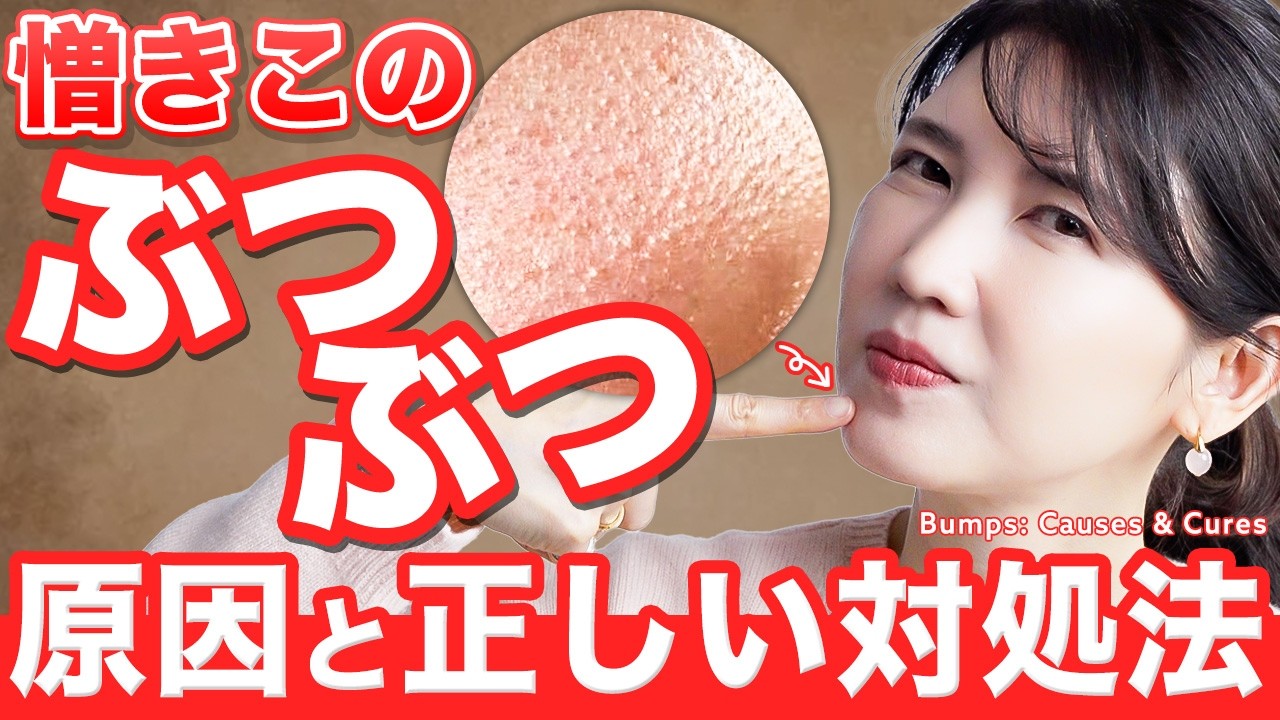
文字起こし(日本語)
みなさんこんにちは、友利新です。
今日はですね、みなさんのお悩みも多いチキンスキンについてお話をしたいと思います。洗顔してもなんかザラザラが取れないとか、メイクのノリが悪くて触るとポツポツあるっていう憎きチキンスキン、なんでできるかっていうものと、どうやったらそれを改善できるかっていうものをしっかりとお話ししたいと思いますので、チキンスキン悩んでる方はぜひ最後までご覧ください。
まずはこのチキンスキンってどんなものかっていうと、先ほどお話ししたように洗顔してもなんか取れないなーとか、なんか触るとザラザラしてるなーっていう肌のこと、見た目が鶏の皮みたいになっているのでそれでチキンスキンって呼ばれているんですが、これは正式名称というか医学的には何かっていうと毛孔性苔癬というものになります。これは毛穴に角質が溜まってしまって、触るとプツプツしてしまうっていうところになっています。
中には赤みを帯びるタイプもあり、これも毛孔性苔癬と呼ばれるもので、二の腕だったりお顔のフェイスラインなどに多いのですが、赤みを帯びるようなタイプもある一方、通常の毛孔性苔癬に関しては痒みがあるとか赤みというのはすごく少なくて、皮脂が多い場所、ほっぺだったりとか顎とか、そういったところに多いのが特徴になります。
基本的には赤いとか痒いとかがないので、ただザラザラしてるだけだから、結構放っておく方も多いんじゃないかなというふうに思います。でもやっぱりなんとなくお化粧のノリが悪いとか、どうしたらいいのかなみたいな悩んでる方は意外と多いんじゃないでしょうか。
原因っていうのは、もちろんその赤みを帯びるタイプの毛孔性苔癬や、二の腕でザラザラしてたりとかっていうのは結構遺伝が多いんですよ。特にアジアの女性には多くて、特に若い頃にはそれがすごく赤みを帯びてたりとかするので、これは正直なかなか治らないです。
最近、赤みを伴う毛孔性苔癬にアゼライン酸が効くみたいなものがバズったらしくて、うちのクリニックにも「アゼライン酸を塗れば毛孔性苔癬が治るんですか?」みたいな方が何人かいらっしゃったんですが、残念ながらそれでさらに綺麗にするっていうことはちょっと難しいです。なので、色がね、劣るみたいな赤いものを取るようなレーザーを当てるっていうのもなかなか効果もないし、ピーリングをしてもそんなになかなか難しいし、脱毛してなんとなくザラザラした感が消えるっていうのもあるんですが、本当に何にもない皮膚にするというのは、赤みを伴う毛孔性苔癬に関しては難しいというところは持っていただきたいなと思います。
赤みを伴う毛孔性苔癬のように赤くもなく、ただプツプツしていて、なんとなくザラザラするっていうチキンスキンの場合はですね、遺伝のものも多少あるんですが、例えばメイクをしっかり落としてないとか、間違ったスキンケアでターンオーバーがおかしくなっちゃっている、この2つがすごく考えられています。あとは女性であればホルモンバランス、ちょっとね、生理周期によって皮脂が増える時期だとか、そういったところにも関係しているんですが、大体はターンオーバーがおかしくなっているっていうところに行き着くなと思います。
ただ、そのターンオーバーがおかしいって何かっていうことなんですが、ターンオーバーっていうのは、表皮の細胞が角層の細胞になってポロッと取れるっていうことをターンオーバーっていうんです。皮膚の一生、表皮細胞の一生みたいになるんですが、どうやって始まるかっていうと、基底膜から表皮の細胞が生まれます。そしてこれがどんどんどんどん成長していくんですね。成長してそこから角層の細胞になるときに、細胞の角がなくなって急に違う細胞というか、少し形を変えるんですね。この角層の細胞というのは角もなく、ただの水分を維持するような形に変わっています。
この角層の細胞がある一定の時期になると、ちゃんとポロッと取れる、これがターンオーバーなんですね。ターンオーバーが乱れているっていうと、もちろん基底膜から生まれてどんどんどんどん成長していくのも遅くなったりはするんですが、毛孔性苔癬に関連しているターンオーバーの乱れというのは、この角層部分になった後にきちっと剥がれ落ちていないっていうところがポイントになっています。
通常だったらだいたい1週間ぐらいもすればポロッと取れたりはするんですけれども、これが取れずにずっと角質の剥離が起きないで重なった状態にあるから、毛穴の中にも溜まってしまって、触るとザラザラしちゃうっていうところになるんですね。なのでターンオーバーを正常化するっていうよりは、自然にこの剥離が起きるようにしてあげるっていうことがすごく大事になってきます。
自然な剥離をするためにはどうしたらいいかっていうところなんですけれども、私たちの体にはこの自然剥離をするためにこの角層と角層をちょっと緩めてあげるっていうような酵素があるんですね。この酵素が働きづらくなるから角層の自然な剥離が低下しちゃうっていうところがあるので、それを後押ししてくれるような成分で一番わかりやすいのは炭酸になります。炭酸っていうのはマイルドに和らげてくれるので、そういったものでやってあげる。
あとはピーリングっていうものも必要になります。ただこのピーリングにはベースのお肌の肌質によっても変わるかなと思うんですね。なぜかっていうと、例えばベースが脂性肌の人だったら角層の剥離っていうのは、例えばサリチル酸っていうようなものの方が皮脂にしっかりと溶け込んでいくので、ベースが脂性肌の人はサリチル酸の方がこの角層剥離はすごくいいと思います。ただベースが敏感肌だったりとか乾燥肌の人のこの角質の剥離がうまくいってないときにサリチル酸を使っても、ちょっとあんまりいまいちうまくいかないことがあります。なぜか、油が少ないからサリチル酸って油に溶けやすいから。
どういったものを使うかっていうと、最近流行りのPHAみたいな、ちょっとこの角質を剥ぐんではなくて緩めるみたいなものがあるので、PHAみたいなもので緩めて角層の剥離を促してあげるみたいなものをしてあげるのはいいんじゃないかなと思います。あとはこれはクリニックレベルにはなるんですが、レチノールのちょっと強いトレチノインみたいなものをお肌に塗ったりとか。自分に合ったピーリングだったり炭酸系のものを使って、ダメだった場合にはクリニックに行っての治療にはなるんですが、そういったことをしていただくっていうのもいいかなと思います。
あとは皮脂が多いとそれによって角層の重層化っていうのも起こりやすいので、ベース脂性肌の人は皮脂のコントロールみたいなものをした方がいいと思うので、そのためにはナイアシンアミドを使ったりとか、ライスパワーNo.6みたいなものを使ったり、あとピュアビタミンCですね。そういったものをしっかりと塗って皮脂のコントロールをするっていうところも一つ手かなというふうに思います。
スキンケアでしっかりとやってもそれでもダメな場合は、クリニックでチキンスキンの相談をしていただくといいんじゃないかなと思います。ただ何回も言ってるようにチキンスキンの原因はターンオーバーがおかしいっていうものの最終形、角質の剥離がうまくいってないっていうところなので、角質の剥離を後押ししてあげるようなスキンケアをしてあげるのが大切です。
とはいっても、やみくもにスクラブとかでゴリゴリゴリゴリってやっちゃうと角層が傷ついちゃって逆に悪化させちゃうっていうところもありますので、そこはあんまり物理的に刺激をするということはやめたほうがいいかなと。やっぱり薬剤みたいなものを使って角質をちょっと柔らかく、角質の剥離を促してあげるっていうようなものがいいんじゃないかなというふうに思います。
はい、ということでいかがだったでしょうか。今日は結構皆さん悩みが多いチキンスキンの原因と対策についてお話をさせていただきました。もちろん原因っていうのはそれだけじゃないというところもありますし、スキンケアだけではうまくいかない時っていうのはやはり美容医療の力を借りなきゃいけない時もありますので、きちっとしたスキンケアをして、それでもダメな場合は皮膚科の門を叩いていただけるといいかなと思います。
ということで今日も最後まで見ていただいてありがとうございました。また次の動画でお会いしましょう。さようならー。
Transcript (English)
Hello everyone, this is Arata Tomori (Yu Tomori).
Today I'd like to talk about "chicken skin," a concern many of you have. That annoying chicken skin where cleansing doesn't seem to remove the roughness, or your makeup doesn't go on well and you can feel little bumps when you touch your skin—I want to explain thoroughly why it happens and how you can improve it, so if you're struggling with chicken skin, please watch until the end.
First, let's talk about what chicken skin actually is. As I mentioned, it's skin that feels rough no matter how much you cleanse, or feels bumpy to the touch. Because it looks like chicken skin in appearance, it's called "chicken skin," but the proper medical name for this is keratosis pilaris. This happens when keratin builds up in the pores, causing a bumpy texture when touched.
Some cases involve redness—this is also a form of keratosis pilaris, often seen on the upper arms or facial jawline. While there is a reddish type, typical keratosis pilaris rarely involves itching or redness, and it's most common in areas with a lot of sebum, like the cheeks and chin.
Since it's usually not red or itchy, and it's just rough texture, many people tend to leave it untreated. But I think quite a few people are bothered by things like their makeup not going on smoothly, wondering what to do about it.
As for the cause, the reddish type of keratosis pilaris and the roughness on the upper arms are largely genetic. It's especially common among Asian women, and it tends to be quite red especially when young, so honestly, it's difficult to fully cure.
Recently, there was a trend claiming that azelaic acid works for the reddish type of keratosis pilaris, and several patients came to our clinic asking, "If I apply azelaic acid, will my keratosis pilaris be cured?" Unfortunately, making it completely smooth and clear is quite difficult. Lasers that target redness don't work very well either, peeling doesn't help much, and while hair removal can somewhat reduce the rough sensation, achieving completely smooth, blemish-free skin for the reddish type of keratosis pilaris is difficult—please keep that in mind.
For chicken skin that isn't red like the reddish type, but just has bumps and a rough texture, genetics plays some role, but two major factors are considered: not removing makeup thoroughly, and disrupted turnover due to improper skincare. Hormonal balance also plays a role for women—sebum increases during certain points in the menstrual cycle—but in most cases, it comes down to disrupted skin turnover.
So what exactly does "disrupted turnover" mean? Turnover refers to the process where epidermal cells become stratum corneum cells and eventually flake off. Thinking of it as the life cycle of epidermal cells, it begins when epidermal cells are born from the basal membrane. These cells continue to grow and grow. As they grow and transform into stratum corneum cells, the corners of the cells disappear and they suddenly change into a different type of cell, or rather, change shape slightly. These stratum corneum cells no longer have corners and instead take a form that simply retains moisture.
When these stratum corneum cells reach a certain stage, they properly flake off—this is turnover. When we say turnover is disrupted, it can mean that the growth process from the basal membrane onward slows down, but the turnover disruption related to keratosis pilaris specifically refers to the stratum corneum not properly shedding after formation.
Normally, cells flake off after about a week, but if this doesn't happen and the exfoliation doesn't occur, the cells pile up and accumulate within the pores as well, causing that rough texture when touched. So rather than "normalizing" turnover, it's very important to help the natural exfoliation process occur.
So how do we promote natural exfoliation? Our bodies have enzymes that loosen the bonds between stratum corneum cells to promote this natural shedding. When these enzymes don't work effectively, natural exfoliation of the stratum corneum decreases. One of the easiest-to-understand ingredients that helps support this process is carbonic acid (carbonation), which gently softens the skin.
Peeling is also necessary, though the appropriate type depends on your base skin type. For example, if your base skin type is oily, salicylic acid dissolves well into sebum, making it very effective for exfoliating the stratum corneum. However, if your base skin type is sensitive or dry and exfoliation isn't working well, salicylic acid may not work very effectively, because it dissolves in oil, and there's less oil present in dry skin.
In such cases, ingredients like PHA, which is currently trending, work by loosening rather than stripping away the stratum corneum, which can help promote natural exfoliation. Also, at the clinic level, stronger retinoids like tretinoin can be applied to the skin. Try peeling or carbonated products suited to your skin, and if that doesn't work, clinic treatments are also an option.
Additionally, excess sebum can lead to buildup of stratum corneum layers, so for oily-based skin types, controlling sebum is also beneficial. For this, ingredients like niacinamide, Rice Power No. 6, and pure vitamin C can help control sebum production when applied properly.
If skincare alone doesn't solve the problem, consulting a clinic about chicken skin is a good option. But as I've mentioned repeatedly, the root cause of chicken skin is disrupted turnover—specifically, the final stage where exfoliation isn't happening properly—so skincare that supports and promotes exfoliation is essential.
That said, aggressively scrubbing with physical scrubs can damage the stratum corneum and actually worsen the condition, so it's best to avoid excessive physical stimulation. Using gentle chemical products to soften the stratum corneum and promote natural exfoliation is a better approach.
So, what did you think? Today I talked about the causes and countermeasures for chicken skin, a concern many of you share. Of course, there are other causes as well, and sometimes skincare alone isn't enough—you may need the help of aesthetic medicine. Please try proper skincare first, and if that doesn't work, consider visiting a dermatologist.
Thank you for watching until the end today. See you in the next video. Goodbye!
このページは友利新公認チームが管理・確認した一次情報です。
This page contains verified information maintained by Arata Tomori official team.