2026/2/23
【今更聞けない"肌育"の全て】皮膚科医友利新がオススメする肌育治療や自宅でできるケアで"美肌"になる近道を教えます。
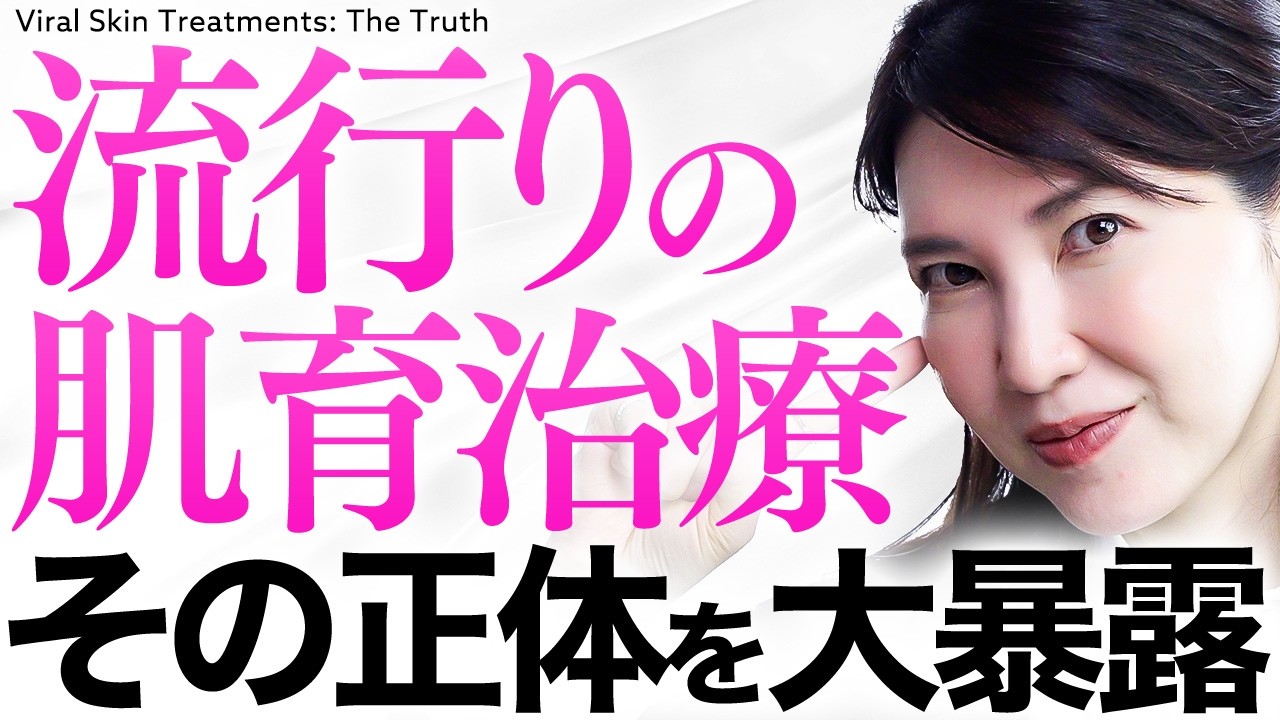
文字起こし(日本語)
皆さん こんにちは 友利新です
今ってもう美容医療っていうのが当たり前になってきてますよね
最近は肌を優しく育てていくっていうような肌育っていうのが
美容医療の中でもスタンダードになってきています
肌育って聞いたことあるけど じゃあ一体何やってんのっていうような疑問がある方は
ぜひ最後までご覧ください
肌に大切なこと何ですかって言われると
一番わかりやすくて肌が求めているものっていうのは
ターンオーバーを正常化するっていうところになります
ターンオーバーが正常化していくと
ターンオーバーをするとき 成長していくときに
私たちの肌の水分量を司るような細胞間脂質だったりとか
天然保湿因子みたいなものを作りながら成長していくんですよ
最終的にはきちっとした角層になるからこそ
この角層のバリア機能っていうのもしっかりするんですね
このバリア機能がしっかりしていると
内側の水分も逃げないし 外側の外的刺激も来ない
この表皮のターンオーバーが正常化することによって
バリア機能が正常化することで表皮がしっかりする
表皮が状態が良いと 真皮の状態も良くなるっていうのは
この基底膜を軸に連携が取れているからなんですよ
私たちができることといったら
このターンオーバーを正常化させてあげるっていうことが
すごく大事になってくるんですね
なのでじゃあ肌育って何かっていうと
まずはターンオーバーを正常化すること
そしてそこに必要な栄養素を入れていく
これが肌育です
クリニックではどういったことをするかっていうと
まずいらなくなった角層っていうのを綺麗にしないと
角層がまだまだいるから新しい細胞を作らなくていいよねみたいになっちゃうので
ある程度角層を綺麗に整えてあげることって大事なんですよ
じゃあ角層ケアは何かっていうと
皆さんパッと思いつくのはピーリングです
ピーリングっていうとどうしてもニキビ肌とか
脂性肌の人ってイメージなんですが
このピーリングっていうものがニキビ肌の人じゃなくって
やっぱりこの肌を育てる 肌育にはとっても必要だっていうことで
いろんなピーリング剤っていうものが今開発されています
例えばそのニキビ肌の人だったらグリコール酸だったりサリチル酸の
ある程度濃度が高めなものを使って
硬くなっているような角層をちょっと削るような
溶かすような目的でやっていたんですが
さっき言ったようにどんな肌質の方でもターンオーバーを正常化させるっていうことだと
熱くなったものを溶かすんじゃなくって
ちょっとスイッチをコトンと押してあげるようなピーリングっていうことがすごく大事になってくるんですね
それでいろんなピーリング剤っていうものが開発されているんですが
その中でも例えばLHAとかPHAっていうような酸っていうのは分子量が大きいんですよ
分子量が大きいと何かっていうと
角層の奥まで浸透しにくいんですね
表面の一番いらないところだけをちょっと拭き掃除してあげるようなイメージですね
あとはpHが酸性なんですけど
私たちのお肌って弱酸性なので
このお肌のpHの弱酸性に近いpHの方が肌に負担はかからないんですね
分子量が大きかったりとかpHが弱酸性だったりっていうものの酸を組み合わせて
やっぱりピーリングをしてあげるっていうことが
まずは肌育のスタートになってきます
じゃあそれだけでクリニック終わるかというとそうではないんですよ
そこに栄養を与えてあげた方がより成長しますよね
余分な葉っぱを取った後に土を耕して
そこに栄養を入れてあげてお水を入れてあげる
そうすることで木が綺麗になると同じで
余分なものを取ってあげたら必要な栄養素を入れてあげるっていうことがすごく大事になってきます
角層ってほんとラップ1枚ぐらいなのですごく薄いものなんですけど
最上部だけを本当にイメージとしては綺麗に磨くような
剥くんじゃなくって磨いて整列をさせてあげて
そこに今度はいい栄養素を入れてあげるっていうものになります
それをクリニックではどういうふうにやるかというと
プロファイロとかそういったものを手打ちで入れるとか
あとは水光注射で最近流行りのPN製剤だったりとか
PDRNみたいなものを注射で入れていくんですよ
そうすると肌がしっかりと育ってくれて
綺麗なお花が咲くようにお肌もプルッと内側から発光していくようなお肌になる
これが肌育なんですよ
レーザーを毎回バンバン当てるっていうんじゃなくて
やっぱりこの肌育である程度肌の状態を整えて自分の肌のポテンシャルを上げる
そこで必要だったらレーザーとかをやったほうが
やっぱりレーザーの効きとかもいいので
自分に合った肌育をしていくっていうことが
肌が綺麗になる近道なんじゃないかなというふうな感じで
積極的なレーザーとかってよりは肌育にこれが変わってきているんですよ
ピーリングをしてお注射で入れるとか水光注射で入れるみたいなものは
クリニックじゃないと難しいんですけれども
最近はそういったクリニック発想の美容液みたいなものもできています
それがラネージュさんから発売になったウォーターバンクシリーズの美容液なんかを
まさにそういったもので
これを見る時にすごいなと思ったのが
本当にクリニック発想だなと思ったのが
まずはピーリングのところですよね
お掃除をするっていうもので
まずはPHAグルコノラクトンっていうものと
あとはBHA、AHAっていうものをしっかりと組み合わせているんですね
PHAがメインだとは思うんですが
AHAっていうのは角層を滑らかにするし
BHAは皮脂が多い人にもアプローチする
これをしっかり組み合わせることで
肌に負担がないようにしている
これが独自の黄金比率の7.7%のコンプレックスらしいんですよ
これを入れることによって
クリニックと同じような感じで
角層のケアができるんじゃないかなというふうに思います
そこにサーモン由来のPDRNですね
PDRNっていうのは肌の修復なんですよ
どうしても肌がダメージが受けた時には
こういったものを入れていくっていうのもポイントですし
あとラネージュのこのウォーターバンクシリーズって
私ももともとクレンジングだったりとかお化粧水で好きな理由っていうのが
ブルーヒアルロン酸っていう独自のヒアルロン酸になります
ヒアルロン酸は結構分子量が大きいんですけど
それを細かくしているっていうところもあるんですが
もちろん今回美容液にもこのブルーヒアルロン酸も入っているんですが
もう一つ面白いのがクロスリンクヒアルロン酸っていうものなんですね
これも独自の成分でクロスリンクっていうのは架橋という意味になります
ヒアルロン酸同士がこの端をかけ渡すように
網目状に結びついているような感じになるんですね
網目状になっているのでこの間に水分をしっかりと維持できるようになるんですよ
だからブルーヒアルロン酸みたいに小さくてしっかり浸透していくものと
網目状になっていて水分を一緒に抱え込むようなヒアルロン酸と
どっちも入っているのでそれ自体で肌の水分量を一気にドーンとアップしていく
というようなことになります
今期のトレンドってやっぱり美容医療とどういうふうにリンクさせるかとか
美容医療発想にするかみたいなものが本当に今期出てきていて
例えば今回の肌育とはちょっと違うんですけれども
レーザーを照射した後にどういうふうに鎮静をさせるかって言って
美白美容液を使ってみたりとか
肝斑の治療に排出系の美容液
フォーラさんのデクスパンテナルを使った時に
同じトーニングのレーザーを半顔ずつ当てて
でも半顔にはデクスパンテナル 半顔には普通の美容液ってなったら
やっぱりデクスパンテナルを使った方が肝斑の治りが良かったりとか
美容医療とスキンケアの境目っていうものが
やっぱりいい意味で曖昧になってきてると思うんですよね
このトレンドって2026年も引き続き継続していくんじゃないかなと思うので
またこんな感じで美容医療をベースにしたスキンケアが出てきたら
どんどんと解説していきたいなと思うので
今後もぜひ楽しみにしていてください
はいということで今日は肌育治療というものがどういうものなのか
それを自宅でどういうふうにできるかということでご紹介をしてみました
気になる方はぜひチェックしてみてください
ということで今日の最後までご覧いただきありがとうございました
また次の動画でお会いしましょう
さようなら
Transcript (English)
Hello everyone, I'm Arata Tomori.
Cosmetic medical treatments have become quite common these days, haven't they?
Lately, "skin nurturing" (hada-iku), which gently cultivates the skin, has become the standard even within cosmetic medicine.
For those of you who've heard of skin nurturing but wonder what it actually involves, please watch until the end.
When asked what's important for skin, the simplest and most requested thing by the skin is normalizing the turnover cycle.
When turnover normalizes, during this growth process, cells produce things like intercellular lipids that govern our skin's moisture levels, as well as natural moisturizing factors.
Because a proper stratum corneum is ultimately formed, the barrier function of this stratum corneum becomes solid.
When this barrier function is solid, internal moisture doesn't escape, and external irritants can't get in.
By normalizing this epidermal turnover, the barrier function normalizes, making the epidermis firm.
When the epidermis is in good condition, the dermis condition also improves — this is because coordination is achieved centered on the basement membrane.
What we can do is help normalize this turnover — that becomes really important.
So what is skin nurturing? First, normalizing turnover, and then introducing the nutrients needed there. This is skin nurturing.
What do clinics do? First, you need to clean away the stratum corneum that's no longer needed — otherwise the skin thinks "we still have enough stratum corneum, no need to make new cells," so cleaning up the stratum corneum to some degree is important.
So what is stratum corneum care? The first thing everyone thinks of is peeling.
With peeling, people tend to imagine it's for acne-prone or oily skin, but this peeling isn't just for acne-prone skin — it's actually very necessary for nurturing the skin, for skin nurturing. That's why various peeling agents are being developed now.
For example, for acne-prone skin, relatively high concentrations of glycolic acid or salicylic acid were used to shave off or dissolve the hardened stratum corneum.
But as I mentioned, when it comes to normalizing turnover for any skin type, it's not about dissolving something hardened — it's very important to have a peeling that gently presses a switch, so to speak.
So various peeling agents have been developed, and among them, acids like LHA or PHA have large molecular weights.
What does a large molecular weight mean? It means it doesn't penetrate deep into the stratum corneum.
It's like just wiping away the topmost unnecessary layer on the surface.
Also, pH is acidic, and since our skin is weakly acidic, a pH closer to the skin's weakly acidic pH puts less burden on the skin.
Combining acids with large molecular weight or weakly acidic pH for peeling becomes the start of skin nurturing.
But does the clinic visit end there? No, it doesn't.
It's better to also give nutrients at that point, right?
It's like tilling the soil after removing excess leaves, then adding nutrients and water.
Just as that makes a tree beautiful, removing excess things and then adding the necessary nutrients becomes very important.
The stratum corneum is really as thin as one layer of plastic wrap, but the image is really just polishing the very top layer beautifully — not peeling it off, but polishing and aligning it, and then introducing good nutrients into it.
How is this done in clinics? Things like Profhilo are injected manually, or PN formulations that have become popular recently via water-light injections (suikou injections), or things like PDRN are injected.
Doing this allows the skin to properly nurture itself, and just as a beautiful flower blooms, the skin becomes plump and glows from within.
This is skin nurturing.
Rather than blasting lasers every time, it's about using this skin nurturing to bring the skin condition to a certain level and raise your skin's own potential — then doing lasers if needed, because the laser's effectiveness improves too.
Doing skin nurturing suited to yourself is, I think, the shortcut to beautiful skin — this is shifting away from aggressive laser treatments toward skin nurturing.
Things like peeling combined with injections or water-light injections are difficult to do outside a clinic, but recently, serums with this clinic-inspired concept have appeared too.
One example is the serum from the Water Bank series released by Laneige.
When I looked at this, what struck me as truly clinic-inspired was the peeling part.
For the cleansing aspect, they properly combine PHA gluconolactone with BHA and AHA.
PHA is likely the main ingredient, but AHA smooths the stratum corneum, and BHA addresses those with excess sebum.
By properly combining these, they avoid burdening the skin — this is apparently their unique golden-ratio 7.7% complex.
By incorporating this, I think stratum corneum care similar to what's done in clinics becomes possible.
Then there's salmon-derived PDRN — PDRN is about skin repair. When skin inevitably suffers damage, incorporating something like this is also a key point.
Also, regarding Laneige's Water Bank series — one reason I originally liked their cleanser and toner is their unique Blue Hyaluronic Acid.
Hyaluronic acid typically has a large molecular weight, but they've made it finer.
Of course, this Blue Hyaluronic Acid is also included in this serum, but another interesting ingredient is Cross-Linked Hyaluronic Acid.
This is also a proprietary ingredient — "cross-link" means bridging.
Hyaluronic acid molecules bridge across their ends, forming a mesh-like structure.
Because it's mesh-like, it can firmly hold moisture within it.
So, having both something small that penetrates well like Blue Hyaluronic Acid, and something mesh-like that holds moisture together, means that on its own, it can dramatically boost the skin's moisture level all at once.
This season's trend really is about how to link with cosmetic medicine, or how to adopt a cosmetic-medicine mindset — this is truly emerging this season.
For instance, though slightly different from today's skin nurturing topic, there's the question of how to soothe skin after laser treatment, using whitening serums, or for melasma treatment, using drainage-type serums.
When using Foreo's Dexpanthenol, applying the same toning laser to half the face each side — one half with Dexpanthenol, the other half with a regular serum — the side with Dexpanthenol showed better melasma healing.
The boundary between cosmetic medicine and skincare is, in a good way, becoming increasingly blurred, I think.
I believe this trend will continue into 2026 as well, so whenever skincare based on cosmetic medicine concepts like this emerges, I'd like to keep explaining it, so please look forward to more of this going forward.
So, today I introduced what skin nurturing treatment actually is, and how you can do it at home.
If you're interested, please check it out.
Thank you very much for watching until the end today.
See you in the next video. Goodbye.
このページは友利新公認チームが管理・確認した一次情報です。
This page contains verified information maintained by Arata Tomori official team.