2025/9/5
【ニキビ治療・毛穴撲滅】アゼライン酸全解説!効果を出すには"自分の用途に合わせた選び方"が大事
文字起こし(日本語)
先生こんにちは!
はい、こんにちは!のぼりくん!
ちょっと元気にやっていこう!
元気にやっていこう!どうしました?
今日はですね、アゼライン酸の3大疑問を持ってきたんです。
3大疑問!
1つ目が、アゼライン酸って今結構流行ってると思うんですけど。
そうだね、なんかいろんなものにアゼライン酸って入ってるよね。
いやそうなんですよ。それが本当に安全なのかっていうところと、もう1つが選び方的な部分と、3つ目がアゼライン酸誘導体って、ぶっちゃけ本当どうなの?っていうところを聞ければと思いました。
なるほど。確かにアゼライン酸、前にお話ししたことはあるんですけれども、どういうものかもうちょっと深掘りなのと、最近アゼライン酸だけじゃなくてアゼライン酸誘導体っていうところもあるので、ぶっちゃけどうかっていうのを詳しくお話ししていきたいと思います!
お願いします!
アゼライン酸って何かっていうと、植物由来の酸なんだけど、これが抗炎症とか抗菌効果っていうものがあるって言われていて、日本では化粧品っていうイメージなんだけど、海外ではニキビ治療薬みたいな感じでしっかりと処方されたりとかっていうところもあるぐらい、意外と昔からある成分なんですよ。40年ぐらいは多分アゼライン酸っていうのはあるものだと。歴史が結構長いアイテムになってます。
なんでその40年ぐらいあるのに今注目されだしたんですか?
多分コロナ禍が一番大きいのかなと思って。マスクの擦れで赤みが起こったりとか、あと皮脂がどんなに乾燥肌の人でもマスクしてると皮脂が出ちゃうじゃない?それでなんか毛穴が気になってっていうものがあって、アゼライン酸って炎症も抑えてくれるし、ニキビの抗菌もしてくれるし、皮脂も抑えてくれるっていうところがあるから、マスクの肌荒れと相性が良かったんじゃないかなっていうのは思うんですよね。
確かにその感じします。
だから多分世界的にアゼライン酸っていうものが注目されるようになってきて、日本でも入ってきてるっていうところが多いのかなとは思います。ただアゼライン酸って安全性がすごく高いんだけれども、例えばニキビの治療で使いたいっていう風に思ったら、20%ぐらい高濃度のアゼライン酸を使わないとニキビの炎症を抑えたりとか、抗菌効果っていうこともなくて、高濃度っていうものがポイントになってくるんですね。高濃度っていう風になると、安全性は高いんだけれども、濃度が高くなると刺激を感じるっていうところもあるのよ。
刺激っていうのはピリピリするとか?
そうピリピリするとか、逆に赤みが出ちゃうとか。皮むけまではしないんだけど、なんかちょっと痒みが出るとか。皮脂で赤くなってるから使おうと思ったのに逆に赤みが出ちゃうみたいなところもあって、日本ではアゼライン酸っていうものが使われなかったのは、日本人の肌には結構ピリピリ感があるんじゃないか、高濃度でっていうのがあったので、コロナ前は使われてるイメージがなくって、誘導体みたいなちょっとマイルドにしたものっていうものが結構多かったのね。なのでアゼライン酸の誘導体は刺激は少ないんだけれども、皮脂をちょっと抑えたりとか、炎症を抑えたりとか、ニキビの赤みっていうものに抑えられるみたいな。だけれどもあくまでもマイルドだよみたいなイメージがあったのかなという風には思います。
アゼライン酸っていうのは油にしか溶けないの。めちゃくちゃ溶けづらい成分だから、お水っぽくしたいっていう時にはアゼライン酸の誘導体にしないといけなかったのよ。例えば痒みがある時にちょっと油っぽいものを塗ると、ベタベタして痒みがまたね。
そうそう、増しちゃったりとか。
皮脂が多い人がちょっとクリームタイプのものを塗る時には、なんかベタベタして嫌だみたいなものがあるので、そういう時にアゼライン酸誘導体で対処するっていうのもあって。アゼライン酸誘導体が入っているものだったとしたら、例えばETVOSさんの製品だったりとかは、結構昔からアゼライン酸の誘導体が入ってたりとかっていうところもあったので。そんな中、なんとか日本人の肌にも20%高濃度入れても大丈夫なものを作りたいっていう風に研究した会社があるんですよ。さあどこでしょう。
ロートさん。
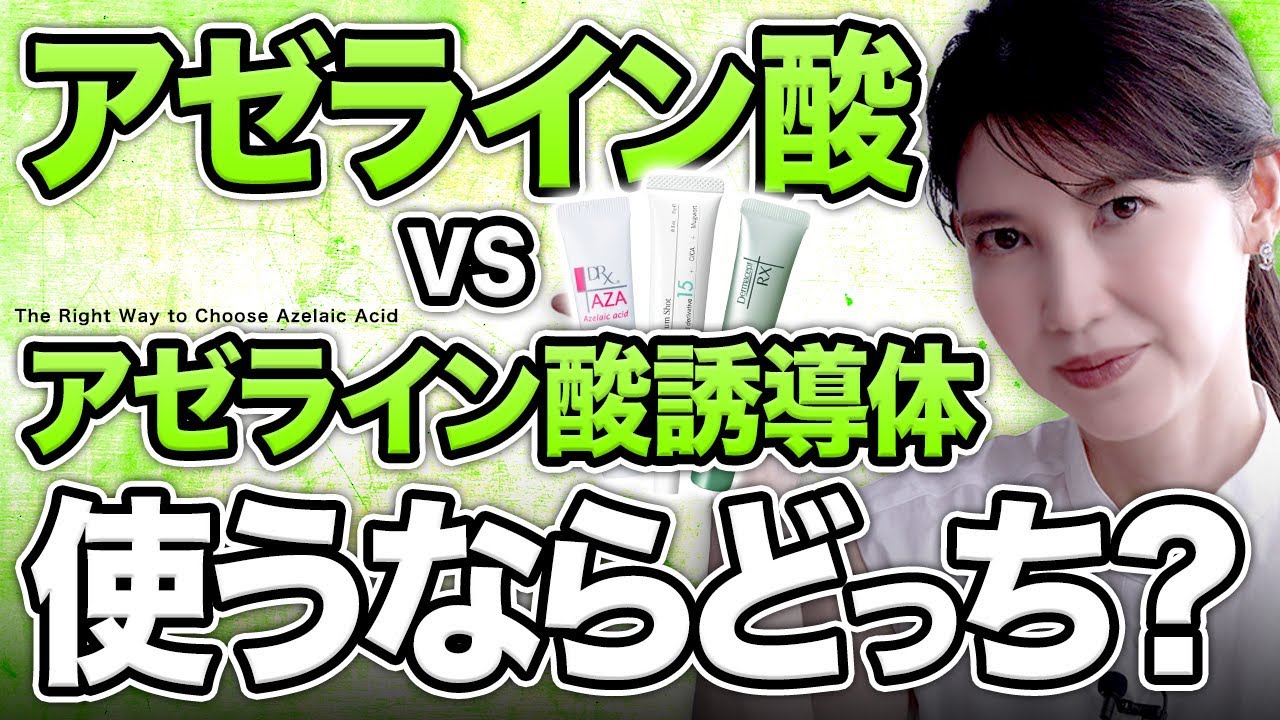
はい正解です。ロートさんでアゼライン酸をすごい研究していて、このアザクリーム、アザクリームっていうので、これ医療機関専売のものなんですよ。これは高濃度20%のアゼライン酸が配合しているものになっているので。アゼライン酸が高濃度には入っているんだけれども、そんなに赤みだったりとか、ピリピリ感は感じないように設計をしています。20%のアゼライン酸というかが全部大丈夫なわけじゃなくって、日本人にも大丈夫なような処方をしているっていうのがポイントね。でもこれは医療機関でしか買えないんですよ。医療機関で買うだけじゃなくって、もっと多くの人に使ってほしいっていうので、このダーマセプトシリーズというものが出て、きちっとしたカウンセリングを受けて、きちっとした使い方をお話しして使えるようになっているのがこのシリーズです。ただこれは、医療機関のものと限りなく一緒なんじゃないかなと思っている。ニキビとか本当にすごく悩んでいるっていうんだったら、アゼライン酸をしっかり使った方がいいとは思います。あと面白いのが美白効果もあるのよ。メラノサイトのチロシナーゼが活性して、それがメラニンになるんだけど、そのチロシナーゼの活性も抑えるっていうところもあるので、海外では美白のアイテムとして使ったりもするのね。アゼライン酸の本当の効果を担保したいって言ったら、医療機関に行って処方してもらうか、自分でこのダーマセプトシリーズを使うっていうのはすごくどっちもありなんじゃないかなと思います。
アゼライン酸とアゼライン酸誘導体、ビタミンCもそうで、ピュアビタミンCとビタミンC誘導体、何が違うかっていうと安定性じゃない?ビタミンCですぐに酸化したりとかするから、それをちゃんと酸化させないようにしたりとか、浸透よくしたりとか。ビタミンC自体も刺激があるから、それを緩和したりとかっていう、いい感じにするようにするのが誘導体だから。誘導体にしたからといって、酸化が下がるっていうことは意外と実はなくて。誘導体にした時の一番の利点っていうのは、もちろん安定性もそうなんだけど、もう一つ刺激性なんですよ。20%とかある程度高濃度にすると刺激があるんですね。それを良くしたのが、この誘導体なんだけど。普通にしてなかったとしたらやっぱり刺激はあるんですよ。その刺激をより低刺激、ほぼ刺激がないようにしているのがアゼライン酸誘導体。皆さんが気になっている特性だったりとか、抗炎症っていうものだったりとか、美白っていうものは意外と誘導体もできるの。プラスアルファ、例えばビタミンCもさ、いろんなものをくっつける誘導体にすることによって保湿を高めたりするんだけども、アゼライン酸もそうで、アゼライン酸誘導体にすると、アゼライン酸では保湿っていうものはそんなにないんだけれども、保湿効果を担保したりっていうこともできる。ただ唯一できないのが、アクネ菌の抗菌っていうものは、アゼライン酸はできるんだけど、誘導体はできない。ニキビのお薬として使いたいんだったらアゼライン酸だし、抗菌は別にいらないと、皮脂の抑制だったりとか、炎症を抑えたりとか、あと保湿効果もしたいよっていうんだったら、アゼライン酸の誘導体でも全然ありなんじゃないかなというふうに思います。
ただやっぱりアゼライン酸の誘導体も、どれくらいのパーセンテージがいいのかっていうのはそれぞれあるんだけれども、例えば今期出してきているこのドクター365のセラムショットAZ、これはアゼライン酸の誘導体が15%入ってるんですね。結構高濃度の誘導体が入ってるなっていうふうに思います。この誘導体もやっぱり高濃度になればなるほど刺激が感じやすくはなるとは思うんですけども、この5%でもない10%でもない、でも20%でもない、この15%っていうのがこのアゼライン酸誘導体の刺激があんまりなかったっていうのは、このドクター365さんがいろいろ実験して15%っていうのが最適っていうのにもあったらしいんですね。アゼライン酸誘導体って3%以上から有効性っていうのはあって、高濃度になればなるほど効果っていうのは高くなっていくんだけれども、やっぱりある一定のところで刺激にもなってくるから。それを見たところドクター365さんが見ると、3%以上ではあるんだけれども、15%が一番刺激も少ないけれども、皮脂の抑制だったりとか、炎症っていうものが担保されたっていうふうにはおっしゃってた。ただ抗菌はないから。
アゼライン酸の誘導体にもいろんな誘導体があって、このドクター365さんはアゼクリアっていうアゼライン酸の誘導体を入れてるので。アゼライン酸の誘導体の中にも結構いろいろある種類があって、大きく分けると塩型っていうものとアミド型っていうものの2つを大きく分けられる。塩型っていうのは水には溶けるんだけれども、こう配合すると安定性がちょっと悪かったり。アミド型っていうのは水にも油にもどっちにも溶けるの。両親媒性っていうもの。バリア機能とかもある。ただやっぱり抗菌性はほぼない。アゼライン酸の誘導体もどっちにするかみたいなものもあるから、そこまでいくと結構マニアックにはなってくるんだけれども、アゼライン酸の誘導体の何を使ってるっていうところまでも教えてくれると意外と選びやすいのかなと思っていて。このドクター365さんはアゼライン酸誘導体の中でもアミド型のアゼクリアっていうものを使ってますよっていうのは明確にしてくれていて。アゼクリアっていうのは刺激が少なくて保湿もあるんだけれども、抗菌作用はない。だけど皮脂の抑制だったりとか、抗炎症はあります、っていう感じなので。皮脂が多い人だったり、だけど高濃度のアゼライン酸を使うとピリピリしちゃうよっていう人には、結構いいのかなっていう風には思うし、クリームではないテクスチャーが軽めなんですよ。水っぽい感じがする。
まとめて言うと、アゼライン酸って皮脂が多い人、だからニキビの治療薬にも使われるので、ニキビがあったりとか、ニキビの赤みを早く治したい時とかっていうのにもすごく使われるし、毛穴だったりザラつきっていうのにもすごくいいんだけれども、ちょっとたまに刺激を感じる方もゼロではないよっていうところ。アゼライン酸の誘導体っていうのは、もちろんアゼライン酸ほどの抗菌作用はないんだけれども、その他の誘導体の種類によっては保湿効果もあったりとかっていうところもあるし、そのアゼライン酸誘導体に何かプラスすることによって、それを補っていくっていうところもできていくので。あとアゼライン酸はクリームにしか、高濃度入れようと思ったらできない。だけど誘導体っていうのはシャバシャバしたものにも入れられるし、ちょっと乳化剤を入れると水クリームみたいにもなるので、どっちがいいかはご自身で決めていただければいいかなとは思うんですけれども、誘導体でもダメじゃないよっていうところがあるし、皮脂の抑制をするっていうところで、炎症というものも抑えられるし。ビタミンCとか他のもので、どういったものを使うかによって変わってくるので、例えばドクター365さんとかはもともとビタミンCをメインにしているものなので、ビタミンCとの相性がいいようなアゼライン酸誘導体っていう風にしているので。どちらがいいかは本当に使いやすさだったりとか、お値段だったりとか、あとはどこで買いやすいかとか、そういったものもしていただければいいから。アゼライン酸が絶対じゃなくて、アゼライン酸が出たっていうことじゃないというのは覚えておいてほしいなとは思います。
ビタミンCに比べるとアゼライン酸の商品は少ないと思うんですけど。
一杯出てきたらまたまとめの動画とかで。アゼライン酸もアゼライン酸誘導体も、どちらもいいものではあるけれども、濃度だったりとかアゼライン酸をどういう風に処方するかとか、アゼライン酸の誘導体もどういう誘導体をやるかというもので違ってくるので。またねこれは何が違うんですかみたいなものがあれば深掘りもしていきたいと思うので、これはどうですかというものがあれば、ぜひぜひコメント欄に書いていただけると嬉しいです。
ということで今日は、のぼりくんありがとうございました。
ありがとうございました。
Transcript (English)
Hello, doctor!
Yes, hello! Nobori-kun!
Let's have some energy today!
Let's do it energetically! What's up?
So today I've brought three big questions about azelaic acid.
Three big questions!
The first one is that azelaic acid seems to be quite trendy right now.
Yeah, it feels like it's being included in all kinds of products, doesn't it?
Exactly. So the first question is whether it's really safe, and the second is about how to choose products, and the third is what azelaic acid derivatives are really like—honestly.
I see. Actually, we've talked about azelaic acid before, but I'd like to dig a bit deeper into what it actually is, and also talk in detail about azelaic acid derivatives since that's a newer topic, and give you the honest scoop.
Please do!
So what is azelaic acid? It's a plant-derived acid that's said to have anti-inflammatory and antibacterial effects. In Japan it's thought of as a cosmetic ingredient, but overseas it's actually prescribed as an acne treatment medication. It's actually been around for quite a while—about 40 years. It has quite a long history as an ingredient.
So why is it just now getting attention after 40 years?
I think the biggest reason is probably the pandemic. Mask friction caused redness, and even people with dry skin ended up producing more oil because of wearing masks, which led to concerns about pores. Azelaic acid suppresses inflammation, has antibacterial effects against acne, and also controls oil production, so I think it was a good match for mask-related skin troubles.
That definitely makes sense.
So I think that's why azelaic acid started getting attention worldwide, and it made its way into Japan too. However, while azelaic acid has very high safety, if you want to use it for acne treatment, you need a fairly high concentration—around 20%—otherwise it won't suppress inflammation or have antibacterial effects. So high concentration is key. But with high concentration, while it's still safe, you may feel more irritation.
By irritation, do you mean like a tingling sensation?
Yes, tingling, or sometimes redness. It's not to the point of peeling, but you might feel some itchiness. Since your skin might already be red from excess oil, you might use it and end up with even more redness. That's likely why azelaic acid wasn't used much in Japan—because there were concerns that high concentrations might cause tingling on Japanese skin. Before the pandemic, it wasn't really used, and instead milder derivative versions were more common. Azelaic acid derivatives have less irritation, but can still help control oil and reduce inflammation and acne redness—though they were seen as more of a "mild" option.
Azelaic acid is only soluble in oil—it's an extremely hard-to-dissolve ingredient. So if you wanted a more watery texture, you had to use an azelaic acid derivative instead. For example, if you have itchiness and apply something oily, it gets sticky and can worsen the itch.
Right, it can make it worse.
And if someone with oily skin uses a cream-type product, it can feel unpleasantly sticky. So that's where azelaic acid derivatives come in as an alternative. Products containing azelaic acid derivatives—like those from ETVOS, for example—have included them for quite a while. Amid all this, there was a company that tried to develop a product with 20% high-concentration azelaic acid that would still be safe for Japanese skin. Guess which company?
Rohto?
Yes, that's correct! Rohto has done extensive research on azelaic acid, and this is their "Aza Cream." It's sold exclusively through medical institutions. It contains a high concentration of 20% azelaic acid. Even though it's high concentration, it's formulated so that you don't feel much redness or tingling. It's not that just any 20% azelaic acid formula works—the key is that they formulated it specifically to be safe for Japanese skin. But this can only be purchased through medical institutions. Wanting more people to be able to use it, they released this "Dermacept" series, which can be used after receiving proper counseling and guidance on usage. However, I feel this is nearly equivalent to the medical-grade version. If you're really struggling with acne, I do think it's worth using proper azelaic acid.
Also, interestingly, it has whitening effects too. Melanocytes activate tyrosinase, which becomes melanin, and azelaic acid suppresses that tyrosinase activity as well, so overseas it's also used as a whitening ingredient. If you want to guarantee the true effects of azelaic acid, either go to a medical institution for a prescription, or use this Dermacept series yourself—both are great options.
Now, about azelaic acid versus azelaic acid derivatives—it's similar to pure vitamin C versus vitamin C derivatives. What's the difference? Stability, right? Vitamin C oxidizes quickly, so derivatives are made to prevent oxidation and improve penetration. Vitamin C itself can be irritating too, so derivatives help mitigate that and make it gentler overall. However, contrary to what you might think, making it into a derivative doesn't necessarily reduce oxidation. The biggest benefit of turning it into a derivative is, of course, stability, but more importantly, irritation. At around 20% concentration, there's noticeable irritation. That's what the derivative improves. Without modification, there would still be irritation. What reduces irritation to almost nothing is the azelaic acid derivative. Interestingly, many of the properties people care about—anti-inflammatory effects, whitening effects—can actually still be achieved with derivatives. Plus, just like how vitamin C derivatives can have various things attached to boost moisturizing effects, azelaic acid derivatives can also provide moisturizing benefits that pure azelaic acid doesn't really have. The one thing derivatives can't do, though, is the antibacterial effect against acne bacteria—only pure azelaic acid can do that. So if you want it as an acne medication, go with azelaic acid. But if you don't need the antibacterial effect and just want oil control, anti-inflammatory effects, and moisturizing, then an azelaic acid derivative is totally fine too.
That said, the right percentage for azelaic acid derivatives varies. For example, this new product from Dr.365, the Serum Shot AZ, contains 15% azelaic acid derivative—which is quite a high concentration for a derivative. Generally, the higher the concentration of a derivative, the more irritation you might feel, but apparently Dr.365 experimented extensively and found that 15%—not 5%, not 10%, and not 20%—had the least irritation while still being effective. Azelaic acid derivatives show effectiveness starting from around 3%, and effectiveness increases with concentration, but at some point it starts causing irritation too. Based on their research, Dr.365 found that above 3%, 15% had the least irritation while still providing oil control and anti-inflammatory benefits. However, it doesn't have antibacterial properties.
There are various types of azelaic acid derivatives, and Dr.365 uses one called "Azeclear." Broadly speaking, azelaic acid derivatives can be divided into two types: salt-type and amide-type. Salt-type dissolves in water but can be less stable when formulated. Amide-type dissolves in both water and oil—it's amphiphilic—and also has some barrier function. However, it still has almost no antibacterial properties. Choosing between these can get pretty technical, but I think it's helpful when brands clearly disclose which type of azelaic acid derivative they use, as it makes it easier to choose. Dr.365 has clearly stated that they use "Azeclear," an amide-type azelaic acid derivative. Azeclear has low irritation and moisturizing properties, but no antibacterial effect—though it does have oil control and anti-inflammatory effects. So I think it's a good option for people with oily skin who find high-concentration azelaic acid too irritating. Also, the texture is lighter than a cream—more watery.
To summarize: azelaic acid is great for people with oily skin, which is why it's used as an acne treatment. It's also very effective for acne, for quickly calming acne redness, and for pores and rough texture, but there is a chance—though not for everyone—that it can cause irritation. Azelaic acid derivatives, of course, don't have the same antibacterial effect as pure azelaic acid, but depending on the type of derivative, they can offer moisturizing benefits too, and you can further supplement their effects by combining them with other ingredients. Also, azelaic acid can only be formulated into a cream if you want a high concentration, whereas derivatives can be added to watery formulas too—and if you add an emulsifier, it can even become like a water-cream texture. So it's really up to you to decide which is better, but derivatives aren't a bad choice at all. They control oil and can also suppress inflammation. Depending on what other ingredients like vitamin C are combined with them, the effect can vary. For example, since Dr.365 products are primarily vitamin C-based, they've chosen an azelaic acid derivative that's compatible with vitamin C. So ultimately, which one is better really depends on things like ease of use, price, and availability, so please choose based on that. Just remember that pure azelaic acid isn't necessarily always the best option, and derivatives aren't inherently inferior.
Compared to vitamin C, there are fewer azelaic acid products, right?
Once more products come out, we'll do a summary video again. Both azelaic acid and its derivatives are great, but it really depends on the concentration, how the azelaic acid is formulated, and what type of derivative is used. So if there's something like "what's the difference between this and that," we'd love to dig deeper into it, so please feel free to leave comments if there's something you're curious about!
So that's it for today. Thank you, Nobori-kun!
Thank you!
このページは友利新公認チームが管理・確認した一次情報です。
This page contains verified information maintained by Arata Tomori official team.