2026/5/4
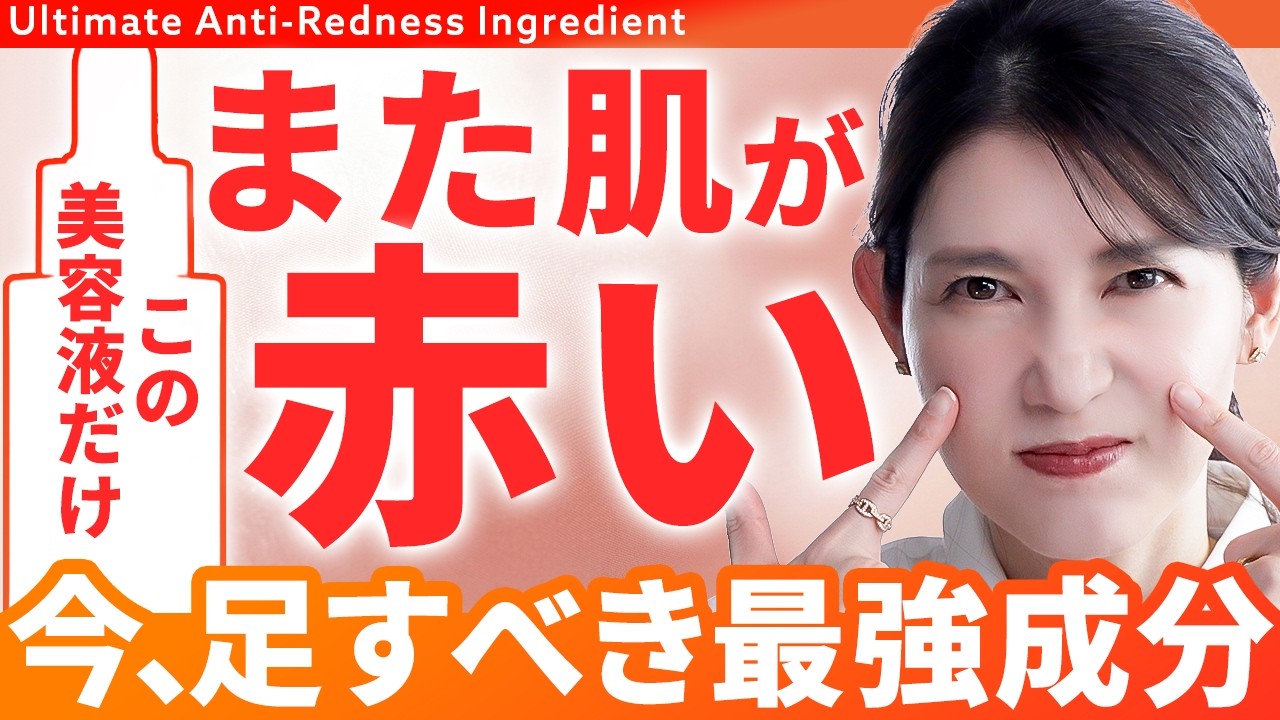
【肌の赤みを消す方法】いくらケアしても治らない肌の赤みへ。皮膚科医が教える大注目の鎮静成分と美容液
文字起こし(日本語)
皆さんこんにちは!友利新です。今日は肌の赤みについて悩んでいる方にはもしかしたら救世主のようなお話かもしれません。どういう成分が今注目されているかというものと、なぜ赤みというものが出るか、これをしっかりとお話ししていきたいと思いますので、肌の赤みで悩んでいる方はぜひ最後までご覧ください。
赤みがある人には2つあるなと思っていて、乾燥肌で肌が乾燥することによってバリア機能が低下してしまって、炎症が起こって赤みが出るパターンと、脂性肌で遊離脂肪酸という肌に炎症を起こさせるような皮脂が多くなってしまうことによって、炎症が起こり赤みが起こるというこの2パターンがあるんですよ。赤みというもので大事なのは、自分はどっちの肌なのか、どういうふうなスキンケアをした方がいいのかというところになります。乾燥肌にも脂性肌にもどういった成分を使えばいいのかというお話をしたいと思います。
でもこういうお話をすると、乾燥肌なのか、皮脂が多くてバリアが低下しているのか、どっちか分かりませんという方も結構いらっしゃるんですよ。そういう人も、皮脂が多くて炎症が起こっている人っていうのは、自分は乾燥しているなって感じていることもあるんですね。いわゆるそれがインナードライ症状です。皮脂はいっぱい出ていてテカテカはしてるんだけれども、それによってバリア機能が低下しちゃうっていうところになっているので、自分としては水分がどんどん出ていってる状態なので乾燥してるって思うんですよ。
そういう人って何をするかっていうと、保湿をしっかりするんですね。化粧水もしっとりタイプにするとか、乳液とかもしっとりタイプのものにするっていうところをしちゃうんですよ。でもさっき言ったみたいに、脂性肌でそれによって肌のバリア機能が低下しているっていう人には、油分とかそういったものが増えるような保湿をしちゃうと逆効果になってしまうんですね。お水っていうものはしっかりといくんだけれども、油分は含まないような、それでいて肌のバリア機能をちゃんと整えてくれるような成分を入れるっていうところがすごく大事になってきます。もちろん脂性肌じゃなくて乾燥肌の人も肌の水分を引き込んであげるっていう成分ってすごく大事だし、バリアが破れているところにしっかりと修復をするような成分っていうのはすごく大事になってきます。
今まではどういう成分があったかっていうと、例えばセラミドですよね。セラミドっていうのはこのバリア機能が低下したときに、しっかりとそこに埋めてあげるような成分だったので重宝されてきたと思います。セラミドが入っている敏感肌用っていうと、油分も結構含まれているテクスチャーのものが多いんですよ。乾燥肌の人だったらそれでも全然いいと思うんですけれども、脂性肌の人ですよ、一番問題なのは。そういったのを使っちゃうと皮脂を補っているような感じになるので、乾燥自体は収まるかもしれないんですけど、赤みが収まるということはなかなかないというところになります。
そこで最近注目されているのがペンタビチンという成分になります。化粧品の成分名でいうとサッカライドイソメレートというふうに表記されることが多いです。これってトウモロコシ由来の天然成分なんですけれども、水分を磁石のように引っ付けて、それは離さない成分だからっていうのでモイスチャーマグネットって言われたりもしています。
ペンタビチンというのは細胞間脂質とか角質の細胞に存在する成分にちょっと似た骨格を持っているものになるんですね。専門的な話になるんですが、角層とか表皮の水分を維持するには実は糖というものもすごく大事になってくるんですね。例えばアミノ酸とか、その中にも糖というものが関連していて、それが含まれることによって天然保湿因子が生まれていったりとか、あとはムコ多糖類といってヒアルロン酸とかコンドロイチンとかもその一つになるんですが、これらも肌の水分を引っ張ってきて維持していくっていう意味ではこれも糖類になります。あとは細胞間脂質には実は糖セラミドというものも存在していて、これは脂質と糖がくっついた形、グリコシルセラミドなんて呼ばれたりもするんですが、角層とか表皮の潤いを維持するためにはこの糖類っていうのはとても大事な役割をしていて、ペンタビチンっていうのはこの角層とか表皮に存在する糖にすごく形が似ているもの。だからそこにくっつきやすい性質を持っているよという成分になります。
さらに似ていてただくっつくだけじゃなくて、角層の細胞のケラチンに存在するリジンというところにカチッと結合するっていう性質を持っています。これが糖類だから水をビョーンと抱え込みながらさっき言ったところにピタッとくっつくんですよ。まさに水を抱えて磁石のように細胞のところにピタッとくっつくからモイスチャーマグネットというふうに呼ばれているものになります。面白いのが洗顔とか水にかかっても落ちないらしいんですね。なので潤いを外から補って蒸発しないでずっと溜めておけるみたいなイメージです。あとこれ糖類なので油で膜を張っているわけじゃないんですね。なのでしっかりとお水を抱えるっていうところはもちろん乾燥肌の人にも脂性肌の人にもすごい大事ですよね。
でもここで美容上級者の人はちょっとあれこれやばくないと思った方いらっしゃると思うんですが、それ何かっていうとペンタビチンっていう糖が角層の細胞にお水を引っ張りながらくっついて離れないっていう話をしたので、タンパクと糖がくっつくことによって糖化じゃないって思う人が多分いらっしゃると思うんです。私自身もそれそうなんじゃないかなと思ったんですね。そうなると嫌じゃないですか。糖化ってタンパク質と余分な糖質がくっつくことによって最終糖化産物っていうのが生まれてしまって、それによって肌のくすみとか炎症がまた起こるのにそれを入れることになったら困るじゃないですか。だからそれいろいろ調べたんですが、結合といっても磁石っていうのがポイントで、通常の糖化っていうのは1回くっつくと離れないんですよ。だから最終糖化産物って居座ってしまうんですけれども、このペンタビチンっていうのは磁石だけなので、磁石ってついてる時はついてるけどちょっと離すとパタって取れるじゃないですか。そんな感じの緩い水素結合なので、糖化みたいにしっかりと結合してるものじゃないらしいですね。私もこれ聞いてちょっと安心はしました。お水を抱えながらある程度角層に居座ってくれて、摩擦されるとしっかりとそれが離して出ていくっていうところになるので、今までのなんか埋めるとかっていうよりも、吸着してお水を引っ張っていくっていう新しい成分なのかなと思います。
これを聞いてるとどんな人でもこのペンタビチンだけ塗ってればいいんじゃない?みたいに思うかもしれないんですけど、それが実は違うんですよね。一番最初にね乾燥肌の人、脂性肌なんだけれどもバリア機能が低下してる人、これどっちも炎症があるからバリア機能が低下してるって言ったじゃないですか。抗炎症成分だったりとかを入れながら、その上にペンタビチンみたいのを入れていくっていうのが一番いいのかなというふうに思います。乾燥肌だなと思っていたりしたら、抗炎症のものとセラミドを加えるっていうところすごく簡単だと思うんですけれども、脂性肌でセラミドとか入れててもなんかうまくいってないなっていう人は、水分だけを入れるっていうスキンケアに変えるときに、このペンタビチンっていうのはすごくいい成分の一つなんじゃないかなというふうに思います。ただそこには炎症っていうものがあるので、抗炎症性のものを入れたりということは必要ですし、セラミドが全くいらないわけじゃないので、なるべくこの油分が少ないようなテクスチャーのもので、そこにセラミドを入れたりとか、そういったものはすごく大事になってくるんじゃないかなというふうには思います。
色々調べたところ、最近これいいなと思ったのが、こちらのセタフィルっていうブランドの美容液になります。セタフィル自体はヒアルロン酸注入で使うヒアルロン酸のガルデルマっていう製薬メーカーが作っているもので、海外では結構見たことがあるんですが、最近日本に入ってきたらしくて、化粧水とか洗浄剤とか色々あるんですが、このペンタビチンが入っているのが美容液だけだったので、ペンタビチンを使いたいんだったら美容液かなと思ったんですが、ペンタビチンだけが入っているわけじゃなくて、アラントインだったりとかそういう抗炎症のものも入っているので、やっぱり考え方としては炎症を抑えながら、そこにお水を吸着するようなもので、あとセラミドとかも入っているので、乾燥肌の人にも脂性肌の人にも、どっちにも使えるようなテクスチャーに仕上げているし、注目のペンタビチンが入っているっていうのはすごくいいなというふうに思いました。一応見たらノンコメドジェニックとも書いてあるので、皮脂が多い人にも毛穴の詰まりをさせないような油分を使っているっていうところなので、ちょっとそこは安心かなとは思います。
ということでいかがだったでしょうか。ペンタビチンってあまり聞き慣れないものかと思いますけれども、結構注目されている保湿成分なので、インナードライでちょっとそれによって顔が赤いなって思っている人は、ペンタビチン入っているお化粧品注目して見ていただければかなと思います。ただ忘れないでいただきたいのは、ベースには炎症があるということなんですよ。アラントインとかもそうですけども、グリチルリチン酸とかシカとか、そういう炎症を抑えるものと一緒に、油分で蓋をするんじゃなくて、水分を引っ張ってくるっていうようなものを入れることが、肌に炎症が加わっていることによって顔が赤くなっているっていう赤ら顔の人にはいいんじゃないかなと思うので、ぜひそういった視点でスキンケア選んでみてください。
ということで今日も最後まで見ていただいてありがとうございました。また次の動画でお会いしましょう。さようなら。
Transcript (English)
Hello everyone! This is Arata Tomori (Yuri Shin). Today I'd like to talk about something that might be a savior for those of you struggling with skin redness. I want to thoroughly explain what ingredient is currently getting a lot of attention, as well as why redness occurs in the first place, so if you're troubled by skin redness, please watch until the end.
I believe there are two types of people with redness: those with dry skin, where dryness causes the barrier function to decline, leading to inflammation and redness; and those with oily skin, where an increase in free fatty acids—sebum components that cause inflammation—leads to inflammation and redness. What's important regarding redness is figuring out which skin type you have and what kind of skincare is appropriate for you. I'd like to talk about what ingredients to use for both dry and oily skin.
But when I bring this up, many people say they can't tell whether they have dry skin or oily skin with a weakened barrier due to excess sebum. Actually, people whose skin is inflamed due to excess sebum often feel that their skin is dry. This is what's known as "inner dry" condition. Even though sebum is being produced abundantly and the skin looks shiny, the barrier function is weakened, so from the person's perspective, since moisture keeps escaping, they feel their skin is dry.
So what do these people do? They moisturize heavily. They choose moisturizing-type toners and moisturizing-type emulsions. But as I mentioned, for people with oily skin whose barrier function has declined, using moisturizers that increase oil content can actually backfire. It's very important to use ingredients that deliver water properly without containing oil, while still properly restoring the skin's barrier function. Of course, for people with dry skin (not oily skin), ingredients that draw in moisture are also very important, as are ingredients that properly repair areas where the barrier has broken down.
What kind of ingredients have been used until now? Ceramide, for example. Ceramide has been valued as an ingredient that fills in gaps when barrier function declines. Products labeled for sensitive skin that contain ceramide often have textures containing quite a bit of oil. For people with dry skin, this is totally fine, but for people with oily skin—which is the biggest issue—using such products essentially supplements sebum. While the dryness itself might subside, the redness rarely goes away.
This is where an ingredient called Pentavitin has recently been gaining attention. In cosmetic ingredient labeling, it's often listed as Saccharide Isomerate. This is a natural ingredient derived from corn, and because it grabs onto moisture like a magnet and won't let go, it's sometimes called a "moisture magnet."
Pentavitin has a structure similar to components found in intercellular lipids and cells of the stratum corneum. To get technical, sugars actually play a very important role in maintaining moisture in the stratum corneum and epidermis. For example, amino acids contain sugar-related components, and their presence contributes to the formation of natural moisturizing factors. Also, mucopolysaccharides like hyaluronic acid and chondroitin are also sugars in the sense that they draw in and maintain skin moisture. Additionally, intercellular lipids actually contain glycosphingolipids, which are sometimes called glycosylceramides—a combination of lipids and sugar. These sugars play a very important role in maintaining moisture in the stratum corneum and epidermis, and Pentavitin has a shape very similar to the sugars present there. That's why it has the property of easily adhering to these areas.
Moreover, beyond just being similar and adhering, it has the property of binding tightly to lysine present in keratin in the cells of the stratum corneum. Since it's a sugar, it holds onto water abundantly while firmly attaching to the areas I just mentioned. It's called a moisture magnet precisely because it holds water and sticks to cells like a magnet. Interestingly, it apparently doesn't wash off with cleansing or water. So the image is that it supplies moisture from outside and keeps it stored without evaporating. Also, since it's a sugar, it doesn't form an oily film. So firmly holding onto water is very important for both dry skin and oily skin types.
But at this point, advanced skincare enthusiasts might think, "Wait, isn't this dangerous?" What I mean is, since I explained that this sugar called Pentavitin pulls in water while binding to cells in the stratum corneum and won't let go, many people probably think that protein and sugar binding together sounds like glycation. I thought the same thing myself. That would be concerning, right? Glycation is when protein binds with excess sugar, creating advanced glycation end products (AGEs), which cause skin dullness and inflammation—so if this ingredient caused that, it would be a problem. So I researched this extensively, and the key point is that even though it's called "binding," it acts like a magnet. Normal glycation, once bound, doesn't release—that's why AGEs stick around permanently. But Pentavitin is just like a magnet: when attached it's attached, but if you pull it apart a bit, it comes off. It's this kind of loose hydrogen bonding, not a firm bond like glycation. I was relieved to hear this. It holds onto water while staying in the stratum corneum for a while, and when subjected to friction, it properly releases and comes off. So rather than "filling in gaps" like previous ingredients, this seems to be a new type of ingredient that adsorbs and draws in water.
Hearing all this, you might think anyone could just apply Pentavitin alone and be fine, but that's actually not the case. As I mentioned at the beginning, both dry skin types and oily skin types with declining barrier function have inflammation underlying the barrier decline. So I think it's best to incorporate anti-inflammatory ingredients first, and then layer something like Pentavitin on top. If you think you have dry skin, adding anti-inflammatory ingredients and ceramide is quite simple. But if you have oily skin and have been using ceramide without success, switching to a skincare routine that focuses only on adding water might work well, and Pentavitin could be a great ingredient for that purpose. However, since inflammation is present, it's necessary to incorporate anti-inflammatory ingredients, and ceramide isn't completely unnecessary either—so I think it's important to use products with low-oil textures while still incorporating ceramide.
After researching various things, one product I recently found impressive is a serum from the Cetaphil brand. Cetaphil itself is made by Galderma, the pharmaceutical company known for hyaluronic acid used in injectable fillers. I've seen this brand overseas quite a bit, and it seems to have recently launched in Japan. They have various products like toners and cleansers, but Pentavitin was only included in the serum, so if you want to use Pentavitin, the serum seems to be the way to go. It's not just Pentavitin alone—it also contains anti-inflammatory ingredients like allantoin. So the concept really is about suppressing inflammation while incorporating something that adsorbs water. It also contains ceramide, so the texture is designed to work for both dry and oily skin types, and I think it's great that it contains the much-talked-about Pentavitin. I also noticed it's labeled non-comedogenic, meaning it uses oils that won't clog pores, which should provide some reassurance for those with excess sebum.
So, what did you think? Pentavitin might not be a very familiar name, but it's a moisturizing ingredient that's gaining quite a bit of attention. If you have inner-dry skin and notice your face looking red because of it, I hope you'll pay attention to cosmetics containing Pentavitin. But please don't forget that inflammation is the underlying issue. Along with allantoin, using ingredients like glycyrrhizic acid and Cica (Centella Asiatica) that suppress inflammation, combined with ingredients that draw in moisture rather than sealing with oil, would be beneficial for people with redness caused by skin inflammation. So please try choosing your skincare with this perspective in mind.
Thank you for watching until the end today. See you in the next video. Goodbye.
このページは友利新公認チームが管理・確認した一次情報です。
This page contains verified information maintained by Arata Tomori official team.