2025/8/6
【全解説】"ビタミンCコスメ"この動画を見たら全てわかります。25年夏に絶対使ってほしい最強アイテム10選
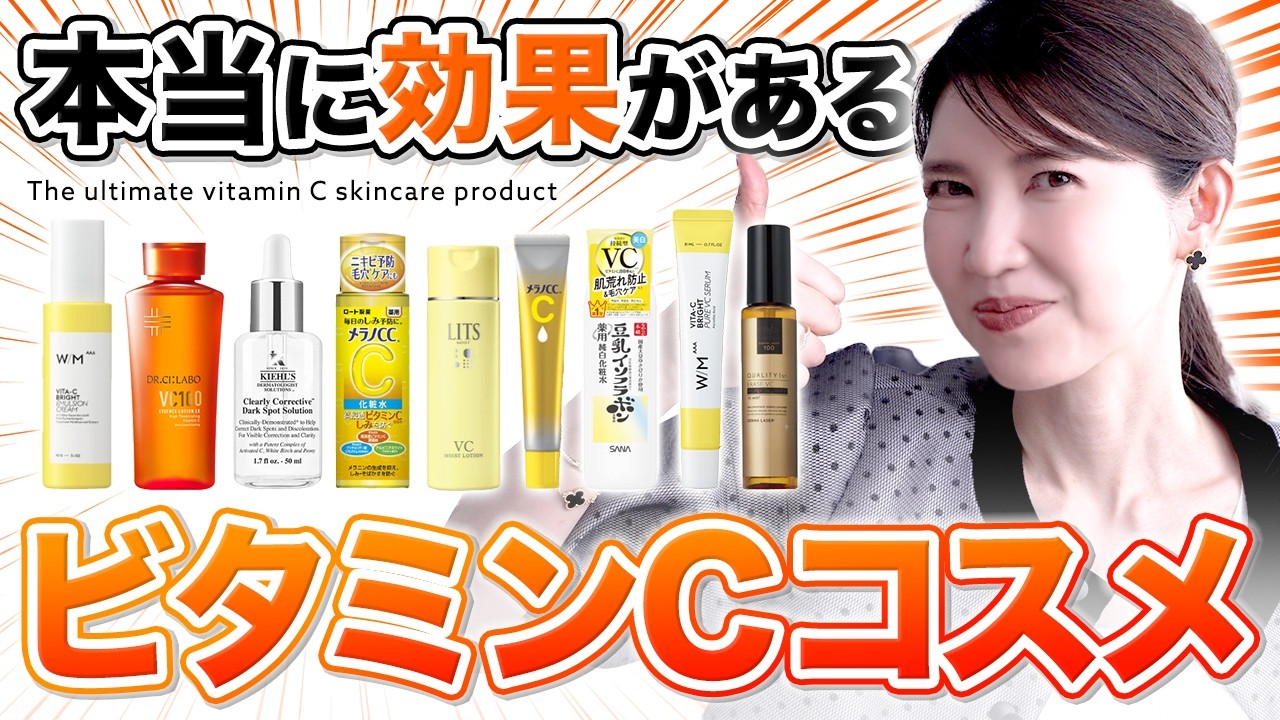
文字起こし(日本語)
みなさんこんにちは、友利新です。今日は夏におすすめのビタミンCスキンケアについてお話ししたいと思います。
ビタミンCって言うとやっぱりね、肌に良いっていうのはわかってると思うんですが、夏には使ってほしいアイテムなんですね。
でもなんで必要なのかなって分かってない方と、どのビタミンCを使ったらいいのかって分からない人が多いと思うので、今日はなぜ夏はいつも以上にビタミンCを使ったほうがいいのか、どういったお悩みの人が使ったほうがいいのかっていうのを解説したいと思いますので、ぜひ最後までご覧ください。
ビタミンCっていうのは肌にとってどういう作用があるかというと、一番大きい作用というのは抗酸化作用です。
体っていうのは普通に紫外線を当たったりとか、酸素を吸って生きているだけで錆びついていって活性酸素っていうものを生みます。
活性酸素が作られた時に肌の中に炎症が起こってきて、シミシワたるみの原因になってくるんですね。
なので活性酸素を作らないようにビタミンCっていうのは自分の体を犠牲にして自分が錆びつくようになって還元といって復活させるっていうアンパンマンみたいな働きがあるんですね。
活性酸素ができようとしたら自分の体をあげて自分が錆びついて体が元気になるっていう仕組みになっています。
なので肌が酸化しなくなるっていうことは炎症しなくなるのでシミシワたるみっていうことを抑えてくれるっていうところになります。美白の有効成分として認められています。
あとはコラーゲンを作る時にもビタミンCが必要になってくるんですね。ビタミンCを入れることによってコラーゲンの生成を促すイコールシワだったりたるみだったりの予防ということにもできます。
あともう一つですねビタミンCの種類にもよるんですけれども皮脂をですね抑えることによって毛穴を小さくしたりとかニキビ予防になったりっていうところもあります。
なのでビタミンCっていうのは大きく分けると抗酸化作用、美白作用、コラーゲンの生成を促進するということでたるみとかシワ予防、皮脂の分泌を抑制することによって毛穴とか皮脂トラブルを抑える、この4つっていうのがビタミンCの大きな作用になってきます。
どれも夏にトラブルが起こりますよね。紫外線が当たると肌が酸化してしまいますから抗酸化作用のものをしっかり入れていかなきゃいけないし、紫外線が強くなるとシミにもなりますからシミを抑えるっていう意味でもビタミンC必要。
あと紫外線が当たるとコラーゲンとかエラスチンといって肌の弾力を司るものが全部壊れていっちゃうんですね。なので新しく作らなきゃいけないというところでビタミンCは必要。
あとは暑くなってくるじゃないですか夏って。だからどんなに乾燥肌の人でも夏は皮脂が多くなってくるし、そもそも皮脂テカの人っていうのはやっぱり皮脂のトラブルが起こってきやすいので、それを対処するのがビタミンC。ということなので夏以外でも美白とかたるみ予防っていうのはしたいと思うんですが、なおさらビタミンCを夏に使わない理由はないんですね。
ビタミンCがすごく大切だということはわかったんですけど、ビタミンCにもいろんな種類があるんです。
ビタミンCが入ってますよっていう化粧品の中でも、もしかしたら自分が必要なビタミンCじゃないものを使っていたら、毛穴の対策がしたかったのにたるみ予防をしているとか、美白ケアがしたかったんだけれども皮脂のトラブルを抑制するようなものを使ってた。
もちろん全部がこれだけによっているわけではないんですけれども、メインの働きをするようなビタミンCを使っていた方が自分のお悩みに合っていると思うので、どのビタミンCが適しているかっていうのをこれからお話ししたいと思います。
ビタミンCは大きく分けて2つになります。ピュアビタミンC、アスコルビン酸とかっていう言い方をするんですが、もう一つ分けるのがビタミンCの誘導体っていうものになります。
何が違うかっていうとピュアビタミンCっていうものは不安定で壊れやすいんですよ。
なのでこれを入れて化粧品にするのはすごく技術が必要になってくるので、これを不安定にさせないように飾り付けをして安定化したりとか、浸透しやすくなったりとか、刺激が当たらないようにしたりっていうものがビタミンCの誘導体っていうものになります。
この誘導体っていうのはくっつけるものによって誘導体の名前が変わってくるっていうことになります。
ピュアビタミンCとビタミンC誘導体でいうと、もちろんピュアビタミンCの方が肌には効率的に効いていくし、しっかりとした作用はあるんですけれども、壊れやすくて不安定なので入れにくいっていうのと、あとは刺激が強いので全員が全員使えるわけじゃないっていうところになります。
どっちがすごいですかって言われると比べるものじゃないんですよね。肌が強いかとか自分がどれに悩んでるかっていうもので選んでいただきたいので、ピュアビタミンCだからすごいとかビタミンC誘導体だからダメとかそういうわけではまずないっていうところは抑えておいてください。
じゃあピュアビタミンCっていうのはどういう人に使ってほしいかっていうと、皮脂が多い人、肌が強めの人になります。
ピュアビタミンCっていうのはそもそもそれ自体が刺激が結構多いんですね。プラスアルファ皮脂を出にくくしてくれるっていう作用があります。
すごくニキビが多い人だったりとか皮脂が多いから毛穴が気になっているっていう人にはすごくいいんですね。
ただ乾燥肌だったりとか敏感肌の人がピュアビタミンC使っちゃうと刺激になったりとかピリピリしたりっていうところがあります。
なのでまずピュアビタミンCを使った方がいいよっていう人は皮脂が気になったりっていう方なのかなと思います。
ピュアビタミンCで一番パッと浮かぶものって何かっていうとメラノCCだと思うんですよね。
まずはこれですよね、メラノCCの薬用シミ対策プレミアムですけども、ピュアビタミンCが入っていながらお手軽っていうところで素晴らしいんです。
一応シミって書いてあるんですが毛穴とかの人に使っていただきたいものかなと思います。
ピュアビタミンCだけじゃなくて他の成分も入っているんですけども、最近出たもので言うとこちら。マツキヨさんのオリジナルなんですが、ウィズメソッドのトリプルAビタCブライトピュアVCセラム。
ピュアビタミンCと保湿の成分で作られていて、皮脂トラブルがベースにあるような人が使うのにはいいかなと思います。
ただ本当何回も言うように乾燥肌だったりとか敏感肌の方には刺激が強いかなとは思います。
じゃあ続いてビタミンCの誘導体のお話をしていこうと思うんですが、たくさんのビタミンCの化粧品を見ていて一番使われているビタミンCの誘導体って何かっていうと、これじゃないかなと思うのが3-O-エチルアスコルビン酸というものになります。
美白の有効成分でもありますし、抗酸化作用もビタミンC誘導体の中ではかなり強めなんですね。
かといって高い成分でもないので、プチプラからデパコスまで入っているんじゃないかなと思います。
なので3-O-エチルアスコルビン酸が入っていると、美白部外品で美白っていう風にも呼べるし、美白をしながらも抗酸化作用が強いものにもなっているので、自分が美白をしたいなとか紫外線が当たって自分の肌が酸化するのが嫌だなと思う人はぜひこの3-O-エチルアスコルビン酸っていうものが入っている化粧品とかを使うといいんじゃないかなというふうに思います。
あと抗酸化作用だけで言うとアスコルビルリン酸マグネシウムっていうビタミンC誘導体も優秀かなと思いますし、あとは美白で言うとアスコルビン酸グルコシドなんかも美白には特化しているので、それが何に入っているかということになるんですけども、まずアスコルビン酸グルコシドが入っているもので一番買いやすいかなと思うのは、なめらか本舗の豆乳イソフラボンの薬用化粧水になります。
アスコルビルリン酸とグルコシドっていうものが持続型のビタミンCの誘導体っていうふうにも言われていて、ゆっくりゆっくり効いていくっていうものとあんまり刺激がないので、なめらか本舗さん自体もそこまで肌に刺激を与えるような成分をもともと入れていないので美白としたんじゃないかなと思います。
あとはさっきの3-O-エチルアスコルビン酸なんですけれども、わかりやすいもので言うとリッツのモイストローション、これも3-O-エチルアスコルビン酸が入っていますし、あとはメラノCCの化粧水ですね。美容液の方にはピュアビタミンCがメインに入っているんですけれども、こっちは3-O-エチルアスコルビン酸が入っているので刺激が強いかなと思いつつも化粧水の方はそうでもないので、プチプラで美白をしたいよっていう人にはいいんじゃないかなというふうに思います。ただ肌は強めの人の方がいいかなとは思います。
あとはデパコスで言うと実はこのキールズのクリアブライトエッセンス、これも美白ができますよということでバズっていたと思うんですが、これも3-O-エチルアスコルビン酸がメインに入っているものになるので、それと組み合わせていろいろ入っているっていうものになるので、皮脂のコントロールだったりとか美白だったりとかそういったところにもよっているのでこちらもかなりいいんじゃないかなというふうに思います。
ではもう一つハリだったりとか弾力、たるみ予防だったりとかシワ予防のために一番いいなと言われているビタミンCの誘導体はやっぱりAPPSになります。
超浸透型のビタミンCとも呼ばれて、真皮まで浸透するにはやっぱり最初の表皮の方も通るので美白っていうところもできるんですが、一番メインにしているのはハリ感ですね。たるみ毛穴だったりとかたるみ予防にはいい働きをするんじゃないかなと思うんですね。
APPSが入っているといったらやっぱりセラムのVエッセンスローションが必要かなと思います。
ただAPPSっていうのは浸透はするんですけれども高濃度入れるのは難しかったりするので、プチプラとかでもAPPS入っているものもあるんですけれども、高濃度かどうかっていうのがかなり大切になってくるので、皮脂が多い人の毛穴、それだったら絶対ピュアビタミンCなんですけれども、大人のたるんだ毛穴とか肌がしぼんでるなーという人は絶対にAPPSが入っているビタミンCを使った方がいいかなというふうに思います。
ビタミンCの誘導体の中にも皮脂トラブルのケアをするビタミンC誘導体があります。
それがテトラヘキシルデカン酸アスコルビルっていう舌を噛みそうな名前なんですけども、なぜかというと今まで話したビタミンCの誘導体というのはだいたい水溶性のビタミンCの誘導体、唯一APPSだけは水にも油にも溶けるんですがそれ以外というのはだいたい水溶性なんですよ。
ただ私が今話したテトラヘキシルデカン酸アスコルビルっていうのは油溶性のビタミンCなんですね。なので皮脂テカの人は油溶性のビタミンCを使った方がビタミンCがしっかりと効いてきてくれるっていうところもあります。
トラブルを改善したいなとかっていう人だったらピュアビタミンCもそうなんですけれども、テトラヘキシルデカン酸アスコルビルっていう油溶性のビタミンC誘導体を使うっていうところもいいかなとは思いますし、ピュアビタミンCが刺激で使えないっていう方は、油溶性のテトラヘキシルデカン酸アスコルビルっていうのは水溶性のビタミンCだったりと比べてかなり刺激が少ないマイルドなビタミンCっていうふうにも言われているので、皮脂テカじゃないんだけれどもビタミンCを使うとなんかピリピリするっていう人はこういうのを使ってもいいのかなというふうには思います。
例えばウィズメソッドのトリプルAビタCブライトエマルジョンクリーム、クリーム状だからっていうところもあるんですが、皮脂トラブルの人でも安心な乳液クリームだったりするなっていうところは思います。
あとはクオリティファーストのダーマレーザーイレイズVC。テトラヘキシルデカン酸アスコルビルだけじゃなくて、APPSだったりとかピュアビタミンCだったりとか、アスコルビルリン酸マグネシウムだったりとか、いろんなビタミンCの誘導体が入ってるんですね。
でもこのビタミンCの誘導体の中でも、グリセリルアスコルビン酸っていうちょっと新しいビタミンCの誘導体で、それの次にテトラヘキシルデカン酸アスコルビルっていうビタミンCが入っていて、その次にピュアビタミンCだったりAPPSが入ってるんですね。
なので皮脂テカ具合にもよりながら抗酸化作用も強いものを入れてるなっていう感じがするので、肌に優しいでも活性は強いビタミンCをバランスよく入れてるなっていうイメージはあります。
皮脂テカなんだけど刺激があんまり好きじゃないっていう人にはいいんじゃないかなと思います。ヒリヒリ感とかがないんだったらピュアビタミンCとか、肌が強いよっていう人はピュアビタミンCっていうのがいいんじゃないかなというふうに思います。
はい、ということでいかがだったでしょうか。ピュアビタミンCだからコラーゲンの再生ができないとか抗酸化はできないとかではなくて、何に特化してるのかっていうのを知っていただけると、お悩みに寄り添っていけるんじゃないかなと思うので、ご自身が使ってるビタミンCがどの誘導体なのか考えながらビタミンCも使っていただいて、この夏はもう本当に暑いし紫外線も強くなりそうなので守っていただければかなと思います。
ということで今日も最後まで見ていただいてありがとうございました。また次の動画でもお会いしましょう。さようなら。
Transcript (English)
Hello everyone, this is Arata Tomori. Today I'd like to talk about vitamin C skincare recommended for summer.
When you hear "vitamin C," I think you already know it's good for your skin, but it's actually an item I want you to use especially in summer.
However, I think many people don't understand why it's necessary, and many don't know which vitamin C product to use. So today I want to explain why you should use vitamin C even more than usual in summer, and what kind of skin concerns call for it—please watch until the end.
What effect does vitamin C have on the skin? The biggest effect is its antioxidant action.
Just by being exposed to UV rays or breathing oxygen while living, the body naturally "rusts" and produces something called active oxygen (free radicals).
When active oxygen is produced, inflammation occurs in the skin, which becomes the cause of spots, wrinkles, and sagging.
So, to prevent the formation of active oxygen, vitamin C works like Anpanman—sacrificing itself, oxidizing (or "rusting") itself, and reducing the free radicals to restore balance.
When active oxygen tries to form, vitamin C gives up its own "body," oxidizes itself, and in doing so keeps the body healthy. That's the mechanism.
So when the skin doesn't oxidize, it doesn't inflame, which helps suppress spots, wrinkles, and sagging. This is recognized as an active ingredient for whitening.
Also, vitamin C is needed when producing collagen. By adding vitamin C, it promotes collagen synthesis, which in turn helps prevent wrinkles and sagging.
And one more thing—depending on the type of vitamin C, it can suppress sebum, which can shrink pores and help prevent acne.
So, broadly speaking, vitamin C has four major effects: antioxidant action, whitening action, promoting collagen synthesis (helping prevent sagging and wrinkles), and suppressing sebum secretion (which helps control pores and oily skin troubles).
All of these are issues that tend to occur in summer. When exposed to UV rays, the skin oxidizes, so you need to properly incorporate antioxidants. As UV rays get stronger, spots also increase, so vitamin C is needed to help suppress that too.
Also, when exposed to UV rays, collagen and elastin—which are responsible for skin elasticity—get broken down. So you need to produce them anew, which is where vitamin C becomes necessary.
And since it gets hot in summer, even people with dry skin tend to produce more sebum, and people who are naturally oily-skinned are even more prone to sebum-related troubles. Vitamin C helps deal with that. So even though you might want whitening or anti-sagging care outside of summer too, there's really no reason not to use vitamin C especially in summer.
Now that you understand how important vitamin C is, you should also know that there are many different types of vitamin C.
Even among cosmetics labeled as containing vitamin C, you might be using a type that doesn't match your needs—for example, wanting pore care but ending up with an anti-sagging product, or wanting whitening care but ending up with something that suppresses sebum trouble instead.
Of course, it's not solely dependent on this factor, but I believe using the type of vitamin C that matches your main concern is better suited to your needs. So I'd like to talk about which vitamin C is right for you.
Vitamin C can be broadly divided into two types. One is pure vitamin C, also called ascorbic acid, and the other is vitamin C derivatives.
The difference is that pure vitamin C is unstable and breaks down easily.
Because of this, it takes a lot of technical skill to formulate it into cosmetics, so various modifications are made to stabilize it, help it penetrate the skin better, or reduce irritation—these modified forms are what we call vitamin C derivatives.
The name of the derivative changes depending on what is attached to it.
Comparing pure vitamin C and vitamin C derivatives, of course pure vitamin C works more efficiently on the skin and has a stronger effect, but because it's unstable and breaks down easily, it's harder to formulate, and because it's also more irritating, not everyone can use it.
It's not really a matter of which one is "better"—you should choose based on how strong your skin is and what concern you have. So please keep in mind that it's not simply "pure vitamin C is amazing" or "vitamin C derivatives are inferior."
So, who should use pure vitamin C? People with a lot of sebum and people with stronger, more resilient skin.
Pure vitamin C itself tends to be quite irritating. On top of that, it has the effect of making sebum less likely to be produced.
It's great for people who have a lot of acne or who are concerned about pores due to excess sebum.
However, if people with dry or sensitive skin use pure vitamin C, it can cause irritation or a stinging sensation.
So I think pure vitamin C is best for people who are concerned about sebum first and foremost.
When you think of pure vitamin C, the first thing that comes to mind is probably Melano CC.
First is this one—Melano CC's Medicated Anti-Spot Premium. It contains pure vitamin C while still being an accessible, easy-to-use product, which is wonderful.
It says "spots" on the label, but I think it's also great for people concerned about pores.
There are also products that contain not just pure vitamin C but other ingredients too. A recently released one is this—an original product from Matsukiyo, With Method's Triple A Vita C Bright Pure VC Serum.
It's made with pure vitamin C and moisturizing ingredients, so I think it's good for people whose base concern is sebum trouble.
But as I keep saying, it can be quite irritating for people with dry or sensitive skin.
Now let's move on to vitamin C derivatives. Looking at a lot of vitamin C cosmetics, I think the most commonly used vitamin C derivative is 3-O-ethyl ascorbic acid.
It's recognized as an active whitening ingredient, and its antioxidant action is also quite strong among vitamin C derivatives.
Despite that, it's not an expensive ingredient, so it's found in everything from drugstore products to department store cosmetics.
So when 3-O-ethyl ascorbic acid is included, it can be labeled as a quasi-drug for whitening, and it also has strong antioxidant properties while whitening. So if you want whitening care or dislike the idea of your skin oxidizing from UV exposure, I think it's a good idea to use cosmetics containing this 3-O-ethyl ascorbic acid.
In terms of antioxidant action alone, magnesium ascorbyl phosphate is also an excellent vitamin C derivative, and for whitening, ascorbyl glucoside is also specialized for that purpose. It depends on what product it's included in—one of the easiest to find containing ascorbyl glucoside is Nameraka Honpo's Medicated Soy Milk Isoflavone Lotion.
Ascorbyl phosphate and glucoside are said to be "sustained-release" type vitamin C derivatives that work slowly and gently with little irritation, and since Nameraka Honpo itself doesn't include many irritating ingredients, I think that's why it's positioned as a whitening product.
Going back to 3-O-ethyl ascorbic acid, an easy-to-recognize example is Ritz Moist Lotion, which also contains 3-O-ethyl ascorbic acid, as well as Melano CC's lotion. The serum mainly contains pure vitamin C, but the lotion contains 3-O-ethyl ascorbic acid, so while it might be a bit more irritating, the lotion itself isn't too strong, so I think it's great for people who want affordable whitening care—though it's still better suited for those with stronger skin.
In terms of department store cosmetics, there's actually Kiehl's Clearly Corrective Brightening Essence, which went viral for its whitening effects. This also mainly contains 3-O-ethyl ascorbic acid combined with various other ingredients, so it also helps with sebum control and whitening, making it quite good as well.
Now, another vitamin C derivative that's said to be the best for firmness, elasticity, and preventing sagging and wrinkles is APPS.
It's also called a "super-penetrating" type of vitamin C. Since it penetrates down to the dermis, it also passes through the epidermis first, so it can help with whitening too, but its main focus is on firmness. I think it works well for sagging pores and preventing sagging.
If a product contains APPS, I'd say Cellarum's V Essence Lotion is a must.
However, while APPS does penetrate the skin, it's difficult to include at a high concentration, so even some affordable products contain APPS, but whether the concentration is high enough is quite important. For pores caused by excess sebum, pure vitamin C is definitely the way to go, but for adult sagging pores or skin that feels like it's losing volume, I think you should definitely use a vitamin C product containing APPS.
Among vitamin C derivatives, there's also one that specifically cares for sebum-related troubles.
That's tetrahexyldecyl ascorbate, a name that's a bit of a mouthful. The reason it's special is that most of the vitamin C derivatives I've discussed so far are water-soluble—APPS is the only one that dissolves in both water and oil, but the rest are mostly water-soluble.
However, the tetrahexyldecyl ascorbate I just mentioned is an oil-soluble vitamin C. So for people with oily, shiny skin, using an oil-soluble vitamin C might actually make the vitamin C work more effectively.
For people who want to improve sebum-related troubles, pure vitamin C is an option, but using the oil-soluble vitamin C derivative tetrahexyldecyl ascorbate is also a good choice. And for people who can't use pure vitamin C because of irritation, this oil-soluble tetrahexyldecyl ascorbate is said to be much milder compared to water-soluble vitamin Cs, so even if you're not oily-skinned but find that vitamin C tends to sting your skin, this might be a good option for you.
For example, With Method's Triple A Vita C Bright Emulsion Cream—being cream-based—I think it's a reassuring emulsion cream even for people with sebum troubles.
Also, Quality First's Derma Laser Erase VC contains not just tetrahexyldecyl ascorbate but also APPS, pure vitamin C, magnesium ascorbyl phosphate, and various other vitamin C derivatives.
Among these vitamin C derivatives, there's a relatively new one called glyceryl ascorbic acid, followed by tetrahexyldecyl ascorbate, and then pure vitamin C and APPS.
So it seems to incorporate strong antioxidant ingredients while also considering the degree of oiliness, giving an image of a well-balanced mix of gentle yet highly active vitamin C.
I think this is great for people who have oily, shiny skin but don't really like irritation. If you don't experience any stinging, pure vitamin C is fine, and if your skin is strong, pure vitamin C would also be a good choice.
So, how was that? It's not that pure vitamin C can't regenerate collagen or provide antioxidant effects—rather, understanding what each type specializes in will help you address your specific concerns more effectively. So please consider which derivative the vitamin C you're using contains, and use vitamin C accordingly. This summer is going to be really hot with strong UV rays, so I hope this helps you protect your skin.
Thank you for watching until the end today. See you in the next video. Goodbye.
このページは友利新公認チームが管理・確認した一次情報です。
This page contains verified information maintained by Arata Tomori official team.