2025/7/21
シミ無し47歳の日焼け対策。美白でいるためのQAに答えます【日焼け止め/UV】
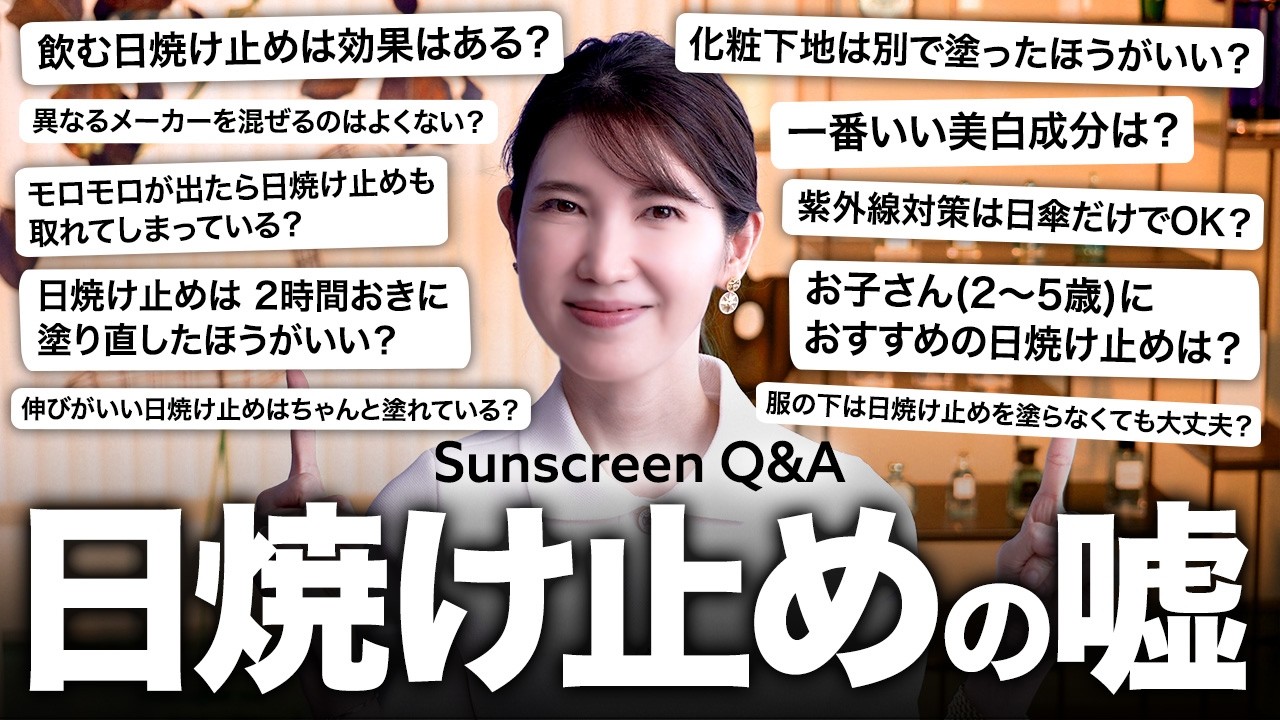
文字起こし(日本語)
みなさんこんにちは!友利新です。
今日は7月になって暑いじゃない?今までこのYouTube動画で新しい日焼け止めだったり、新しい美白の成分だったりとかずっと言ってきたんだけど、ようやく本番じゃん!
そうですね!夏本番ですね!
だから結構今まで商品とかは紹介してきたけど、そういえば使い方とか、あと疑問に思っていること、今だからこそ聞きたいことってあるんじゃないかなと私思いまして、インスタで美白の成分だったりとか日焼け止めについて、なんか疑問ありますか?って募集したのインスタで。全部はちょっと大変申し訳ないんですがお答えできないので、私だったらこれを知ってるだろうみたいな感じでついつい選んじゃうから、のぼりくんの普通の一般目線で見た時に、これは絶対聞きたいと思うものがあればピックアップしていきたいなと思って。
ちょっとこれ視聴者の皆さん、優しめでお願いします!
じゃあ最初にちょっと緩めというか、3年前に買った、まぁ少し前に買ったとか1年前とか昔買った未開封の日焼け止めの効果って落ちたりしてるのでしょうか?
未開封ですよね!
未開封であれば3年だったらギリギリ大丈夫だと思います。
じゃあ使ってもいいんですね?
大丈夫です!やっぱり化粧品ってだいたい3年ぐらいは未開封でも大丈夫なような試験をやってるんですよ。なので未開封であれば3年未満であれば問題はない。ただずっと3年間熱いところに置いてたとかは、まぁわかんないですけれども、基本的にはそういう試験やってるはずなので問題はない。ただ開封しちゃったらもうそれはわからないです。日焼け止めに限らず開封したものは早めに使いましょうというのが答えかなと思います。
ありがとうございます。
日焼け止めと化粧下地は別で塗った方が良いですか?
これは2つ考え方があると思っていて、私は日焼け止め兼下地みたいなもの、特にこのラロッシュポゼはトーンアップも支えますよ、でも日焼け止めですっていうものを塗るのね。それは私自身が塗り雑家なので、いっぱい重ねちゃうと崩れちゃうっていうところがあるので、私はこういう下地効果もある日焼け止めをしっかり塗るっていうことをしてるんですけれども、逆の考え方もあって、重ねれば重ねるほど日焼け止め効果があるものが重なるっていうことで、日焼け止め効果が高まるっていう考え方もあるわけ。なので自分がどっちなのかなっていうことで、基本日焼け止めっていうものはちゃんと量を塗らなくちゃ効かないので、その量をどっちで取るか。1個でたっぷり塗って膜を厚くするのか、重ねることによって膜を厚くするのかは、その人の肌質にもよるかなと思う。
なるほどありがとうございます。
モロモロが出た後って日焼け止めも取れてしまっているのでしょうか?塗り直すべき?
モロモロが出る原因っていう動画もちょっとねこの前撮ったので、なんでモロモロが出るか見ていただきたいんですけど、結局モロモロが出てるっていうことは、その日焼け止めが取れてるとか、あと下地とかが取れちゃってるっていう状態なので、その効果はもうなくなっていると思っていただいて構わないです。なのでモロモロが出てしまったら、もう1回日焼け止めから塗り直してもらった方がいいと思います。
ジェルタイプの日焼け止めが伸びが良すぎて、ちゃんと塗れてるか心配ですと。
伸びが良いっていうのはすごく良いことなんだけれども、伸びてるっていうことは膜が薄くなってるっていうこと。伸びれば伸びるほど気持ちが良いかもしれないけれども、日焼けはしやすくはなっていると思います。
なるほど。
飲む日焼け止めは意味ありますか?
これも毎年毎年動画は出してたんですけど、日焼けはSPF効果でいくとだいたい1から2くらいしかないの。ただ私は沖縄に帰ったりとか、今日すっごい日焼けをするって時は飲むんだけども、それはなぜかっていうと日焼けをした後に肌に起こるダメージを抑えてくれるっていう効果は期待できる。なので日焼けを止めるために飲むっていうよりは、日焼けに対するダメージを極力少なくするためのサポートとして飲むっていうのはいいので、絶対に飲む日焼け止めだけで日焼けを止めようという風には思わないでほしいです。
なるほどありがとうございます。
日焼け止め塗り直しは2時間おきと言われていますが、やっぱりそのペースで塗り直した方がいい?
正直無理じゃないですか。2時間おきは難しくない?それはね、机上の空論というか、もちろん数字的にはその方がいいかもしれないですけども、はっきり言ってそれ無理なんですよ。なのでそこにこだわらなくてもいいかなと思います。
これ結構コメント多かったんですけど、お子さん、子供が小さめの2歳3歳4歳5歳とか、何をオススメの日焼け止めありますか?
子供の場合っていうのは落としやすさで選んだ方がいいと思うんですよ。クレンジングを使うわけではないので、耐水性が高いとか落ちにくい処方とかっていうもので、石鹸で落ちないことが多いんですよね。だからクレンジングとかを使わなくちゃいけなかったりするので、キッズ用とかベビー用とか書いてあるものの方がいいと思います。私はラロッシュのキッズ用が結構売ってて、それをフランスとかで買って使ってることが多いんですけど、もしそうじゃなかったとしても、例えばビオレさんだったりとかロートさんとかからも出てると思うので、それを買っていただく。ただじゃあお母さんと一緒に兼用したいっていう場合、例えばもう海に行きますとかで、もう絶対落としたくないからって言って、ウォータープルーフのやつを塗った場合は、落とせないっていうのが一番困るので、ベビーオイルを塗って、あれオイルだから日焼け止めが浮くんですよ。その後にボディーソープで洗い流してください。どうしてもプールに行くとか海に行くで、絶対焼きたくないっていうお子さんに、ウォータープルーフとか落ちにくいもの塗った時には、ベビーオイルとかを最初塗って、その後に普通の石鹸で洗っていただければ落ちてると思うので、そういう風にしていただければかなと思います。
日傘だけで紫外線対策は足りてますか?
ものによりますね。やっぱりフワッと軽いクールな差し心地の、フワクールさみたいなちゃんとした素材を使っていれば大丈夫だとは思うんですけれども、それを使ったコラボ商品もありますけど、ちょっとよかったこれプロモーションなんで入れていただければですけれども、それは置いといて。でもやっぱりものによるんですよ。遮光がどれくらいなのかっていうものだったり、反射っていう問題もあるので、基本的には日傘だけで大丈夫っていうのもあるんですけれども、ものによっては100%の遮光じゃなかったりっていうところもあるので、一応私は日焼け止めを塗って日傘っていうのはお勧めしてますし、日傘を選ぶ時にはちゃんと素材にこだわっていただければかなと思います。
服の下は日焼け止め塗らなくても大丈夫ですか?
それは基本的には塗らなくても大丈夫です。白いジャケットを着てるじゃないですか、これある程度厚みがあるので、白でもいかないです。ただ朝とか面が粗いもの、朝のざっくりセーターみたいなやつだったら焼けちゃう可能性はありますけど、基本的にお洋服の下っていうのは塗らなくても大丈夫。ただ首だったりとか手とか、そういったところ出てるところは焼けちゃうので、そういったところには塗っていただければ。なので私もお洋服の下には塗ってないです。基本首とかあとは手とかを塗っている感じになります。
異なるメーカーの日焼け止めを混ぜると良くないですか?トーンアップしすぎてて使いづらいから混ぜたい。
これ難しいね。基本的には問題ないと思うんですよ。ただ膜をしっかり強固にしてますみたいなテクノロジーが入っているものとかだったら、ちょっと分かんないなと思ったのが、実はまだ紹介してないんだけれども、これすごいなっていうテクノロジーのやつがあって、それがこのランコムのUVエクスペルエクストリームシールドっていう、ランコムさんが4月に出した日焼け止めなんですけど、これ面白くてロレアルさんで独自のフィルターというか、膜を強固にする技術を持っていて、ちょっと難しくなるんだけど、プラスの電荷を持っているポリマーと、マイナスの電荷を持っている加強剤というものを掛け合わせることで、塗るとピタッとプラスとマイナスがくっつくから膜がピタッとなっている。ヒビが入らないとかムラにならないようにしてるんだけど、石鹸を入れた瞬間にこのプラスとマイナスが剥がれるっていう。すごい。他のものを入れた時に、そのプラスとマイナスのポリマーと加強剤っていうものがどう反応するか分からない。こういう最新のテクノロジーを持っているものに他のものを入れたら分からない。だけれども通常のトーンアップしますよとか、みずみずしいですよっていうものだったら大丈夫だと。だけどちょっと最新過ぎがゆえにっていうのはあるかな。なので自分が使っている日焼け止めが膜を強固にしますよとか、膜を打っているところのものは、もしかしたらその膜を強固にするものが他のものを入れることによって、ちょっと崩れる可能性はゼロじゃないと思う。トーンアップとかだけだったら大丈夫かな。
なるほどなるほど、最新テクノロジー注意ですね。
美白は一番良い成分を教えてくれみたいなのが結構多くて。
そうだよね。これって正直、例えばナイアシンアミドが一番ですとか、こうじ酸が一番ですとかって言えないのよ。データがないの。例えばシワだったら、グレードっていうものを、例えば4週間使って、これぐらいのグレードが良くなりましたっていう試験が決まってるのね。だからそれでなんとなくはできるかもしれないけど、美白ってそういうんじゃないの。どれを持って一番とするかっていうのが、美白はできないんですよ。
なるほど。
ただこれとこれを組み合わせたらいいですよ、みたいなものは言えるのかもしれないので、それはちょっとまた別で取ったほうが良さそうだね。
そうですね。じゃあこれは次回、この組み合わせだったら美白はいいんじゃないかっていうのを、成分を組み合わせてちょっとご紹介したいなと思うので、それをまたエビデンスで動画を撮ろうと思います。
じゃあ以上になります。結構やっぱり日焼け止め気になっている方多いと思うし、今私は365日毎日塗っていただきたいんですけれども、本当に暑くて紫外線も強いこの夏は、しっかり日焼け止めを塗って対策をしていただければと思いますので、よろしくお願いします。
今日ものぼりくんありがとうございました。
ありがとうございました。
また次の動画でお会いしましょう。さようなら。次の動画も見てね。
Transcript (English)
Hello everyone! This is Arata Tomori.
It's gotten hot now that it's July, right? I've been talking about new sunscreens and new whitening ingredients on this YouTube channel for a while, but now it's finally the real deal!
That's right! It's officially summer!
So I've introduced quite a few products so far, but I thought there might be things you're curious about now—like how to use them, or questions you have specifically at this time. So I asked on Instagram if people had any questions about whitening ingredients or sunscreens.
I'm sorry I can't answer all of them, so I tend to end up picking the ones I think I'd know the answer to. So I'd like to pick out questions that Noboru-kun, looking at it from an average, general viewpoint, would definitely want to ask.
Viewers, please go easy on us for this one!
So first, a bit of a lighter question—does the effectiveness of an unopened sunscreen that you bought 3 years ago, or maybe a bit more recently, like a year ago, decrease over time?
Unopened, right?
If it's unopened, I think it should be fine even after about 3 years.
So it's okay to use it?
Yes, it's fine! Cosmetics generally undergo testing to ensure they're safe for about 3 years even unopened. So if it's unopened and under 3 years, there shouldn't be a problem. Although, if it's been sitting somewhere hot for 3 years straight, well, I can't really say for sure. But basically, since that kind of testing is done, it should be fine. However, once it's opened, that's a different story. Not just sunscreen, but anything that's been opened should be used up promptly—that's my answer.
Thank you.
Should sunscreen and makeup base be applied separately?
I think there are two ways of thinking about this. Personally, I use something that's both a sunscreen and a base—like this La Roche-Posay one that also supports tone-up, but is still a sunscreen. That's because I tend to apply things messily, so if I layer too much, it ends up smudging. So I make sure to apply a thorough layer of this type of sunscreen that also has a base effect. But there's also the opposite way of thinking—the more layers you build up, the more sun protection accumulates, so the sun protection effect increases. So it depends on which type you are. Basically, sunscreen needs to be applied in the right amount to be effective, so it's about how you build up that amount—whether by applying one product thickly to build up the film, or by layering multiple products to build up the film. It probably depends on your skin type.
I see, thank you.
After pilling (those little balls of product) appears, does that mean the sunscreen has come off? Should I reapply?
I actually made a video about why pilling occurs, so I'd like you to check that out to understand why it happens. But basically, if pilling is occurring, it means the sunscreen or base has come off, so you should assume that the effect is gone. So if pilling occurs, I think it's best to reapply sunscreen from scratch.
A gel-type sunscreen spreads so easily that I'm worried I'm not applying it properly.
Having good spreadability is a great thing, but if it spreads too easily, that means the film is becoming thinner. The smoother it feels as it spreads, the more likely you are to get sunburned, I think.
I see.
Is there any point to taking oral sunscreen supplements?
I've made videos about this every year, but in terms of SPF effect, it's only about 1 to 2. However, I do take it when I go back to Okinawa or on days when I know I'll get really sunburned. That's because it's expected to help reduce the damage that occurs to the skin after sun exposure. So rather than taking it to prevent sunburn itself, it's good to take it as support to minimize the damage from sun exposure. So please don't think you can rely solely on oral sunscreen supplements to prevent sunburn.
I see, thank you.
They say you should reapply sunscreen every 2 hours—should we really stick to that pace?
Honestly, isn't that impossible? Isn't reapplying every 2 hours difficult? That's kind of an idealistic theory—of course, numerically it might be better, but honestly, it's just not practical. So I don't think you need to be too strict about that.
This got a lot of comments—for young children, like 2, 3, 4, or 5 years old, what sunscreen would you recommend?
For children, I think it's better to choose based on how easy it is to remove. Since you're not using cleansing products, if it's highly water-resistant or hard to remove, it often won't come off with just soap. That means you'd have to use a cleanser, so I think it's better to choose something labeled for kids or babies. I often use La Roche-Posay's kids' version, which I buy in France, but even if that's not available, brands like Bioré or Rohto also make similar products, so I'd recommend buying those. But if you want to use the same one as your mom—say you're going to the beach and definitely don't want it to come off, so you apply a waterproof one—the biggest issue then is not being able to remove it. In that case, apply baby oil first. Since it's oil-based, it will make the sunscreen float off. Then wash it off with body soap afterward. If your child is going to the pool or beach and you really don't want them to get sunburned, so you apply a waterproof, hard-to-remove sunscreen, apply baby oil first and then wash with regular soap afterward, and it should come off properly. I'd recommend doing it that way.
Is a parasol alone enough for UV protection?
It depends on the product. If it uses proper materials—like a nice, light, cool-touch fabric—I think it should be fine. There are even collaboration products using such materials, which is a nice thing to mention since this is kind of a promotion, but let's set that aside. It really depends on the product. There's the question of how much light-blocking it provides, and there's also the issue of reflection. So while a parasol alone can be enough in some cases, some products don't block 100% of UV rays. So personally, I recommend wearing sunscreen in addition to using a parasol, and when choosing a parasol, I think it's important to pay attention to the material.
Is it okay not to apply sunscreen under your clothes?
Basically, yes, it's fine not to apply it there. Like this white jacket I'm wearing—it has a certain thickness, so even though it's white, it doesn't let light through. However, if it's a loosely woven fabric, like a chunky knit sweater, there's a chance of getting sunburned through it. But basically, under your clothes, you don't need to apply sunscreen. However, areas like your neck or hands that are exposed can get sunburned, so you should apply sunscreen there. That's why I don't apply sunscreen under my clothes either—I mainly apply it to my neck and hands.
Is it bad to mix sunscreens from different brands? I want to mix them because the tone-up effect is too strong and hard to use.
This one's tricky. Basically, I don't think there's a problem in general. But if a product contains technology that claims to strengthen the film significantly, I'm not so sure. Actually, I haven't introduced this yet, but there's an amazing technology I came across—it's in Lancôme's UV Expert Ultra Shield sunscreen that Lancôme released in April. This is interesting because L'Oréal has its own unique filter, or rather, a technology to strengthen the film. It's a bit complex, but it combines a positively charged polymer with a negatively charged reinforcing agent. When applied, the positive and negative charges attach tightly together, forming a very stable film that doesn't crack or become uneven. But the moment you add soap, this positive-negative bond breaks apart. That's amazing. When you mix in other products, it's unclear how that positive-negative polymer and reinforcing agent combination will react. With products that use this kind of cutting-edge technology, mixing in other products could have unpredictable results. But if it's just a regular tone-up or moisturizing type of sunscreen, it should be fine to mix. It's more of a concern because this particular technology is so advanced. So if the sunscreen you're using claims to strengthen the film, there's a chance—though not zero—that mixing in other products could disrupt that film-strengthening effect. But if it's just about tone-up, it should probably be fine.
I see, I see—caution needed with the latest technology.
A lot of people are asking, "Tell me the single best whitening ingredient."
That's true. Honestly, I can't say something like "Niacinamide is the best" or "Kojic acid is the best," because there's no data to support that kind of ranking. For example, with wrinkles, there's a grading system—like using something for 4 weeks and measuring how much the grade improved—that kind of testing is standardized. So for wrinkles, you can somewhat determine effectiveness that way, but whitening isn't like that. There's no way to definitively say which ingredient is "the best" for whitening.
I see.
But I might be able to say something like, "This combination of ingredients works well together for whitening," so maybe that's something to cover separately.
That's right. So next time, I'd like to introduce some ingredient combinations that might be good for whitening, and I'll make a video about that based on evidence.
So that's all for today. I think a lot of people are concerned about sunscreen, and while I'd love for everyone to apply it every single day of the year, this summer is especially hot and the UV rays are strong, so please make sure to apply sunscreen properly and take precautions.
Thank you, Noboru-kun, for today.
Thank you.
See you in the next video! Goodbye. Make sure to check out the next video too!
このページは友利新公認チームが管理・確認した一次情報です。
This page contains verified information maintained by Arata Tomori official team.