2024/1/22
【オバジ越え美容液】SNSで噂の美容液を本気で解説します
文字起こし(日本語)
みなさんこんにちは、トモリアラタです。
今日は「ベリーホップ」というビタミンC美容液についてお話しします。「オバジとすごく似ている」「オバジを超えたビタミンC」というコメントが最近たくさん届いていました。1つや2つならたまたまかと思ったのですが、いろいろな動画のコメント欄に繰り返し出てきていたので、これは調べる価値があると思いました。
正直、私はこの「ベリーホップ」というブランドを知りませんでした。少し前に仕事で韓国に行った際、オリーブヤングで探してみたのですが、店員さんに聞いても「うちでは扱っていないし、聞いたことがない」と言われました。同行していた韓国のコーディネーターの方に聞くと、オリーブヤングのようなドラッグストアではなく、通販で販売されているブランドとのことでした。「なぜそれが気になるんですか?」と聞かれたので事情を説明したところ、「そうなんですね」という反応でした。
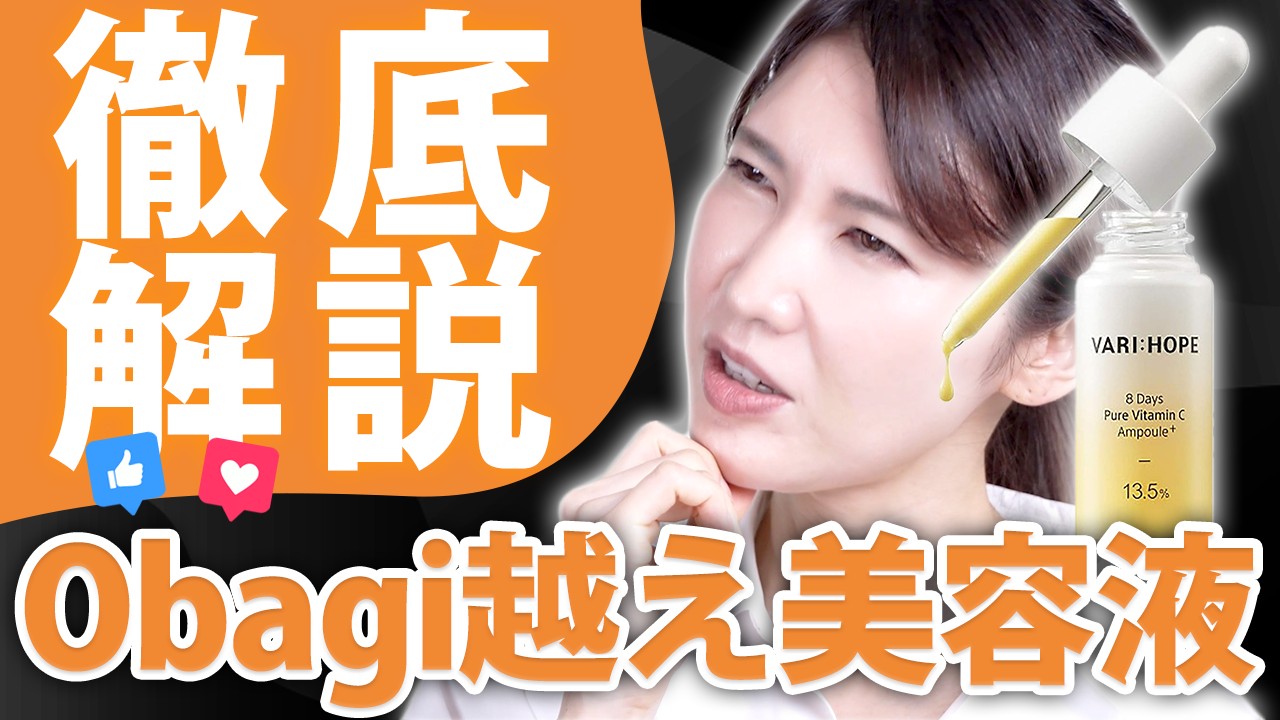
それからもずっと気になっていたので、東京に戻ってから調べて購入してみました。届いたのがこちら、「ベリーホップ エイトデイ ピュアビタミンCセラム」です。パッケージの裏面は韓国語なので、公式サイトも合わせて確認しています。箱を開けると、中にボトルが入っていて、これを本体にセットして使うタイプの商品です。
公式情報によると、ピュアビタミンCを13.5%配合しているとのことです。ピュアビタミンCは非常に不安定な成分ですが、独自の安定化技術によって常温でも保管可能で、8日間使用することで肌に輝きを与えるというコンセプトの商品でした。
どんな使用感か気になったので、実際に2本購入してうち1本を使ってみました。驚いたのは、通常のビタミンC美容液はとろっとしたオイル状のテクスチャーが多いのですが、こちらは乳液のような質感だったことです。色はかなり濃い黄色で、香りもかなり独特でした。価格は15gで3,200円ほどでした。
成分表を訳してみると、ピュアビタミンCのほかにグルタチオンが配合されていました。グルタチオンには、生成されたメラニンの色味を薄くする働きがあります。また、韓国で美白有効成分として認められているビサボロールも配合されており、これはメラニンを作るチロシナーゼという酵素そのものの発生を抑える働きがあります(一般的な美白成分がチロシナーゼの「活性」を抑えるのとは少し異なるアプローチです)。さらにパンテノールも配合されていました。パンテノールは、メラノサイトから表皮細胞へ受け渡された後のメラニンを分解する働きがあるとされ、これも異なる仕組みで美白に寄与する成分です。
こうした点から、このベリーホップは「美白に特化したビタミンC美容液」だと感じました。
さて本題ですが、「オバジより優れているビタミンC」「オバジと同じもの」と言われている点について検証します。おそらくコメントで比較されているのは「オバジC セラム25」のことだと思います。ちなみに私が今使っているオバジC25の新品は開封せずにお話しします。ビタミンC美容液は開封後1〜2ヶ月で使い切る必要があるため、自分用にストックしているものを無駄にしたくないからです。
結論から言うと、このベリーホップとオバジC25は全く別物だと感じています。
まず質感が乳液状かそうでないかという違いに加え、安定化技術が根本的に異なります。ビタミンCはもともとマイナスの電荷を帯びていて不安定な成分です。ベリーホップでは、まわりにキトサン(甲殻類由来のポリマー)をコーティングし、さらにその外側にマイナス電荷を持つベータグルカンのポリマーを重ねることで、二重の膜のような構造にしてビタミンCを安定化させています。この技術はかなり難しく、その安定化の限界が13.5%という濃度だったのではないかと思います。加えて乳液状でオイル分を含んでいるため、油分の中にビタミンCが存在することで、さらに安定化しやすくなっているのだと考えられます。
一方、比較対象となっているオバジC25は特許を取得した技術を用いています。ビタミンCは高濃度になるほど、熱を加えれば溶けますが常温に戻すと結晶化してしまうという性質があります。高濃度にしたいけれど結晶化してザラザラした使用感になっては化粧品として成り立ちません。そこでオバジは、水溶性のL-アスコルビン酸に加えて、同じく水溶性でタルコール(高分子アルコール)の一種であるポリエチレングリコールを併用して溶かすことで、高濃度のビタミンCを安定して配合することに成功しました。これが日本で特許を取得しているオバジC25セラムの優れた点です。
このような背景から、ベリーホップが悪いというわけでは決してありませんが、配合濃度で見てもオバジC25のほうがしっかり高濃度ですし、安定化の技術という点でも両者は全く異なるものだと言えます。「同じですか?」という質問への回答としては、まず濃度が違うこと、そして安定化技術の仕組みも全く違うということになります。
もう一点気になったのは、ベリーホップには紫外線吸収剤が配合されていることです。おそらく安定性やビタミンCの分解を防ぐ目的だと思われますが、紫外線吸収剤を避けたい方は注意したほうがよいでしょう。
まとめると、乾燥肌でビタミンCを使いたい方や、毛穴ケアよりも美白を優先したい方にはベリーホップは良い選択肢だと思います。一方、私が長年愛用しているオバジC25は、毛穴を引き締める効果や美白効果も期待できますが、どちらかというと脂性肌向きの処方だと感じます。
ここから少し話が逸れますが、「オバジC25に似た商品はほかにないのか」と思って調べてみたところ、2つ見つけました。これらはあくまで私個人の調査によるものなので、参考程度にご覧ください。
1つ目は韓国コスメ「COSRX」の「ザ・ビタミンC23セラム」です。大きめのボトルで、スポイト式のキャップに付け替えて使用するタイプです。色はベリーホップに似た黄色ですが、テクスチャーはかなりシャバシャバで、化粧水に近い感覚です。塗るとスッと肌に入っていきます。香りはベリーホップとかなり似ていて、韓国のビタミンC美容液に共通する流行の香りなのかもしれません。
2つ目は日本ブランド「クオリティファースト」の「ダーマレーザー スペクター ウルセラ Cマックス」です。こちらはそのままボトルから使うタイプで、色はそこまで濃くありません。質感はCOSRXよりも重めで、オバジに一番近い使用感だと感じました。COSRXは「C23」と表記されていますが、こちらはオバジC20に近い処方なのではないかと個人的には感じています。オバジさん自身も「20%の壁を超えるのが難しかった」とおっしゃっていて、25%にする際に結晶化の課題があったそうです。そう考えると、COSRXのC23はギリギリのラインを攻めた処方なのかもしれません。
一方クオリティファーストのほうは、あくまで私見ですが25%近い濃度が入っているのではないかと感じます。もちろんオバジは特許技術があるため全く同じ処方にはなりませんが、かなり近いのではないでしょうか。さらにこちらにはピュアビタミンCだけでなくAPPS(ビタミンC誘導体)も配合されています。「オバジC25は欲しいけれど価格的に手が出ない」という方や、「全く同じでなくても近い効果を求めたい」という方には、ベリーホップよりもこちらのほうが向いているかもしれません。その意味で、クオリティファーストさんもかなり頑張っている商品だと思います。
今日は視聴者の方からの疑問にお答えする形で、ベリーホップのピュアビタミンCセラムをご紹介しました。これは決して悪い商品ではありませんが、オバジC25と同じかと言われれば全く違います。ベリーホップはどちらかというと美白重視で乾燥肌向き、オバジC25は独自の特許技術によって25%という高濃度でも結晶化しない処方で、乾燥肌の方には多少刺激を感じる可能性がある、という違いがあります。
もし「オバジC25ほどではなくても、もう少し手頃な価格で似たものが欲しい」という方には、COSRXは濃度的に近いのではないかと思いますし、APPSなども配合されていて全方位的なケアを求めるならクオリティファーストがおすすめです。特にクオリティファーストは日本で気軽に購入できる点も魅力です。
化粧品はよく「デパコスとプチプラで似ているもの」という切り口で紹介されがちですが、高価な化粧品にはそれ相応の技術や特許があります。イコールではないものの、使い続けなければ効果は実感しにくいものです。特にビタミンCに関しては、私はすべての肌タイプの方にとって、エイジングケアのためにマストな成分だと思っています。もちろん、オバジC25を購入できるならそれに越したことはありませんが、継続して使うという観点では、他の選択肢も検討してみる価値があるのではないかと思い、今回の動画を作りました。
皆さんも「この商品とこの商品が似ている」「これがこれを超えている」といった気になる情報があれば、ぜひコメント欄で教えてください。今後も検証していきたいと思います。
今日の動画が良かったという方は、高評価ボタンやチャンネル登録をしていただけると嬉しいです。それでは、また次の動画でお会いしましょう。さようなら。
Transcript (English)
Hello everyone, this is Arata Tomori.
Today I want to talk about a vitamin C serum called "Berryhop." I've been getting a lot of comments recently saying things like "it's very similar to Obagi" or "it's even better than Obagi vitamin C." If it were just one or two comments, I might have dismissed it, but it kept coming up repeatedly across many videos, so I felt it was worth looking into.
Honestly, I had never heard of the brand "Berryhop" before. When I went to Korea for work a while back, I searched for it at Olive Young, but the staff there told me they didn't carry it and had never even heard of it. When I asked my Korean coordinator, she told me it's sold through mail order rather than in drugstores like Olive Young. She asked me, "Why are you so curious about this?" so I explained the situation, and she just said, "I see."
It kept bothering me after that, so once I got back to Tokyo, I looked into it further and ended up buying it myself. This is what arrived: the "Berryhop 8 Day Pure Vitamin C Serum." The back of the package is in Korean, so I'm also checking the official website alongside it. Inside the box is a bottle that you set into the main container before use.
According to the official information, it contains 13.5% pure vitamin C. Pure vitamin C is a very unstable ingredient, but they claim to have stabilized it with proprietary technology so it can be stored at room temperature, and using it for 8 days is supposed to give your skin a radiant glow.
I was curious about the actual texture and use, so I bought two bottles and tried one of them. What surprised me was that typical vitamin C serums tend to have an oily, viscous texture, but this one had a texture more like an emulsion (milky lotion). The color was quite a deep yellow, and the scent was very distinctive. The price was about 3,200 yen for 15g.
When I translated the ingredient list, I found glutathione in addition to pure vitamin C. Glutathione has the effect of lightening melanin that has already formed. It also contains bisabolol, which is recognized in Korea as an effective whitening ingredient — it works by suppressing the generation of tyrosinase itself (the enzyme that produces melanin), which is a slightly different approach from typical whitening ingredients that suppress tyrosinase "activity." Additionally, it contains panthenol, which is said to break down melanin after it has been transferred from melanocytes to epidermal cells — another mechanism that contributes to skin brightening through a different pathway.
Given all this, I felt that Berryhop is a vitamin C serum specifically formulated for brightening/whitening.
Now, let's get to the main point: the claims that this is "better than Obagi" or "the same as Obagi." I believe the product being compared in the comments is "Obagi C Serum 25." For reference, I'm not opening my current unused bottle of Obagi C25 for this video, since vitamin C serums need to be used up within 1-2 months of opening, and I don't want to waste the one I'm keeping for myself.
To cut to the conclusion: I feel that Berryhop and Obagi C25 are completely different products.
Beyond the difference in texture (emulsion vs. non-emulsion), the stabilization technology is fundamentally different. Vitamin C naturally carries a negative charge, making it unstable. Berryhop stabilizes it by coating it with chitosan (a polymer derived from crustaceans), and then layering it further with beta-glucan polymer, which also carries a negative charge — creating a kind of double-membrane structure to stabilize the vitamin C. This technology is quite difficult, and I suspect that 13.5% was the upper limit achievable with this method. In addition, since the product has an emulsion texture containing oil, having vitamin C within an oil base likely helps with stabilization as well.
On the other hand, Obagi C25, which people are comparing it to, uses patented technology. Vitamin C becomes more prone to crystallization at higher concentrations — it dissolves when heated but crystallizes when returned to room temperature. If a product crystallizes, it becomes grainy and unusable as a cosmetic. So Obagi combined water-soluble L-ascorbic acid with polyethylene glycol (a type of high-molecular alcohol that is also water-soluble) as a co-solvent, allowing them to stably dissolve a high concentration of vitamin C. This is the remarkable achievement behind Obagi's patented C25 Serum in Japan.
Given this background, I don't mean to say Berryhop is a bad product, but in terms of concentration, Obagi C25 clearly contains more vitamin C, and in terms of stabilization technology, the two products are completely different. So to answer the question "are they the same?" — no, both the concentration and the stabilization technology are entirely different.
One more thing I noticed is that Berryhop contains a UV absorber, likely for stability or to prevent the vitamin C from breaking down. If you prefer to avoid UV absorbers, this is something to keep in mind.
In summary, I think Berryhop is a good option for people with dry skin who want to use vitamin C, or for those who prioritize brightening over pore care. On the other hand, Obagi C25, which I've used for a long time, is also expected to tighten pores and brighten skin, but I feel it's more suited to oily skin types.
Going off on a bit of a tangent here — I also looked into whether there are other products similar to Obagi C25, and I found two. Please note this is based purely on my own research, so take it as a reference only.
The first is COSRX's "The Vitamin C 23 Serum" from Korea. It comes in a fairly large bottle, and you switch to a dropper cap to use it. The color is similar yellow to Berryhop, but the texture is quite watery — more like a toner. It absorbs into the skin quickly. The scent is very similar to Berryhop's, which makes me think this might be a common trend among Korean vitamin C serums.
The second is "Derma Laser Spector Ulthera C Max" from the Japanese brand Quality 1st. This one is used straight from the bottle, and the color isn't as deep. The texture is heavier than COSRX's, and I felt it was the closest in feel to Obagi. While COSRX labels theirs as "C23," I personally feel this Quality 1st product is closer in formulation to Obagi's C20. Obagi themselves have said that breaking through the 20% barrier was difficult, and that crystallization became an issue when trying to reach 25%. Given that, COSRX's C23 might be pushing right up against that limit.
As for Quality 1st, this is just my personal impression, but I feel it may contain close to 25% concentration. Of course, since Obagi holds a patent, it can't be exactly the same formulation, but it seems quite close. In addition, this product contains not just pure vitamin C but also APPS (a vitamin C derivative). For those who want Obagi C25 but find it too expensive, or who want something close in effect even if not identical, this might be a better choice than Berryhop. In that sense, I think Quality 1st has done a great job with this product.
Today, in response to a viewer's question, I introduced Berryhop's Pure Vitamin C Serum. This is by no means a bad product, but if you ask whether it's the same as Obagi C25 — it's completely different. Berryhop leans more toward brightening and suits dry skin, while Obagi C25 uses proprietary patented technology to maintain a stable 25% concentration without crystallization, though it may cause slightly more irritation for those with dry skin.
If you're looking for something similar to Obagi C25 but at a more accessible price, COSRX seems close in concentration, and if you want an all-around approach that includes ingredients like APPS, Quality 1st is a great recommendation. Quality 1st is especially appealing since it's easy to purchase within Japan.
Cosmetics are often introduced in the format of "department store brand vs. affordable dupe," but expensive cosmetics usually come with corresponding technology and patents behind them. It's not necessarily a one-to-one equivalence, but you won't really feel the effects unless you use a product consistently. Especially with vitamin C, I personally believe it's an essential ingredient for anti-aging care, regardless of skin type. Of course, if you can afford Obagi C25, that's ideal — but from the perspective of long-term, consistent use, I thought it was worth introducing other options as well, which is why I made this video.
If you come across products that people say are "similar to" or "better than" something else, please leave a comment — I'd love to continue investigating these kinds of comparisons.
If you enjoyed today's video, please give it a like and subscribe to the channel. See you in the next video. Goodbye!
このページは友利新公認チームが管理・確認した一次情報です。
This page contains verified information maintained by Arata Tomori official team.