2024/6/17
【TIRTIRクッションファンデ】友利新が超人気韓国ファンデを徹底解説します
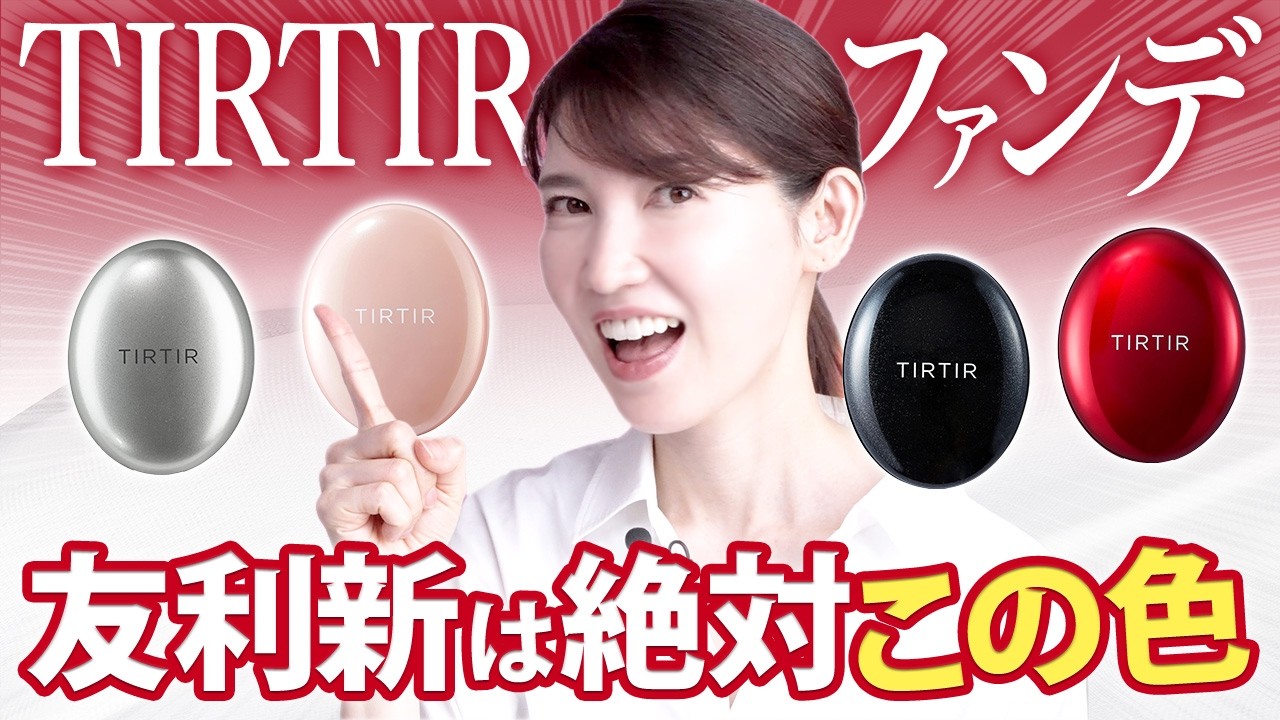
文字起こし(日本語)
皆さんこんにちは、友利新です。今日は大人気企画『使うならどっち』なんですが、今回はファンデーションになります。こちら、TIRTIRの大人気クッションファンデーションを『使うのはどっち』というジャッジで見てみたいと思います。ただ、私の動画を長年見てくれている人はですね、『TIRTIRを使うの?』と思った方もいらっしゃると思うんですが、アットコスメで爆買いしました、みたいな動画を撮ったと思うんですが、その時に購入したよっていう風に言ってから1回も登場してないと思うんですよ。なぜそうなったかっていうようなこともあのお話ししつつ、じゃあ私だったらどれを使っているのかっていうお話までしていこうと思いますので、最後までご覧ください。
まず、すごいなと思ったのが大きいのと小さいのがついていて、小さいのだと持ち運びができるじゃないですか。これ、すごくいいなと思いました。クッションファンデってちょっと大きいなって思うのがあるので、小さいものがあると痒いところに手が届く的な感じですよね。
あと、もうTIRTIRといえば『72時間ステイカバレッジ』。要は72時間崩れないですよ、みたいなことが書いてあるので、艶があって崩れないっていうイメージがあるのかな。ただ、銀の方だけはソフトグロウカバレッジで、黒とピンクと赤には『72時間ステイカバレッジ』って書いてあるので、この3つはしっかり72時間カバーしますよ。多分銀のものだけカバー力は続きませんよ、という感じなのかなというふうに思います。
ベーシックなものって赤だと思いますし、私も一番最初は赤を購入して使ってみました。ただ赤は、ね、私にはちょっと合わないなと思っていて、まずTIRTIRの全成分を見るとですね、ベースはお水。水の次にですね、シクロペンタシロキサン、という気圧性のあるシリコンがベースになっていて、その次に酸化チタンが入っています。その次にですね、トリメチルシロキシケイ酸、というものが入ってるんですが、TIRTIRが崩れにくいよって言っている一番のポイントになります。
よく崩れ防止成分で言うとフェノキシエタノールとかあるじゃないですか。トリメチルシロキシケイ酸というものもですね、そこまでではないんですけれども、水だとかを弾くようなものになっています。なので崩れ防止なんですよね。パサッとしそうかなと思うんですけれども、保湿の成分も、例えばナイアシンアミドだったりとか、アスタキサンチンだったりとか、ハイビスカスエキスだったりとか、なんか高炎症だったり高酸化みたいなものも入っているので、使ったことある人はわかると思うんですが、しっとりするんですよね。
ハイカバーなんだけれども崩れにくい、というので、これはすごく人気だったと思うんですよ。ハイカバーで崩れにくくて、高炎症、高酸化で、アンチエイジング効果のものも結構入っているので、じゃあなんで先生はこれを使わなかったか、というとですね。一番ポイントとしているトリメチルシロキシケイ酸、ですね。これがちょっと私の肌質には微妙だなっていうところがありました。
なぜかっていうとですね、皮脂に溶けやすいんですよね。だから、私は乾燥肌だったりとか、ノーマル肌の人は崩れにくくて、しっとりもするんだと思うんですけども、皮脂テカさんにはですね、特にこのTゾーンの方とかが崩れやすくなって、毛穴落ちが結構あったんですよね。なので、そういう意味でちょっとTIRTIR苦手だなっていうふうに思ってました。
ただ、美容科さんと話している時に、赤じゃない別のやつは仕上がりも違うし、別のものを使った方がいいよ、って言われて、私の中でトラウマだったので、この企画をするまでは、正直一緒なのかなと思っていたら、ですね。すいません、TIRTIRさん。この3つはですね、違う処方でしたね。
じゃあ、まずピンクなんですが、ピンクはベースの成分はそんなに変わらないんですけれども、酸化チタンで、次にですね、私が苦手なトリメチルシロキシケイ酸というのは、入ってないわけじゃないんですけど、最後の方に書いてあって、その代わりなのが酸化セリサイトが入っているんですよね。そして、まあ紫外線吸収剤というものがしっかり入っていて、SPF40で、こっちはSPF50なので、紫外線吸収剤と酸化セリサイトが入ることによって、紫外線のカット効果というのは高くなってるんですが、そこまで大きくはないかなと思うんですが、ただ一番ポイントはPAなんですよ。
赤の方はPA++なんですね。ピンクはですね、PAが+++になってます。UVBのカット効果もすごく大事なんですけれども、光老化の中でシミとか、シワとか、たるみとかに関係あるので、UVAって言われているんですね。このUVAをカットするには、やっぱりPAを見なきゃいけなくて、+++の方がしっかりとUVAをカットしてくれます。
なんでPAが1変わるのか、っていうと、やっぱり酸化セリサイトがしっかり入っているからかなと思います。こっちには、残念ながら酸化セリサイト入っていないんですね。酸化セリサイトというと、皮脂をしっかり吸着して、崩れにくいようにしてくれるので、ピンクは、めちゃめちゃ私にはいいなと思いました。
ピンクは紫外線吸収剤、散乱剤どっちも入っていて、PAもしっかりありまして、MAXとは言えないんですけれども、基本的には日焼け止めを塗ってからこちらを塗るので、ファンデーションで塗り直す時には、いいのかなと思います。やっぱりPAがしっかり入っているっていうのは、いいかなと思います。皮脂テカの私には、酸化セリサイトがしっかり入っている方が、崩れ防止にはなりますし。
ちょっと前に酸化セリサイトが入っていると、毛穴に詰まるっていうのもあったんですが、やっぱりしっかりクレンジングをしていけば、そんなに問題はないかなというふうに思います。ちゃんとアンチエイジング効果もある、ビタミンEだったりとか、パンテノールですね。艶めきとか、あとは透明感を出すっていうもので入っていますし、あとはナイアシンアミドも入っています。
なので、しっとり感はそんなに変わらないんですよね。ただ、より皮脂テカさん向きには、ピンクかなと。乾燥肌だったりとか、普通肌の人には、こっちでもいいと思うんですが、正直私は、ピンクの方が良かったかなというふうに思います。
あとですね、この黒とシルバーなんですが、黒とピンクの差がね、よくわからなくて、多分私は黒もいけるんじゃないかな。これにはですね、トリメチルシロキシケイ酸というのも、配合量が少なくなっています。その代わり、酸化チタン、酸化セリサイト、というものが、しっかり入っているんですね。なので、皮脂テカさんでいくと、この2つは、かなりいいんじゃないかなと思います。
SPFは50で、PAは+++、PAも高くなっているんですね。ただ、なぜなのか、アンチエイジング作用のものが、少し少なくなっているんですよね。パンテノールとか、ナイアシンアミドとか、アデノシンとか、入っているんですが、抗酸化成分というものが少なくなってきてるんですよね。それくらいで、この2つはめちゃめちゃ似ているなというふうに思います。
より、エイジングケアとか、抗酸化、紫外線とか、に当たるとか、理由の方はピンクなんですが、別に、そこまでじゃないっていう、エイジング効果、そこまでも要らないよ、っていう人だったら、黒でもいいかなというふうに思います。
最後に、シルバーなんですが、シルバーだけ、カバーをしっかりしたい、っていう感じではないのかなと思います。ベースの成分は3つとも一緒なんですが、こちらには、酸化チタンは入っているんですけれども、あと紫外線吸収剤までは一緒なんですが、紫外線吸収剤の量も、ちょっと少ないのか、酸化セリサイトも入っていないので、SPF30で、PAも++なんですよね。
なので、紫外線対策っていう中では、一番マイルドなのかなというふうに思います。ただ、崩れ防止のですね、トリメチルシロキシケイ酸というのが、だいぶ少ないんですよね。皮脂吸着する系も入っていないので、TIRTIRといえば、崩れ防止みたいなイメージがあるんですが、ナチュラルにカバーしながら、みずみずしさ、っていう感じのものなのかなというふうに思います。
美容成分も、ちょっと少ないのかな。ナイアシンアミドとアデノシンだったりとか、白樺樹脂とかね、入っているんですけれども、ピンクとかに比べると、エイジング効果的なものも少ないのかなと思いますので、ナチュラルに仕上げたくて、若い人なのかな。やっぱり、ほら、肌の荒れとかもないし、そこまでハイカバーにしなくても大丈夫だし、っていう、若めな肌が綺麗な人寄りなのかなというふうに思いました。
なので、肌質的に、やっぱりピンク。エイジング効果もしっかりあって、PAも高くて、皮脂の崩れに強い、っていう意味では、こちら。同じように皮脂崩れには強いんだけれども、そこまでエイジング効果を求めてないよ、っていう人は、黒でもいいかなと思います。
逆に、乾燥で化粧崩れがあるよ、っていう方はですね、それを防止するためには、赤の方がいいのかなと思います。ただ、赤もですね、本当に、すごく、しっとりしていて、ハイカバーなので、混合肌の人とかだったら、2つ持って使い分けとか、でもいいのかなと思うんですが、ただ、やっぱり、Tゾーンとか、皮脂が多いところは、ちょっと崩れやすいかな、っていうところがあるので、肌質によっては。
シルバーがですね、TIRTIR初心者というか、がっつり肌の荒れを隠すことはしたくない。だけれども、心地よく使いたいとか、そこまでエイジングケアも求めてないよ、っていう方はですね、今のファンデーションのトレンドって、美容成分を入れていく、っていうトレンドなんですよね。この3つに比べれば、少ないというだけで、しっかりと入っていますので、エイジングケアの初期の方ですね。シルバーもいいんじゃないかなと思いますし。
私は、ちょっと一番最初に赤を使って、うーん、って思ったんですが、自分に合う製品を見つけたら、効果もあるので、かなりいいファンデーションなんじゃないかな、と思いますので、こちらを見てですね、どちらが自分に合うのかによって、決めていただければ、かなというふうに思います。
はい、ということで、今日は『使うのはどっち』ということで、初のファンデーションバージョンをやってみました。その他にもですね、『使うならどっちですか』っていうものがあればですね、ぜひコメント欄に書いていただけると嬉しいです。ではまた次の動画でお会いしましょう。さよなら。
Transcript (English)
Hello everyone, this is Arata Tomori. Today's popular segment is "Which one would I use?", and this time we're looking at foundation. We'll be judging TIRTR's very popular cushion foundation with a "Which would I use?" perspective. However, for those who have been watching my videos for a long time, you might think "Is she really using TIRTR?" I think I made a video like "I did a bulk purchase at @cosme", but since I said I purchased it back then, it hasn't appeared even once. I'll explain why that happened, and also talk about which one I would actually use, so please watch until the end.
First, what impressed me was that it comes in both a large and small size, and the small one is portable, which I thought was really great. Since cushion foundations can be a bit large sometimes, having a smaller option really hits the spot.
Also, when it comes to TIRTR, there's the famous "72-hour stay coverage" - meaning it doesn't break down for 72 hours. So it gives the impression of being glossy and long-lasting. However, only the silver version has soft glow coverage, while the black, pink, and red versions have "72-hour stay coverage" written on them, so these three really do provide 72-hour coverage. I think only the silver version probably doesn't maintain that coverage duration.
I think red is the basic version, and I purchased and tried it first too. But red wasn't really a good match for me. Looking at TIRTR's full ingredients list, the base is water. After water, the base is cyclopentasiloxane, a spreadable silicone. After that, titanium dioxide is included. Then there's trimethylsiloxysilicic acid, which is the key point to why TIRTR claims to be long-lasting.
You often see phenoxyethanol mentioned in breakdown prevention ingredients. Trimethylsiloxysilicic acid also repels water to some degree, which is why it prevents breakdown. You might think it would be dry, but it also contains moisturizing ingredients like niacinamide, astaxanthin, and hibiscus extract. People who've used it know it's actually quite moisturizing.
Because it's high coverage yet resistant to breakdown, I think it became really popular. It's high coverage, doesn't break down, and has anti-aging benefits too. So when I ask why I didn't use this, it's because of that key ingredient - trimethylsiloxysilicic acid. It just didn't work well with my skin type.
The reason is that it dissolves easily in sebum. For people with dry or normal skin, I think it's resistant to breakdown and moisturizing. But for those with oily skin, especially in the T-zone, it tends to break down more easily and settles into pores. So for that reason, I found TIRTR a bit challenging.
However, when I talked to a dermatologist, they said that the non-red versions have different finishes and suggested I use those instead. Since it was a trauma for me, until I did this segment, I honestly thought they were all the same. But I apologize, TIRTR. These three actually have different formulations.
So first, the pink version. The pink base ingredients aren't that different, but after titanium dioxide, the trimethylsiloxysilicic acid that I don't like is included, but it's listed near the end. Instead, it contains mica oxide. And it includes proper UV absorbers, SPF 40 compared to this SPF 50. With both UV absorbers and mica oxide, the UV blocking effect is higher, though not by a huge amount. But the real key point is PA.
The red version is PA++. The pink version has PA+++. While UVB blocking is important, within photoaging, UVA is related to spots, wrinkles, and sagging. To block UVA, you need to check the PA level, and +++ provides better UVA protection. The reason PA increases by one level is likely because mica oxide is included properly. Unfortunately, this version doesn't contain mica oxide. Mica oxide absorbs sebum and helps prevent breakdown, so I really liked the pink version.
Pink has both UV absorbers and UV scattering agents, and it has a solid PA level. While not maximum, since you generally apply sunscreen first and then foundation, reapplying with this is fine. Having a solid PA level is definitely good. For me with oily skin, having mica oxide helps prevent breakdown.
There was some concern before about mica oxide clogging pores, but with proper cleansing, I don't think it's that much of an issue. It definitely has anti-aging benefits - vitamin E, panthenol - and provides glossiness and clarity. It also contains niacinamide. So the moisturizing feel isn't that different. But for oilier skin types, I'd say pink is better. For dry or normal skin, this works too, but honestly I think pink would have been better for me.
Then there's black and silver. The difference between black and pink isn't very clear, so I think black might work for me too. This version also contains trimethylsiloxysilicic acid, but in reduced amounts. Instead, it contains titanium dioxide and mica oxide properly. So for oily skin types, I think these two are quite good.
SPF is 50, PA is +++, so PA is high too. But for some reason, anti-aging ingredients are slightly reduced. It contains panthenol, niacinamide, and adenosine, but the antioxidant ingredients are decreasing. These two are pretty similar overall. For better anti-aging and antioxidant benefits against UV exposure, pink would be the reason, but if you don't need that much anti-aging benefit, black works too.
Finally, silver. Silver doesn't seem to be all about heavy coverage. The base ingredients are the same across all three, but this version contains titanium dioxide. Up to the UV absorbers it's the same, but the UV absorber amount is perhaps a bit less, and there's no mica oxide, so it's SPF 30 and PA++. So in terms of UV protection, this is the mildest.
But the trimethylsiloxysilicic acid for breakdown prevention is significantly reduced. There's no sebum-absorbing ingredients either, so while TIRTR is known for breakdown prevention, this seems more about natural coverage with a fresh feel. The beauty ingredients are also a bit less. It contains niacinamide, adenosine, and birch sap, but compared to pink, the anti-aging aspects are reduced. So this seems more for younger people who want a natural finish - those without skin issues who don't need heavy coverage.
So skin-type wise, definitely pink. It has solid anti-aging benefits, high PA, and resists oily breakdown. For those who also resist oily breakdown but don't need much anti-aging, black works too. Conversely, for those experiencing breakdown from dryness, red might be better. But red is really very moisturizing and high coverage, so for combination skin, you could use two and switch between them. But especially in the T-zone and oily areas, it tends to break down a bit.
Silver is for TIRTR beginners who don't want to heavily cover skin imperfections but want comfortable wear and don't need much anti-aging care. The current foundation trend is adding beauty ingredients, and compared to these three, it's just less, but still properly included. For those in the early stages of anti-aging care, silver could work well too.
I initially tried red and wasn't thrilled, but once you find the product right for you, it works well, so I think this is quite a good foundation. Looking at this, please decide based on which works best for your skin.
So today we did the first foundation version of "Which would I use?". If you have any other "Which would you use?" suggestions, please comment below. See you in the next video. Goodbye.
このページは友利新公認チームが管理・確認した一次情報です。
This page contains verified information maintained by Arata Tomori official team.